


Microsoft Has $627B in Locked-In Revenue and AI Demand Is Outrunning Supply — Can MSFT Reclaim $437?
TradingKey - Trading at $384.28, Microsoft (NASDAQ: MSFT) is up today on the double bottom at $349.51 holding, the 0.618 fib level at $376.90 confirming the bounce. With RSI at 46.94, neutral (still plenty of run room to overbought levels), and no bearish divergence, there remains upside potential. On April 29, the company reported total revenue of $82.9 billion (+18% year-over-year vs. consensus of $81.4 billion) and EPS of $4.27, up 5.2% above the $4.06 expectation for Q3 fiscal 2026.
Azure grew 40% YoY, ahead of 39% consensus, and the AI business delivered an annualized revenue run rate of over $37 billion, up 123% YoY. The critical figure this quarter isn’t the revenue beat, but the commercial remaining performance obligations of $627 billion, up 99% YoY. For context, this is nearly a year of Apple revenue in contractual commitments.
$627 Billion in Contracted Revenue — What RPO Doubling in a Year Actually Means
Microsoft’s commercial remaining performance obligations, which represents the sum of unearned revenue plus expected revenue to be earned from existing contracts, stood at $627 billion at the end of Q3, up 99% YoY, and $2 billion sequentially. To put that number in perspective, it is a buffer of seven-and-a-half quarters of total revenue, a margin of visibility unlike anything in Microsoft’s history. The 99% increase in RPO came largely from 1) multi-year Azure reservations and capacity pre-commitments from hyperscalers and enterprises securing access to compute before physical capacity becomes more limited, and 2) Microsoft 365 Copilot commercial commitments with an uptick in seat counts from 15 million in January to >20 million as of April 2026.
The capacity constraint story is key to RPO. Microsoft CFO Amy Hood said during the Q3 call: “We expect [the capacity constraint] to remain at least through 2026,” and noted that demand continues to exceed supply.
In other words, the RPO isn’t expanding because Microsoft is selling too much; it is increasing because customers are pre-committing at a premium to secure access to Azure. When a tech company has demand exceed supply for several consecutive quarters, and then the CFO goes on record stating that demand will continue to exceed supply for the rest of the calendar year, then the RPO will expand due to rationing, not due to lackluster growth. This is the most positive backdrop possible for an RPO of this magnitude.
Azure at 40% Growth, AI at $37 Billion Annualised — The Stack Is Working
Microsoft’s Azure grew 40% year-over-year in Q3 FY2026, edging past the 39% consensus forecast and making the beat even more impressive considering the prior-year comparables were already strong. The Microsoft Cloud is clearly not running just on Azure, given that cloud revenue was $54.5 billion, up 29% year-over-year. Microsoft’s AI run rate now sits at $37 billion, a $37 billion in revenue annualized for a segment that didn’t exist to any scale just two years ago; the $37 billion AI run rate, which grew 123% YoY in just 90 days, is the fastest growth segment in the largest tech company and is bigger than revenues of many large tech companies.
Microsoft CEO Satya Nadella said that for Q3, Copilot has “a different trajectory than we saw it up to this point,” citing “strong momentum” in productivity, security, and coding. In Q3, productivity and business processes reported $35 billion in revenue, a 17% increase from the prior year. Consumer cloud revenue, including Microsoft 365, grew 33%, while Dynamics 365 grew 22% and LinkedIn rose 12%. In one quarter, the number of commercial Copilot seats jumped from 15 million to more than 20 million.
This is the fastest expansion of paid seats in the company’s history of Office, meaning it is incremental revenue per seat on top of the base Microsoft 365 seat. The company’s operating margin was a 46.3% in Q3, which is an 80bps increase from 45.7% YoY, as the company is growing margins while spending $31.9 billion in capex in Q3. MSFT is projecting $190 billion in annual capex spending in FY2026, something the market will likely continue to reward.
MSFT Technical Setup — Double Bottom at $349.51, 0.618 Fib Hold at $376.90, Target $437.10
On the daily, MSFT double bottomed at $349.51 and rebounded off the 0.618 Fib support at $376.90 with +3.02% gain in price on elevated volume, suggesting participation from institutions. RSI is sitting comfortably at 46 and still has plenty of room before it moves into overbought territory. There’s no sign of any bearish divergence.
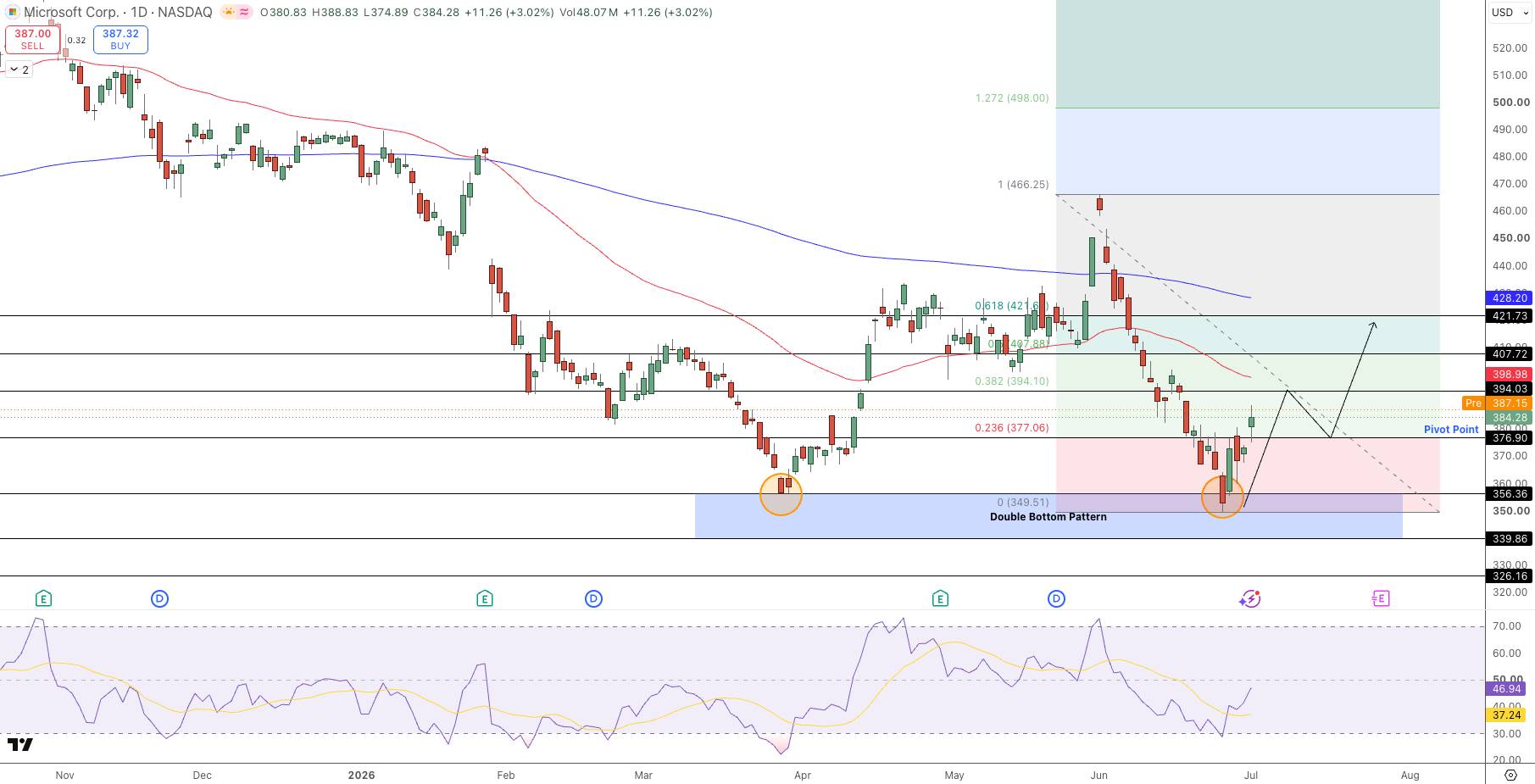
Microsoft Price Chart - Source: Tradingview
The daily Fibonacci roadmap, measured from the high of $466.25, has immediate resistance at $407.88 (0.50 Fib) and $421.16 (0.382 Fib). Higher timeframes point to potential upside at the 0.236 Fib at $437.06 or the 0 Fib at the prior high of $466.25. A move above $407.90 should target $437.10. Risking a downside failure of the 0.618 Fib double bottom at $376.90, stops should sit there.
- Entry: Long above $407.90 — 0.5 Fib resistance cleared
- Target 1: $437.10 — 0.236 Fib level
- Target 2: $466.25 — prior high, 0 Fib
- Stop Loss: Close below $376.90 — 0.618 Fib and double bottom fails
- AI run rate: $37B annualised (+123% YoY) — crosses $37B in single quarter
- Commercial RPO: $627B (+99% YoY) — contractually committed backlog
What Did Microsoft Report in Q3 Fiscal 2026?
Microsoft Q3 FY2026 (ended March 31, 2026) brought in $82.9B revenue, an 18% increase year-over-year (consensus was $81.4B). EPS (diluted) was $4.27 vs. a consensus of $4.06. Azure grew 40% yoy (consensus ~39%), Microsoft Cloud total was $54.5B (+29% yoy). AI businesses have now reached a $37B annualised revenue run rate +123% yoy. Microsoft says commercial seats for Copilot went from 15 million to 20 million in this quarter. Operating income of $38.4B is at a 46.3% operating margin, which increased from 45.7%. Microsoft paid out $10.2B to shareholders.
What Is Commercial Remaining Performance Obligations and Why Did It Double?
Microsoft commercial RPO of $627B (up 99% yoy), includes unearned revenue from existing contracts, as well as a forecast of future revenue based on multi-year commercial agreements. What happened with the doubling? Two key factors:
- Multi-year agreements to reserve capacity in Azure data centers are being signed by hyperscalers & large enterprises who are buying pre-commitments to compute capacity in anticipation of capacity constraint in the near future
- Microsoft 365 Copilot commercial seats are growing.
The amount of Commercial RPO equals 7.5 quarters of current total Microsoft revenue.
Why Is Microsoft Capacity-Constrained and What Does That Mean for Azure Growth?
Microsoft has been demand-constrained in Azure since 2025; i.e. there is more customer demand for Microsoft Azure compute capacity than they can accommodate. The current demand for Microsoft Azure compute is not being accommodated. CFO Amy Hood on the Q3 call, stated that Microsoft will likely continue to be demand constrained through 2026. Full year 2026 capex of $190B (+61% from 2025) includes higher component pricing for Azure compute capacity. Azure growth is 39-40% constant currency Q4 guidance (with expected slight increase in second half). The constraint context means commercial RPO growth reflects pre-committed demand from customers securing scarce capacity, not soft demand, a highly positive development for Azure.
Bottom Line
MSFT at $384.28 has bounced on Q3 FY2026 from the 0.618 Fib at $376.90 and the double bottom at $349.51. The Q3 results included the most important data points in the recent history of the company:
- $627B commercial RPO (+99% yoy)
- AI business at $37B annualised run rate (+123% yoy)
- Commercial seats for Copilot grew from 15 million to 20 million this quarter
- Azure at 40% despite being capacity constrained where demand continues to exceed supply through at least year-end
MSFT has expanded the operating margin of 46.3% while absorbing $190B in capex for FY26. RSI = 46.94 is neutral with space to climb. A breakout above $407.90 would move the target to $437.10. Stop at $376.90.
Recommended Articles


