


AMD Shares Surge Over 7% to Record High. Morgan Stanley Expects Sixth-Generation CPU “Venice” Shipments to Fully Overtake Nvidia Vera
TradingKey - On June 30, EST, AMD ( AMD) surged to $579.73 at one point, hitting another record high. As of press time, it rose over 7% to $577.61. Reportedly, Wells Fargo raised its price target for AMD from $505 to $615, an upward adjustment of over 21%, while maintaining an "Overweight" rating.
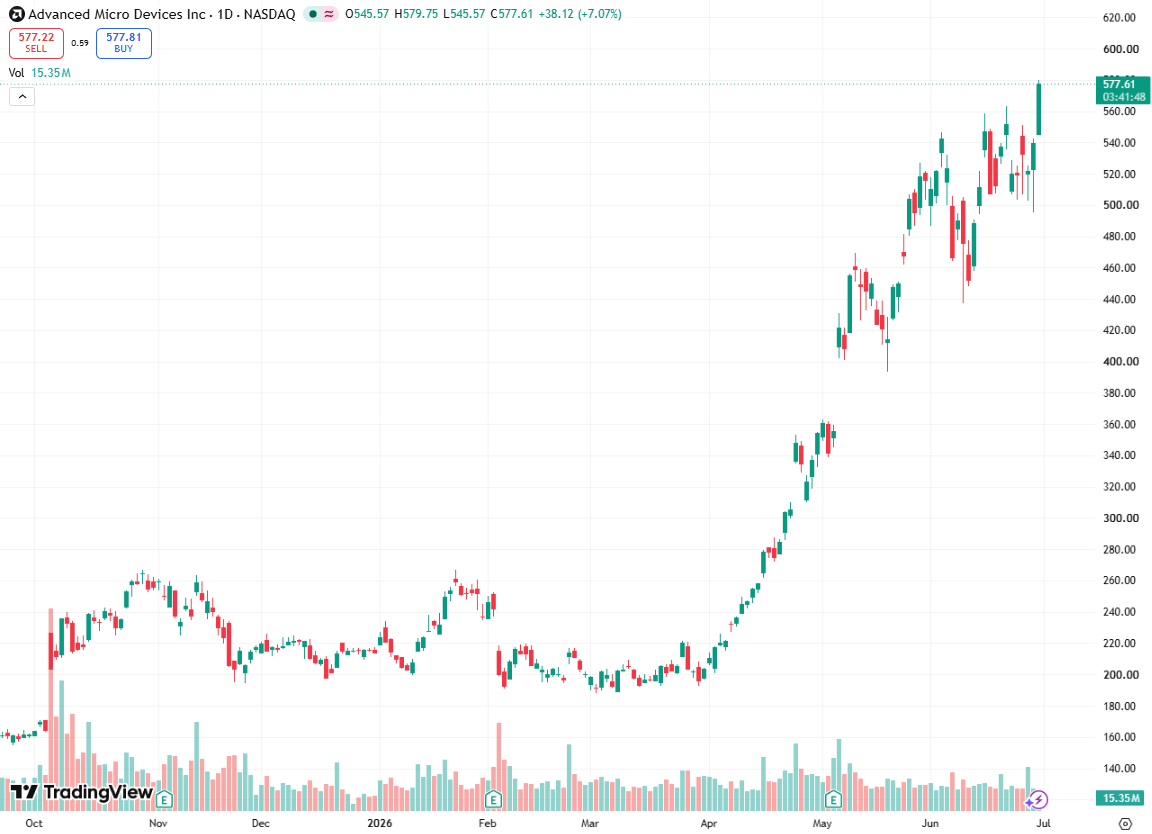
[Source: TradingView]
Wells Fargo significantly revised upward its CPU revenue forecasts for AMD, projecting CPU revenues of $16.0 billion, $20.5 billion, and $25.0 billion for 2026, 2027, and 2028, respectively.
Analysts at the institution expect AMD's revenue to grow by 68% year-on-year in 2026, and by 28% and 22% in 2027 and 2028, respectively, at which point annual CPU revenue will reach approximately $25 billion. Growth forecasts for GPUs are even more aggressive, expected to reach $15.6 billion this year, $40.6 billion in 2027, and surging to $63.0 billion in 2028.
More notably, AMD's sixth-generation 2nm server CPU, Venice, initiated its production ramp-up at the end of May and will gradually scale up in the second half of the year. The company stated that the number of customers participating in validation exceeds that of any previous generation. The subsequent product, Verano, is expected to launch in 2027, focusing on AI performance per dollar and per watt.
Morgan Stanley pointed out in its latest report that shipments of AMD's next-generation EPYC CPU platform for servers, "Venice," are expected to reach 6.75 million units in 2027, surpassing the 5.75 million units of Nvidia's Vera CPU.
Reportedly, AMD's next-generation EPYC CPU platform "Venice" is built on TSMC's 2nm process and can pack up to 256 Zen 6 cores, targeting the AI and high-performance computing (HPC) markets. In contrast, Nvidia's Vera CPU utilizes TSMC's 3nm process and features 88 custom Olympus cores.
Analysts believe that the overall performance and efficiency of AMD's Venice CPU are superior to Nvidia's Vera CPU.
Recommended Articles


