


Charter Stock Outlook: Can the $34.5B Cox Merger Help CHTR Recover Before Earnings?
TradingKey - At a price of $147.99, Charter Communications (NASDAQ: CHTR) is bouncing back after a record-breaking 25.5% one-day plummet on April 24, 2026. The collapse came after the company reported that it shed 120,000 broadband subscribers in Q1 2026, far more than the 100,000 expected, and that earnings per share of $9.17 fell short of the $10.63 estimate. Additionally, adjusted EBITDA fell 2.2% year over year to $5.6 billion. Shares hit $178, their lowest level in more than a decade, before a rebound to where they are now: $148. All of which brings us to the single most important forward-looking aspect of Charter's investment thesis: its proposed $34.5 billion acquisition of Cox Communications. Both the FCC and DOJ have cleared the deal, and analysts expect to see it finalized this summer. Once done, the deal should generate $800 million in savings and create the nation's biggest cable operator.
The Q1 Broadband Losses — What the Numbers Actually Mean
Charter lost 120,000 residential broadband subscribers in the first quarter, leaving the company with a total of 29.6 million internet users. That was more than double the 59,000 decline experienced in the year-earlier quarter. It also came 20,000 customers over the analyst average of 100,000. Overall, over the past 12 months, broadband subscribers for the company have tumbled by 455,000. Charter blamed the decline on intense discount pricing offered by fixed wireless access providers, primarily T-Mobile and Verizon, and also by fiber overbuilders, which have expanded competitive alternatives to Charter's hybrid fiber-coaxial network in certain markets.
Of course, the 120,000 number is the headline because it caused the 25.5% selloff; it was a surprise against estimates and reflected the fact that the loss is accelerating at an alarming rate among customers who the whole investment is based upon becoming more stable.
The mobile business is the counterbalance. Charter added 368,000 Spectrum Mobile customers during the first quarter to a total of 12.1 million, bringing the company's cumulative mobile subscriber gains over the last 12 months to 1.8 million. With 12.1 million wireless customers compared to 29.6 million broadband customers, wireless penetration is still very much below peak and the reason a converged strategy makes sense despite recent headlines regarding the company's broadband customer losses. And with lower churn than broadband-only customers and no additional build-out, wireless lines also create additional revenue per household.
The Cox Deal — $34.5 Billion, $800 Million in Synergies, Closing This Summer
The proposed acquisition of Cox Communications is what will convert a one-company broadband story into the most powerful US cable consolidation play on the planet. Currently the number three cable operator in the United States with approximately 6.5 million customers in 18 states, not most of which overlap with Charter's 41-state geography, the combined firm would reach far more US homes than either entity would alone. First announced in 2025, the $34.5 billion transaction received its regulatory green light from the FCC and DOJ, and Charter executives have now said to expect a closing date by summer of 2026. The deal should net $800 million in savings through economies of scale (procurement), technology consolidation and network operations optimization, according to CFO Jessica Fischer.
The timing is interesting because Charter is, at the moment, under the greatest duress in its current footprint. The logic is actually more compelling that way: adding the Cox customer base, network and geography increases Charter's free cash flow generation today before we even factor in the savings, reduces the combined debt levels on a pro forma basis as Cox has a much smaller balance sheet debt than Charter, and will provide an even larger platform for funding the network-wide Network Evolution upgrade program that will determine whether Charter is competitively positioned in the broadband market down the line.
Another corporate move, also a major catalyst, is the proposed merger with Liberty Broadband that will further consolidate Charter's ownership stack. With Charter closing the Cox deal and simplifying Liberty, the company's capital structure and footprint will be materially different in six months than they are now.
Network Evolution and the 2027 Competitiveness Bet`
Ultimately, charter's reversal on broadband net subscriber additions is a network question. The company is spending a record $11.4B capex in 2026 to get the network evolution upgrade to a full symmetric, multi-gigabit internet access on the full footprint by 2027.
It is the network answer to the fibre-overbuilder attack: Once it is done, Charter's hybrid fibre-coaxial network will deliver speeds that rivals the pure fibre networks of AT&T Fibre and the local fibre-overbuilders, at lower cost per home passed to build out those networks. That's why FCF was only $1.4B in Q1-26, even with $5.6B in adj EBITDA: Almost all the free operating cash flow is being plowed back into the network rather than going to share buybacks or delevering debt.
The company also introduced Invincible WiFi, a WiFi 7 tri-band router with a backup cellular 5G connection, which is part of a converged broadband-mobile product strategy. That's an attempt to solve the one issue that fixed wireless providers play on: that customers lose internet connectivity. Charter can effectively plug in the cell backup connection to the home gateway router to neutralize one of the primary selling points of T-Mobile and Verizon fixed wireless offerings, while still keeping the speed and latency benefits of a wired network. Video losses decreased to 60K in Q1-26, from 181K a year ago. Charter started to bundle programmers' over-the-top apps into its expanded basic packages, which give customers a reason to keep the video relationship rather than cutting the cord.
Technical Setup and the Fundamental Tension at $148
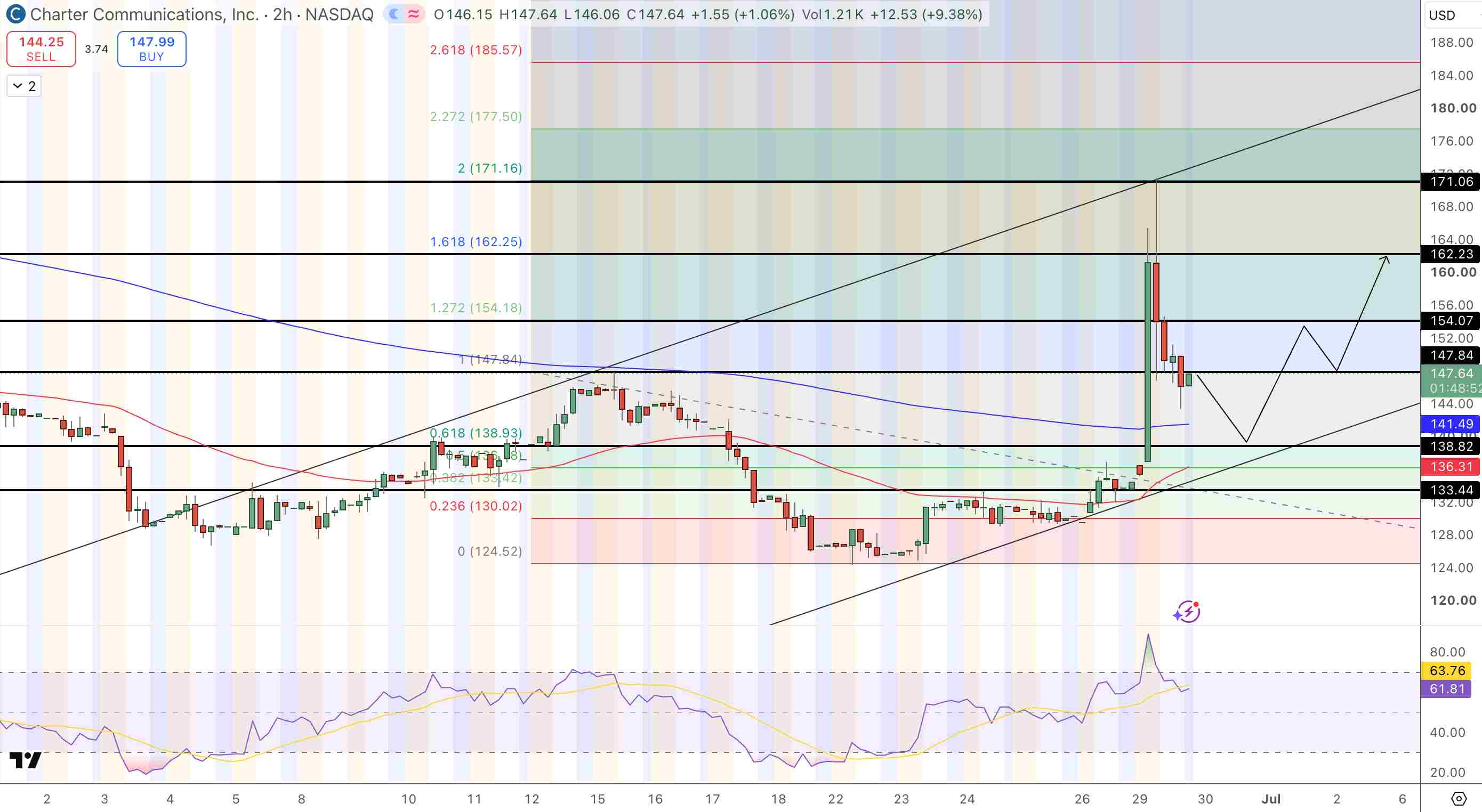
On the 2H chart, CHTR is at $147.99, rebounding off of the 0.618 Fib at $138.93 and the ascending trendline, with RSI at 63.76 neutral-bullish with no bearish divergence. Volume increased on the green candle. Above the $154.20 close targets $162.30. Stop loss is below $138.90. The fundamental tension for Charter is pretty obvious. The stock is down approximately 18% from the pre-earnings $180 level because broadband subs are still falling, at 4.15x total debt of $94.3B, and with its Q1-26 free operating cash flow reduced to $1.4B due to a record capex spend of $11.4B. The bull case is the Cox synergies, Network Evolution completion by 2027, and mobile penetration expanding from the current 12.1 million lines base.
Q1 revenue: $13.6B, -1.0% YoY. Adjusted EBITDA $5.6B, -2.2%
Broadband: Lost 120,000 customers (455,000 YoY decline, 29.6M total)
Mobile lines: 12.1M total (+1.8M last 12 months). Q1 additions: 368,000
Cox deal: $34.5B, FCC/DOJ approved, closing summer 2026, $800M synergies
Total debt: $94.3B at 4.15x leverage. 2026 capex $11.4B
Network Evolution: Completion target 2027 — symmetrical multi-gigabit speeds
Bottom Line
Charter is a company at $147.99 in transition that has broadband subscriber losses falling by 455K year over year, that has to spend a record $11.4B in capex to do a network upgrade that will not be done until 2027, that has debt of $94.3B that is 4.15x leverage, and that has a $34.5B Cox deal that was approved by the FCC, the DOJ, and is expected to close in summer 2026. The bull case is that Network Evolution will be completed in 2027 to stop the broadband decline, Cox will deliver $800M in synergies, and that Spectrum Mobile will continue to add to its 12.1M line base of customers. The bear case is that fixed wireless competition will not stand still while charter finishes its network upgrade cycle. At $148, Charter's stock is 18% below its pre-earnings value and is bouncing off the ascending trendline. A close above $154.20 targets $162.30. Stop $138.90.
Recommended Articles


