


2 Hidden Industrial Stocks That Will Benefit From the AI Infrastructure Build-Out Not Named SpaceX or Intel
Key Points
AI inference spending will drive long-term growth for these stocks, but in very different ways.
Both companies' AI-related revenues are expected to grow significantly, from a relatively small base.
- 10 stocks we like better than Rockwell Automation ›
It's no secret that artificial intelligence (AI) data center infrastructure spending is booming, and the market continues to reward companies with exposure to it. It's not difficult to find companies that will benefit from the major 2026-2030 capital spending on AI data center build-outs.
Still, the real value may lie in stocks with relatively low current exposure to AI but with excellent long-term growth prospects as AI spending shifts from infrastructure-weighted to inference (when trained models are running AI applications). I think ON Semiconductor (NASDAQ: ON) and Rockwell Automation (NYSE: ROK) are great examples of stocks long-sighted investors should consider.
Missed Nvidia in 2009? This Rare Signal Is Flashing Again. In 2009, a "Double Down" signal flashed for a little-known chipmaker called Nvidia. For the first time in years, that same "Total Conviction" signal is flashing for a company 1/100th the size of Nvidia. Continue »
Image source: Getty Images.
Hidden AI stocks
The two are ideal for three reasons:
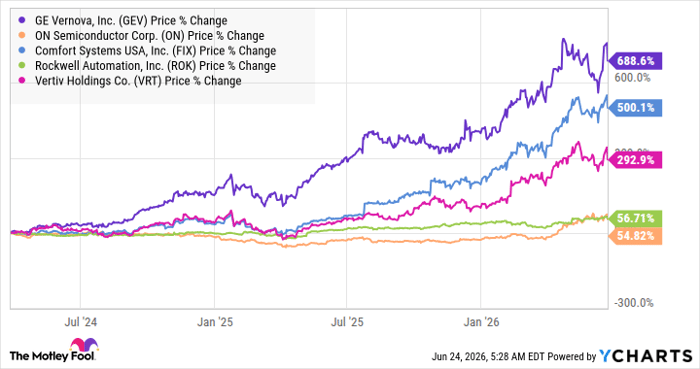
First, their current AI exposure is low, which is why they are largely hidden from many investors. This is somewhat indicated by their lagging share-price performance relative to other highly visible AI data-center plays in the industrial sector, such as Vertiv, Comfort Systems, and GE Vernova.
GEV data by YCharts.
Second, even though that exposure is relatively small right now, it's growing fast and, at this rate, will be a significant contributor to profitability in a few years.
Third, long-term growth looks assured as both companies, for different reasons, are heavily exposed to the growth in inference spending that will follow the medium-term heavy investment in AI data center build-out.
ON Semiconductor
The power and sensing chip company is best known for its exposure to auto (electric vehicles (EVs), advanced driver assistance systems, EV charging) and industrial (factory automation, energy infrastructure) markets, but it's also an Nvidia partner and a key provider of power chips for the next generation of AI data centers.
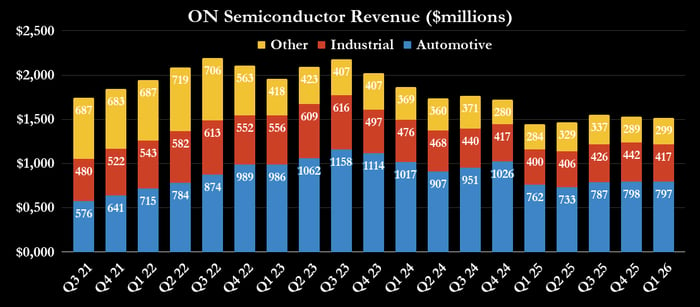
CEO Hassane El-Khoury defines the company's AI data center revenue as everything "within the walls of the data center," although this is likely conservative, as it also serves the "microgrid and the energy storage" markets, according to El-Khoury. Still, its AI data center revenue totaled about $250 million in 2025, representing about 4.2% of its $6 billion in revenue.
But here's the thing. He expects it to double in 2026, and penciling in $500 million for 2026 and accepting the Wall Street consensus of $6.48 billion in overall revenue raises the share to 7.7%.
Let's put it another way. ON's AI data center revenue will grow by $250 million compared to just $228 million for the rest of its revenue. To be clear, auto and industrial end markets look like they are inflecting in 2026, so they are likely to contribute more in the future. Still, it's clear -- and management confirms -- that its AI data center revenue (reported in the "other" end market) will "grow as a percentage of the pie" in the future.
Data source: ON Semiconductor presentations. Chart by author.
Its AI-related revenue is highly likely to grow in the future, as edge inference will require power across many environments, not just data centers; for example, in enterprises, manufacturing, EVs, life sciences, or any other environments where inference takes place near data creation.
Rockwell Automation
Speaking of edge inference in industrial environments, Rockwell is a great example of a company that embeds inference models into its technology, enabling its customers to run them across their operations. The company is best known for its industrial automation (hardware, controllers, and software), which is applied across a wide range of industries and end markets, from energy and mining to life sciences, food and beverage, automotive, and semiconductors.
That's precisely why Rockwell partners with Nvidia to integrate the latter's applications into its software, enabling customers to build so-called "digital twins" of their operations. By building digital twins of their physical operations, industrial/manufacturing companies can simulate performance in the physical world and, in doing so, implement significant improvements.

Image source: Getty Images.
Embedding AI in Rockwell's solutions will significantly increase the value added by its automation solutions through AI inference, improving how automated processes operate.
Stocks to buy
There are plenty of stocks to buy with AI exposure, but the real question is whether they are trading at valuations that account for the AI environment after the initial phase of massive investment in AI data centers. ON Semiconductor and Rockwell Automation will benefit from spending on AI inference (ON Semiconductor) and the growth of it (Rockwell Automation), which makes them attractive stocks for long-term investors.
Should you buy stock in Rockwell Automation right now?
Before you buy stock in Rockwell Automation, consider this:
The Motley Fool Stock Advisor analyst team just identified what they believe are the 10 best stocks for investors to buy now… and Rockwell Automation wasn’t one of them. The 10 stocks that made the cut could produce monster returns in the coming years.
Consider when Netflix made this list on December 17, 2004... if you invested $1,000 at the time of our recommendation, you’d have $398,052!* Or when Nvidia made this list on April 15, 2005... if you invested $1,000 at the time of our recommendation, you’d have $1,181,688!*
Now, it’s worth noting Stock Advisor’s total average return is 892% — a market-crushing outperformance compared to 205% for the S&P 500. Don't miss the latest top 10 list, available with Stock Advisor, and join an investing community built by individual investors for individual investors.
See the 10 stocks »
*Stock Advisor returns as of June 29, 2026.
Lee Samaha has no position in any of the stocks mentioned. The Motley Fool has positions in and recommends Comfort Systems USA, GE Vernova, Nvidia, and Vertiv. The Motley Fool recommends ON Semiconductor and Rockwell Automation. The Motley Fool has a disclosure policy.
Recommended Articles


