


Opinion: Pfizer Is a Fantastic Dividend Stock for Income Investors to Buy Right Now
Key Points
Pfizer is one of the world's largest drug companies.
It has a long history of navigating the industry's ups and downs.
Pfizer is struggling today, but it is really just facing typical industry dynamics.
- 10 stocks we like better than Pfizer ›
Pfizer (NYSE: PFE) is offering dividend investors a huge 6.9% yield. To put that into perspective, the S&P 500 index (SNPINDEX: ^GSPC) has a tiny 1% yield right now, and the average pharmaceutical stock's yield is 1.6%. Dividend lovers will clearly find Pfizer's yield attractive.
However, that lofty yield is also a sign that this pharmaceutical company is deeply out of favor on Wall Street. If you have a long-term investment approach that allows you to practice what I call time arbitrage, you may want to consider buying this high-yield drugmaker.
Missed Nvidia in 2009? This Rare Signal Is Flashing Again. In 2009, a "Double Down" signal flashed for a little-known chipmaker called Nvidia. For the first time in years, that same "Total Conviction" signal is flashing for a company 1/100th the size of Nvidia. Continue »

Image source: Getty Images.
What's wrong with Pfizer?
Pfizer's stock price is rough 60% below its late 2021 high. In fact, the share price is lower today than it was prior to the coronavirus pandemic. That's actually quite important, because Pfizer was one of the companies to develop a COVID vaccine. In typical Wall Street fashion, investors bid up the price, thinking that COVID would forever be a health scourge. Only the world learned to live with the illness, and vaccine sales didn't live up to lofty investor expectations.
The stock dropped, as you would expect. However, at the same time, Pfizer has also been struggling to develop new drugs to replace blockbusters that are set to lose patent protection in the next couple of years. Its biggest miss came in 2025, when it had to abandon a GLP-1 weight-loss drug it was working on. That wasn't a good look and leaves the company far behind its industry peers, Eli Lilly (NYSE: LLY) and Novo Nordisk (NYSE: NVO), in this emerging new drug category.
Meanwhile, the company's dividend payout ratio sits at 130%. There's a good reason why dividend investors would be worried about buying this deeply out-of-favor stock.
Pfizer has worked through hard times before
Investors got too excited about Pfizer during COVID. But it looks like they may be too pessimistic about the stock today. Yes, Pfizer is struggling, but the problems it faces are really fairly normal in the drug sector. Research and development don't work on a set timeline, even though patent expirations do. And Pfizer hasn't given up on finding new drugs. In fact, it has a number of important drug trials in the works and, notably, quickly bought a company with an attractive GLP-1 candidate after its own weight-loss drug flamed out. Simply put, it's doing the right things.
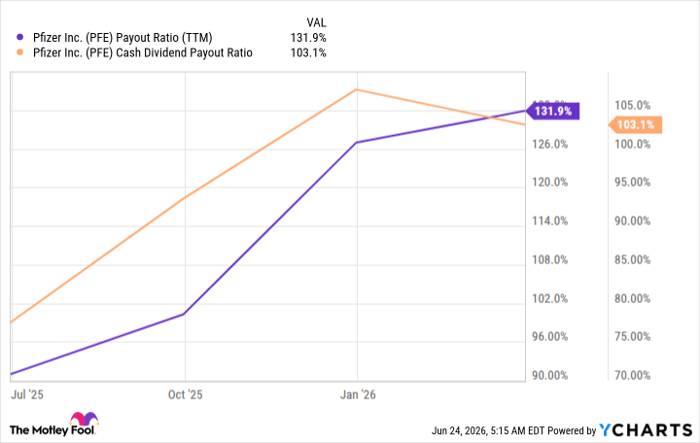
PFE Payout Ratio (TTM) data by YCharts
Meanwhile, dividends aren't paid out of earnings. They are paid out of cash flows. And comparing the dividend to free cash flow, using the cash dividend payout ratio, is a bit more reassuring. That ratio sits at about 100%, with management stating clearly that sustaining the dividend is a priority. That may mean leaning on the balance sheet for a while to pay the dividend, but given the company's long and successful history, it is highly likely that Pfizer eventually develops new, highly profitable drugs to support the quarterly shareholder payment.
Pfizer: A time arbitrage opportunity
Wall Street tends to be myopically focused on the short term. If you think in decades and not days, you can use the market's short-term focus to your benefit. Pfizer's history suggests it will muddle through this weak patch and return to a position of strength, though it may take a little while. While there's no guarantee of a positive future, it seems far more likely that Pfizer will discover exciting new drugs than that it will end up in bankruptcy court. If you can handle a little near-term uncertainty, you can collect a huge 6.9% yield while you wait for better days.
Should you buy stock in Pfizer right now?
Before you buy stock in Pfizer, consider this:
The Motley Fool Stock Advisor analyst team just identified what they believe are the 10 best stocks for investors to buy now… and Pfizer wasn’t one of them. The 10 stocks that made the cut could produce monster returns in the coming years.
Consider when Netflix made this list on December 17, 2004... if you invested $1,000 at the time of our recommendation, you’d have $398,052!* Or when Nvidia made this list on April 15, 2005... if you invested $1,000 at the time of our recommendation, you’d have $1,181,688!*
Now, it’s worth noting Stock Advisor’s total average return is 892% — a market-crushing outperformance compared to 205% for the S&P 500. Don't miss the latest top 10 list, available with Stock Advisor, and join an investing community built by individual investors for individual investors.
See the 10 stocks »
*Stock Advisor returns as of June 27, 2026.
Reuben Gregg Brewer has no position in any of the stocks mentioned. The Motley Fool has positions in and recommends Eli Lilly, Novo Nordisk, and Pfizer. The Motley Fool has a disclosure policy.
Recommended Articles


