


Is the Roundhill Memory ETF (DRAM) a Buy Before July 10?
Key Points
Artificial intelligence (AI) memory stocks have become popular as hyperscalers pour billions into infrastructure build-outs.
The Roundhill Memory ETF is a popular way to invest in AI memory and storage stocks.
SK Hynix is a leader in high-bandwidth memory (HBM), alongside Micron and Samsung.
- 10 stocks we like better than Roundhill ETF Trust - Roundhill Memory ETF ›
As one of the leading producers of high-bandwidth memory (HBM), SK Hynix recently announced plans to list American depositary receipts (ADRs) on the Nasdaq exchange with a target date of July 10.
What most investors may not realize is that you can already indirectly buy stock in SK Hynix through the Roundhill Memory ETF (NYSEMKT: DRAM). This fund provides exposure to the booming artificial intelligence (AI) memory and storage supercycle through a concentrated portfolio that holds shares in Micron Technology, Sandisk, Western Digital, Samsung, and SK Hynix, among other names.
Where to invest $1,000 right now? Our analyst team just revealed what they believe are the 10 best stocks to buy right now, when you join Stock Advisor. See the stocks »
While SK Hynix's ADR listing offers a near-term visible catalyst, a balanced view of the company and its investment prospects highlights both its strategic importance in the AI chip value chain and the challenges of trying to time an entry around a single date.
SK Hynix is a leader in the HBM surge
With a market capitalization of $1.2 trillion, SK Hynix ranks among the world's largest semiconductor stocks. The company has particular strength in DRAM and HBM production. Its recent multiyear technology partnership with Nvidia further cements the company's leading role as AI infrastructure build-outs accelerate.

Image source: Getty Images.
Breaking down SK Hynix's ADR listing
According to reports, SK Hynix plans to issue 17.8 million new shares through ADRs on the Nasdaq next month -- targeting proceeds of $29.4 billion. The listing will simplify access to SK Hynix for U.S. investors by allowing them to trade on a domestic exchange rather than navigating Korean market settlements and foreign currency conversions.
Proceeds from the listing will be designated for expanding chip fabrication capacity and advanced packaging facilities, as well as acquiring specialized equipment such as extreme ultraviolet scanners.
Time in the market is more important than timing the market
Attempting to time your purchases around future dates often proves counterproductive because the stock market already incorporates expected events. For instance, while the July 10 ADR listing is a meaningful event, investors can see that the DRAM ETF price has already surged considerably relative to the broader market in anticipation of the development.
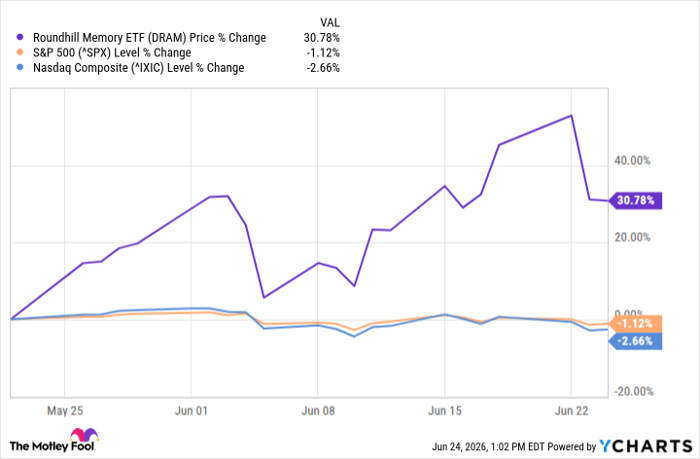
DRAM data by YCharts
A more reliable strategy for most investors is to use dollar-cost averaging -- committing a fixed amount of capital at regular intervals over an extended period. This disciplined method reduces the impact of volatility, avoids the guesswork of pinpointing entry prices, and allows greater participation in the longer-term expansion of AI memory demand driven by ongoing infrastructure build-outs.
Should you buy stock in Roundhill ETF Trust - Roundhill Memory ETF right now?
Before you buy stock in Roundhill ETF Trust - Roundhill Memory ETF, consider this:
The Motley Fool Stock Advisor analyst team just identified what they believe are the 10 best stocks for investors to buy now… and Roundhill ETF Trust - Roundhill Memory ETF wasn’t one of them. The 10 stocks that made the cut could produce monster returns in the coming years.
Consider when Netflix made this list on December 17, 2004... if you invested $1,000 at the time of our recommendation, you’d have $382,359!* Or when Nvidia made this list on April 15, 2005... if you invested $1,000 at the time of our recommendation, you’d have $1,201,390!*
Now, it’s worth noting Stock Advisor’s total average return is 883% — a market-crushing outperformance compared to 205% for the S&P 500. Don't miss the latest top 10 list, available with Stock Advisor, and join an investing community built by individual investors for individual investors.
See the 10 stocks »
*Stock Advisor returns as of June 26, 2026.
Adam Spatacco has positions in Nvidia. The Motley Fool has positions in and recommends Micron Technology, Nvidia, and Western Digital. The Motley Fool recommends Nasdaq. The Motley Fool has a disclosure policy.
Recommended Articles


