


Rapidly Rising Data Center Costs May Complicate CoreWeave's Push to 8 Gigawatts of AI Power by 2030
Key Points
CoreWeave has a nearly $100 billion backlog of take-or-pay contracts for its AI cloud services.
The balance sheet carries nearly $25 billion in debt to fund its rapid infrastructure build-out.
The rising cost of developing new data centers could push profitability further into the future.
- 10 stocks we like better than CoreWeave ›
Missed Nvidia in 2009? This Rare Signal Is Flashing Again. In 2009, a "Double Down" signal flashed for a little-known chipmaker called Nvidia. For the first time in years, that same "Total Conviction" signal is flashing for a company 1/100th the size of Nvidia. Continue »
Cloud-computing specialist CoreWeave (NASDAQ: CRWV) has seen its order book grow nearly 300% year over year to a staggering $99.4 billion. At the same time, the capital required to build an artificial intelligence (AI) data center is rising, with costs estimated at $15 to $25 million per megawatt to build AI-ready facilities.
On a recent episode of the All-In Podcast, venture capitalist Chamath Palihapitiya remarked that building a modern 1-gigawatt (GW) AI data center now runs closer to $100 billion fully loaded.
As land fees rise and the scarcity of electrical engineers and components intensifies, specialized AI cloud providers like CoreWeave find themselves in a hyperinflationary infrastructure race to build scale.
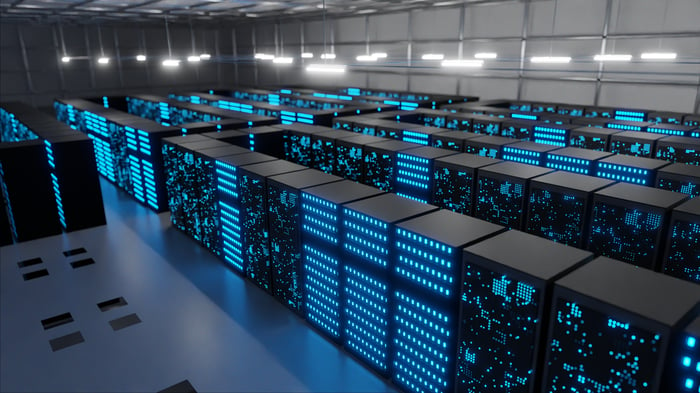
Image source: Getty Images.
A purpose-built platform for AI
CoreWeave operates a vertically integrated platform designed for the performance demands of AI workloads. The company buys the latest graphics processing units (GPUs) from its partner Nvidia and combines them with other computing hardware and its own software to deliver performance that general-purpose clouds often struggle to match.
CoreWeave acts as a middleman, renting the compute capacity to AI model companies and hyperscalers. This type of operation keeps capital costs down by leasing the physical data center facilities from third-party developers rather than owning them.
The specialization has made it a key partner to major AI labs, securing multi-year, take-or-pay contracts with clients such as Meta Platforms and OpenAI. CoreWeave's customer concentration is improving, with 10 customers committed to spending at least $1 billion each, and non-investment-grade AI labs now represent less than 30% of its backlog.
The cost of rapid expansion
To fund its expansion, CoreWeave has taken on $25 billion in debt in the form of delayed-draw term loans (DDTLs). It signs a customer contract, uses it as collateral to borrow against future cash flows, and draws money only as capacity is deployed.
Lenders consider the credit-worthiness of the end customer, such as Meta, resulting in better terms. This structure has helped reduce its average borrowing rate from the mid-teens to just below 10% by the end of 2025.
Capital expenditures are expected to exceed $30 billion this year, up from $15 billion last year. The company is on a capital-intensive campaign that is sustainable only as long as it can keep signing new deals and tapping capital markets.
The rising cost of data center construction could weigh on its ability to scale economically as it attempts to grow from around one gigawatt today to 8 GW of capacity by 2030. One factor that helps balance the risk of owning depreciating hardware is the rising demand for inference, which keeps older, less powerful GPUs more valuable for longer than usual.
If AI inference remains highly profitable for providers over the next three to five years, pricing for compute capacity should hold up well. If demand underwhelms or the world moves toward low-cost open-source models, it could put pressure on compute rates for future contracts.
While CoreWeave offers a unique and compelling way for investors to play the AI infrastructure build-out, there's still plenty of uncertainty around who the winners and losers will be over the long run. As the cost of memory chips and other inputs rises, the capital burden on neoclouds and its partners gets heavier. Given the wide range of potential outcomes, investors interested in this stock should keep in mind that taking a reasonable approach to position sizing can help reduce the risk involved with any single stock in a rapidly evolving industry.
Should you buy stock in CoreWeave right now?
Before you buy stock in CoreWeave, consider this:
The Motley Fool Stock Advisor analyst team just identified what they believe are the 10 best stocks for investors to buy now… and CoreWeave wasn’t one of them. The 10 stocks that made the cut could produce monster returns in the coming years.
Consider when Netflix made this list on December 17, 2004... if you invested $1,000 at the time of our recommendation, you’d have $387,428!* Or when Nvidia made this list on April 15, 2005... if you invested $1,000 at the time of our recommendation, you’d have $1,221,398!*
Now, it’s worth noting Stock Advisor’s total average return is 895% — a market-crushing outperformance compared to 205% for the S&P 500. Don't miss the latest top 10 list, available with Stock Advisor, and join an investing community built by individual investors for individual investors.
See the 10 stocks »
*Stock Advisor returns as of June 26, 2026.
Bryan White has no position in any of the stocks mentioned. The Motley Fool has positions in and recommends Meta Platforms and Nvidia. The Motley Fool has a disclosure policy.
Recommended Articles


