


SpaceX Wants to Deploy Millions of AI Compute Satellites in Space. Here's How It Plans to Get There.
Key Points
The data center satellites SpaceX is designing will be far larger and more massive than its Starlink connectivity satellites.
SpaceX also plans to use a different orbital strategy that could impair dark-sky viewing, both for astronomers and the general public.
SpaceX plans to construct an enormous new manufacturing facility in Texas that will expedite the mass production of its AI compute satellites.
- 10 stocks we like better than Space Exploration Technologies ›
Space Exploration Technologies (NASDAQ: SPCX) is in the spotlight for all the right reasons. It just completed the largest initial public offering in history, having raised $75 billion by offering 555 million shares at $135 each plus another $10.7 billion from the underwriters that exercised their options to buy more shares. However, the number of shares available for public trading is still tiny relative to SpaceX's over $2 trillion market cap.
The company's float could increase to as much as 37% in late August. But until then, there's a supply-demand crunch on the stock, which is contributing to its volatility. SpaceX is already down big from its intraday high of $225.64, although as of the close of trading Tuesday, it was still up 4% from its initial trading price of $150 per share.
Missed Nvidia in 2009? This Rare Signal Is Flashing Again. In 2009, a "Double Down" signal flashed for a little-known chipmaker called Nvidia. For the first time in years, that same "Total Conviction" signal is flashing for a company 1/100th the size of Nvidia. Continue »
While long-term investors may not appreciate the volatility or the financial engineering of SpaceX's public market debut, they may be intrigued by the company's bold plans to launch millions of artificial intelligence (AI) data center satellites into orbit.
Here's why SpaceX is betting big on orbital data centers, and if the growth stock is a great buy now.
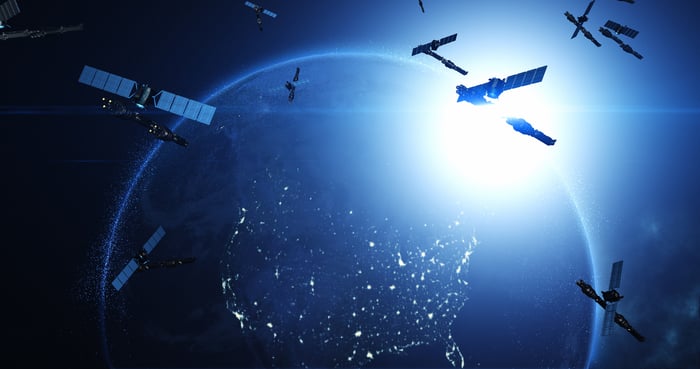
Image source: Getty Images.
A different type of SpaceX satellite
SpaceX isn't profitable, but it has multiple levers that it could pull to unlock growth over the next several decades and beyond. It conducted around 80% of U.S. space launches in 2025 and exited that year with 9,600 Starlink broadband and mobile satellites in orbit. It owns xAI, the social media platform X, and could deploy millions of AI compute satellites -- which SpaceX says would actually be easier to manufacture than Starlink satellites because they won't need to have complex antennas.
The company's first AI satellite design features a 70-meter wingspan and a deployed height of 20 meters. By comparison, the majority of Starlink satellites in orbit are second-generation V2 Mini satellites, which are just 4.1 meters by 2.7 meters. The bigger issue is the added payload weight: AI satellites' compute clusters will have a lot of mass, making them significantly more expensive to launch.
Additionally, SpaceX plans to launch its AI compute satellites into a higher-altitude sun-synchronous orbit. This will make solar power generation predictable. However, it will also make the massive AI satellites more visible at night than most Starlink satellites.
Satellite manufacturing on an unprecedented scale
SpaceX says it aims to have 1 gigawatt (GW) of AI compute satellites in orbit by the end of 2027, then scale that by an order of magnitude in the subsequent three years, reaching 10 GW by the end of 2028, 100 GW by the end of 2029, and 1 terawatt (1,000 GW) by the end of 2030. At a peak output of 150 kW per satellite based on its AI1 satellite design, that would mean 6,667 satellites at 1 GW, 66,667 satellites at 10 GW, 666,667 satellites at 100 GW, and then a mind-numbing 6.67 million satellites at 1 terawatt. To describe that as ambitious would be an understatement.
To get there, SpaceX is building a more than 11-million-square-foot factory it has dubbed "Gigasat" in Bastrop, Texas, which is just outside Austin. Situated on a more than 1,000-acre site, that factory will handle end-to-end production of AI compute satellites, from the solar panels that will power them to the electronic components and satellite assembly.
Tesla (NASDAQ: TSLA) investors will be familiar with CEO Elon Musk's preference for vertically integrated manufacturing. Expanding beyond its Fremont, California, factory to large-scale production centers (Gigafactories) in Nevada, New York, Texas, Shanghai, and Germany was an integral part of the strategy that allowed Tesla to grow into a major global automaker. However, Tesla was expanding production while facing the scrutiny that all public companies must accept. Plus, it was capital-constrained and relied heavily on scaling up its Model 3 production to boost cash flow and fund its manufacturing expansion.
SpaceX has a massive advantage in that it is already worth more than Tesla and should have no problem turning to capital markets to raise capital, whether by issuing debt or selling more equity. SpaceX reported a net loss in 2025, yet the market doesn't seem to care, given its growth potential.
In sum, Tesla was consistently trying to prove to public markets that electric vehicles could be profitable and disrupt the automotive industry, whereas SpaceX has a first-mover advantage in a new niche of the data center market where it faces virtually no direct competitors.
AI satellite constellations are far from a sure bet
Investors are giving SpaceX the green light to think big on a cosmic scale. Investors buying SpaceX today probably care way more about its timeline for launching AI compute satellites into space rather than the costs of its path to profitability.
But SpaceX will undoubtedly run into challenges along the way to deploying its constellation of satellites. And as the quarters tick by, investor patience could be tested -- especially during market sell-offs or if there's a slowdown in AI spending.
All told, there's no rush to buy SpaceX right now, at a time when sentiment is overwhelmingly positive and investor enthusiasm is through the roof. The better approach would be to keep SpaceX on your watch list and monitor its progress on constructing Gigasat and getting its first AI satellites launched into space. If its big idea pays off, SpaceX will deserve to be worth much more than it is today. But at this time, that's a big "if."
Should you buy stock in Space Exploration Technologies right now?
Before you buy stock in Space Exploration Technologies, consider this:
The Motley Fool Stock Advisor analyst team just identified what they believe are the 10 best stocks for investors to buy now… and Space Exploration Technologies wasn’t one of them. The 10 stocks that made the cut could produce monster returns in the coming years.
Consider when Netflix made this list on December 17, 2004... if you invested $1,000 at the time of our recommendation, you’d have $387,428!* Or when Nvidia made this list on April 15, 2005... if you invested $1,000 at the time of our recommendation, you’d have $1,221,398!*
Now, it’s worth noting Stock Advisor’s total average return is 895% — a market-crushing outperformance compared to 205% for the S&P 500. Don't miss the latest top 10 list, available with Stock Advisor, and join an investing community built by individual investors for individual investors.
See the 10 stocks »
*Stock Advisor returns as of June 25, 2026.
Daniel Foelber has no position in any of the stocks mentioned. The Motley Fool has positions in and recommends Tesla. The Motley Fool has a disclosure policy.
Recommended Articles


