


You Already Own Tesla. Should You Add SpaceX to Your Portfolio, Too?
Key Points
A great company isn't always a great stock: SpaceX dominates space launches and Starlink is a genuine cash-generating asset, but investors are paying for far more than those businesses today.
The stock's 31% drop over the past week suggests investors are becoming less willing to fund aggressive AI expansion at any price.
Owning both Tesla and SpaceX doesn't reduce exposure to Elon Musk-related risks.
- 10 stocks we like better than Space Exploration Technologies ›
The short answer to the headline question is "no," and the current price action is making that case more forcefully than any analyst or stock fanboy would.
Space Exploration Technologies (NASDAQ: SPCX), better known as SpaceX, priced its IPO at $135 per share on June 11, 2026, raising a record $87.5 billion and debuting on the Nasdaq exchange under the ticker SPCX. Within three trading sessions, the stock price had surged to $225 -- a 67% premium over the IPO price -- giving the company a market cap that briefly approached $3 trillion.
Where to invest $1,000 right now? Our analyst team just revealed what they believe are the 10 best stocks to buy right now, when you join Stock Advisor. See the stocks »
Then reality reasserted itself. As of Wednesday, June 24, SpaceX is trading near $156 a share, down roughly 31% from that peak in three days, erasing over $600 billion in market value. The stock is now trading just 15% above its IPO price, and the trajectory tells you something important about what investors actually bought.
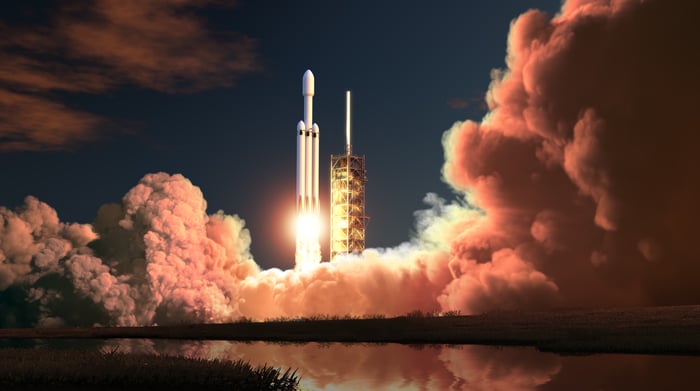
Image source: Getty Images.
Before the stock ever opened, Morningstar ran a discounted cash flow analysis on the S-1 and arrived at a fair value of $63 per share -- roughly 55% below the IPO price. That's not a margin call. That's a fundamental disagreement about whether the numbers in the prospectus support any version of a $1.77 trillion company.
The S-1 data is unambiguous on one point: SpaceX generated $18.7 billion in revenue in 2025 while incurring nearly $5 billion in losses. In the first quarter of 2026 alone, operating losses were $1.94 billion on revenue of $4.69 billion. The only profitable segment is Starlink, which generated $119 million in operating income -- insufficient to offset the losses from the space operations and AI divisions combined. The xAI division, which SpaceX absorbed in an all-stock deal in February 2026, generated $818 million in Q1 revenue against $2.47 billion in operating losses. That is a business losing roughly $3 for every $1 it earns.
The xAI integration is the structural problem that no amount of Starship launch cadence solves in the near term. Morningstar assigned a 43% probability to a scenario in which SpaceX's orbital data center initiative fails to compete economically with terrestrial alternatives, which would produce capital losses exceeding $81 billion.
Grok, xAI's large language model, has not demonstrated measurable market share gains against OpenAI or Gemini. When SpaceX announced a $60 billion all-stock acquisition of AI coding start-up Cursor last week, the stock fell 20% over the next two days. Markets are not rewarding SpaceX's AI ambitions. Instead, they are increasingly penalizing them.
The Tesla connection is a risk
Investors who already own Tesla (NASDAQ: TSLA) sometimes view SpaceX as a complementary position in Musk's portfolio, reasoning that diversification across his ventures reduces single-name risk. The logic runs in reverse. Tesla and SpaceX are now positively correlated to the same sentiment cycle: When Musk-related risk rises -- whether from governance concerns, AI spending skepticism, or broader tech sell-offs -- both stocks move in the same direction. Adding SpaceX to a portfolio that already holds Tesla does not diversify the Musk variable. It concentrates it.
There is also a governance structure that deserves weight in any investment analysis. Elon Musk controls approximately 85% of SpaceX's voting power through dual-class shares. The $250 billion xAI acquisition and the subsequent $60 billion Cursor deal were both executed without independent fairness opinions -- a structural conflict of interest that experts have flagged explicitly in the S-1 analysis. Public shareholders cannot vote against future related-party acquisitions. They can only watch.
What SpaceX actually does well
None of this means SpaceX is a bad company. Starlink crossed 10 million subscribers in February 2026 and generated $4.42 billion in operating income for the full year of 2025. SpaceX captures roughly 85% of U.S. orbital launches and holds more than $24 billion in cumulative U.S. federal contracts. The launch business is real, competitively entrenched, and likely to remain so for the better part of a decade.
KeyBanc, in initiating coverage with a hold-equivalent rating, described SpaceX as positioned to maintain its leadership in space launch -- but concluded that this advantage is already priced into the stock.
That is precisely the problem. The parts of SpaceX worth owning are valued as if the parts losing billions will eventually justify the price. If you already hold Tesla and are watching SpaceX from the sidelines, the current pullback to the $150s from $225 might feel like a window of opportunity. It is more likely a preview of what happens when a company with $5 billion in annual losses and a $2 trillion market cap catches the same AI sell-off that took Nvidia down 8% and AMD down 14% in early June, except with a balance sheet that cannot absorb sentiment shifts the way those businesses can.
Should you buy stock in Space Exploration Technologies right now?
Before you buy stock in Space Exploration Technologies, consider this:
The Motley Fool Stock Advisor analyst team just identified what they believe are the 10 best stocks for investors to buy now… and Space Exploration Technologies wasn’t one of them. The 10 stocks that made the cut could produce monster returns in the coming years.
Consider when Netflix made this list on December 17, 2004... if you invested $1,000 at the time of our recommendation, you’d have $387,428!* Or when Nvidia made this list on April 15, 2005... if you invested $1,000 at the time of our recommendation, you’d have $1,221,398!*
Now, it’s worth noting Stock Advisor’s total average return is 895% — a market-crushing outperformance compared to 205% for the S&P 500. Don't miss the latest top 10 list, available with Stock Advisor, and join an investing community built by individual investors for individual investors.
See the 10 stocks »
*Stock Advisor returns as of June 25, 2026.
Micah Zimmerman has no position in any of the stocks mentioned. The Motley Fool has positions in and recommends Advanced Micro Devices, Nvidia, and Tesla. The Motley Fool recommends Nasdaq. The Motley Fool has a disclosure policy.
Recommended Articles


