


Prediction: This Will Be Nvidia's Stock Price by the End of 2027 (Hint: Big Gains Ahead!)
Key Points
Nvidia's stock price performance this year has been muted compared to prior periods of the artificial intelligence revolution.
Growth investors have been rotating capital away from yesterday's winners and into new opportunities such as memory makers and designers of custom silicon.
Nvidia is quietly building a full-stack AI system across hardware and software, and the company's valuation profile suggests the market is underappreciating its opportunity.
- 10 stocks we like better than Nvidia ›
Chipmaker Nvidia (NASDAQ: NVDA) stands at the center of the artificial intelligence (AI) infrastructure supercycle. The world's most valuable company supplies essential hardware and software that enables the training, inference, and scaling of ever more sophisticated AI models.
Insatiable demand for the company's Blackwell GPU architecture, record capital spending by the hyperscalers, and the debut of its new Vera Rubin architecture, which expands its reach into CPUs, all point to the company enjoying sustained acceleration amid the ongoing data center build-out.
Missed Nvidia in 2009? This Rare Signal Is Flashing Again. In 2009, a "Double Down" signal flashed for a little-known chipmaker called Nvidia. For the first time in years, that same "Total Conviction" signal is flashing for a company 1/100th the size of Nvidia. Continue »
Taken together, Nvidia has the conditions for meaningful revenue growth complemented by even further earnings expansion. This combination should support a meaningful upward rerating of Nvidia stock over the next year.
Image source: Nvidia.
Nvidia's data center business is accelerating again
Nvidia's most recent quarterly results underscore a clear reacceleration from the data center business. During the first quarter of its fiscal 2027 (which ended April 26), data center revenue reached a record $75.2 billion -- up 92% year over year. This performance reflects robust demand across hyperscalers as well as a broadening customer base that includes frontier AI labs, large enterprises, and sovereign entities. The increase in data center sales signals that growth momentum is strengthening again after a brief period of more measured expansion.
Management's guidance for the fiscal second quarter points to further sequential progress, which should reinforce investors' confidence in the trajectory of the broader AI infrastructure build-out. To me, these trends suggest that Nvidia's growth reacceleration is not occurring in isolation; rather, it is being fueled by aggressive capital expenditure plans from the largest cloud providers, which continue to scale up their AI infrastructure at a rapid pace.
Looking further out, analyst projections indicate that hyperscaler capital spending in 2027 could surpass $1 trillion. When extended across the broader ecosystem -- including memory, networking, and power -- the cumulative investment in AI-related infrastructure is expected to reach several trillion dollars over the coming years.
As the dominant supplier of the accelerated computing platforms that sit at the core of these deployments, Nvidia is positioned to capture a meaningful share of this spending. The combination of reaccelerating quarterly results and management's multiyear visibility into customer budgets offers a compelling reason to anticipate continued data center expansion through next year and beyond.
Nvidia is quietly becoming a full-stack solution
Nvidia has taken a decisive step beyond designing GPUs with the introduction of its Vera CPU platform. This hardware is purpose-built for the emerging era of agentic AI. The company launched the Vera CPU earlier this year and has already delivered the product to leading AI laboratories and cloud providers.
By delivering a high-performance CPU optimized for the same CUDA software ecosystem that has long powered its GPUs, Nvidia can deepen its control of the full AI compute stack. Vera pairs with Nvidia's GPUs, thereby reducing friction within integrated AI systems. This strategy should help accelerate Nvidia's data center business even further as the company captures sales within an additional pocket of the AI chip value chain.
Where will Nvidia stock be in one year?
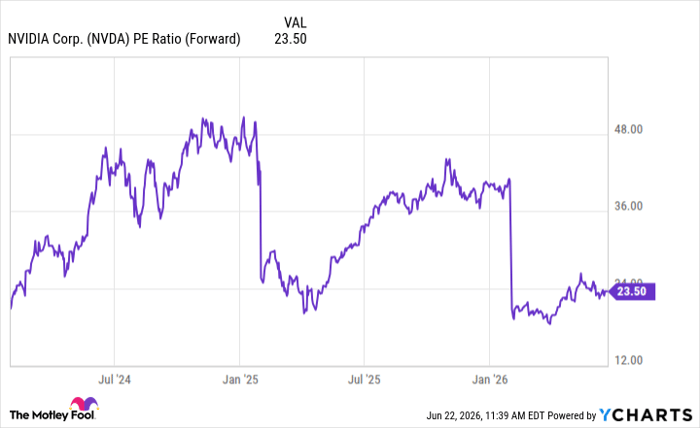
These secular growth drivers -- Blackwell adoption, hyperscaler infrastructure spending, and the new Vera CPU -- are converging at a time when Nvidia's forward price-to-earnings (P/E) multiple sits well below the levels it usually traded at during earlier phases of the AI revolution.
NVDA PE Ratio (Forward) data by YCharts.
With earnings poised to expand from the data center segment, Nvidia's current valuation leaves it meaningful room for valuation expansion. Even a conservative rerating to between 24 and 27 times Nvidia's expected fiscal 2028 earnings per share (EPS) of $12.73 could propel its stock price well above $300 -- implying more than 50% upside from current trading levels.
Investors who focus on the durability of these catalysts rather than short-term noise around the growing levels of competition in the AI accelerator space or the sensitive macroeconomic environment will benefit from Nvidia's operational outperformance. Eventually, its valuation multiples will normalize toward levels consistent with the company's leading role in the AI infrastructure build-out.
Should you buy stock in Nvidia right now?
Before you buy stock in Nvidia, consider this:
The Motley Fool Stock Advisor analyst team just identified what they believe are the 10 best stocks for investors to buy now… and Nvidia wasn’t one of them. The 10 stocks that made the cut could produce monster returns in the coming years.
Consider when Netflix made this list on December 17, 2004... if you invested $1,000 at the time of our recommendation, you’d have $392,713!* Or when Nvidia made this list on April 15, 2005... if you invested $1,000 at the time of our recommendation, you’d have $1,227,782!*
Now, it’s worth noting Stock Advisor’s total average return is 897% — a market-crushing outperformance compared to 208% for the S&P 500. Don't miss the latest top 10 list, available with Stock Advisor, and join an investing community built by individual investors for individual investors.
See the 10 stocks »
*Stock Advisor returns as of June 24, 2026.
Adam Spatacco has positions in Nvidia. The Motley Fool has positions in and recommends Nvidia. The Motley Fool has a disclosure policy.
Recommended Articles


