


Lennar Hasn't Sold Homes This Cheap Since 2017. Here's What That Means for the Housing Market.
Key Points
Lennar cut average home prices to 2017 levels, prioritizing sales volume over short-term margins.
Lower prices improve affordability, but elevated mortgage rates remain the biggest obstacle for buyers.
- 10 stocks we like better than Lennar ›
The number jumped out at me the moment I saw it. Lennar's (NYSE: LEN) average sales price for homes delivered in the second quarter of 2026 was $371,000 -- a price the company hasn't seen since the first quarter of 2017, when it averaged $365,000.
That's not a small number to sit with here. It means that one of America's largest homebuilders just rolled back its prices by nearly a decade in nominal terms. In a country where the median existing home now sits above $412,000, let's get into the signal this is sending.
Where to invest $1,000 right now? Our analyst team just revealed what they believe are the 10 best stocks to buy right now, when you join Stock Advisor. See the stocks »
How Lennar got here
This didn't happen because the housing market collapsed. Lennar delivered 20,519 homes in Q2 2026 -- a 2% year-over-year increase -- and maintained full-year delivery guidance of 82,000 to 83,000 homes. It happened because Lennar deliberately chose to compete on price, rather than wait for conditions to improve.
CEO Stuart Miller was direct about the math in the earnings release: The $371,000 price reflected approximately 12.9% in incentives, along with base price adjustments to keep volume moving. That incentive level is high by historical standards -- the company's normalized range is 4% to 6% -- but Miller noted that it's narrowing for the first time in three years as the gaps between elevated mortgage rates, home prices, and household incomes start to close.
The goal is volume now, margin recovery later. It's a patient strategy, and the operational data supports it -- construction costs are down 13% over the past two years, and cycle times have hit a record low of 121 days.
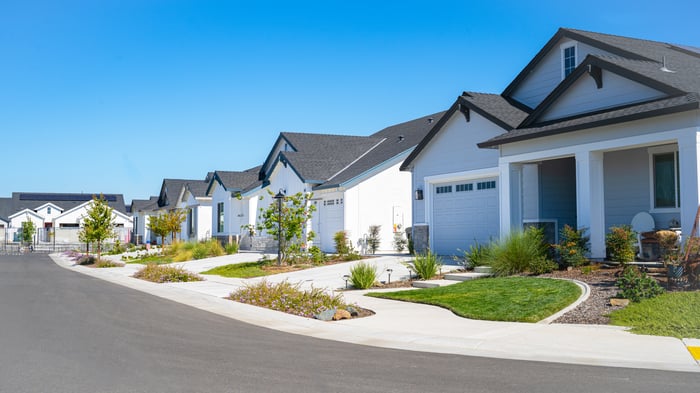
Image source: Getty Images.
The rate cut problem
Lower home prices are not, by themselves, a solution to the affordability crisis. They're one part of a much harder equation.
The 30-year fixed mortgage rate sits at roughly 6.47% as of this week. Qualifying for a mortgage on the median existing home at today's rates requires an annual household income of approximately $95,000 -- well above what most first-time buyers earn. First-time buyers now represent just 21% of the market, the lowest share in 44 years. The NAHB estimates a nationwide shortage of roughly 1.2 million housing units. There is no shortage of demand -- there is a shortage of buyers who can afford to act on it.
Here's where Lennar's price reduction becomes relevant in a way that a simple headline misses: a $371,000 home financed at 6.47% on a 30-year real estate mortgage carries a monthly principal and interest payment of roughly $2,340. The same home priced at $412,000 -- the median existing resale -- carries a payment closer to $2,600. That $260 monthly difference won't solve the affordability crisis, but it represents real purchasing power for buyers stretching to qualify. Think of it as a builder clearing a path through a thicket that policy alone can't cut through fast enough.
What Lennar expects next -- and the investor takeaway
Lennar guided for third-quarter 2026 average home prices in the range of $375,000 to $380,000, with gross margin improving to approximately 16% as incentive levels moderate and cost discipline compounds. That modest price increase suggests that the company believes the floor is in -- that it has reached a price point where demand is sufficient, and margin recovery can begin without chasing buyers away.
The gap between today's builder prices and existing resale inventory is now wide enough that new construction is increasingly the most accessible entry point for buyers who want to own. That's an unusual dynamic -- new homes are traditionally priced at a premium to existing ones -- and it reflects how much builders have absorbed to keep the market moving.
For Lennar shareholders, the compressed margin cycle is painful, but the logic behind it is sound. Miller used the phrase "execute around the affordability challenge" on the earnings call, rather than "wait it out." That posture -- active adaptation rather than passive patience -- is what separates a resilient operator from one that just hopes conditions normalize.
For the broader housing market, Lennar's pricing is a pressure valve. The structural shortage won't be solved by incentives. However, a major national builder consistently delivering homes under $400,000 in a world where resale inventory sits well above that is a real, meaningful development for the buyers who need it most.
Should you buy stock in Lennar right now?
Before you buy stock in Lennar, consider this:
The Motley Fool Stock Advisor analyst team just identified what they believe are the 10 best stocks for investors to buy now… and Lennar wasn’t one of them. The 10 stocks that made the cut could produce monster returns in the coming years.
Consider when Netflix made this list on December 17, 2004... if you invested $1,000 at the time of our recommendation, you’d have $392,713!* Or when Nvidia made this list on April 15, 2005... if you invested $1,000 at the time of our recommendation, you’d have $1,227,782!*
Now, it’s worth noting Stock Advisor’s total average return is 897% — a market-crushing outperformance compared to 208% for the S&P 500. Don't miss the latest top 10 list, available with Stock Advisor, and join an investing community built by individual investors for individual investors.
See the 10 stocks »
*Stock Advisor returns as of June 24, 2026.
Micah Zimmerman has no position in any of the stocks mentioned. The Motley Fool has positions in and recommends Lennar. The Motley Fool has a disclosure policy.
Recommended Articles


