


Plunging More Than 15%; SpaceX Market Value Set to Fall Below $2 Trillion, This Space Company Rumored to Merge With Tesla
TradingKey - Following SpaceX ( SPCX) announcing its debut investment-grade bond issuance, rumors of an upcoming merger with Tesla sent the company's stock price sliding again.
As of press time, SpaceX was down 15.45% at $156.41, nearing a break below its debut listing price of $150, with its latest market capitalization at $2.05 trillion.
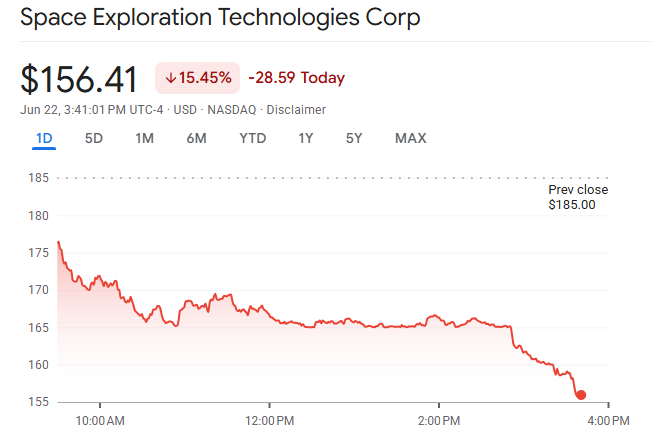
[Source: Google Finance]
Elon Musk's biographer, Walter Isaacson, has publicly stated that a merger between Tesla and SpaceX makes a great deal of sense.
This aligns with prediction market trends: data from the Kalshi platform shows that the probability of the two companies completing a merger by May 2027 has risen to 57%, continuing to climb following SpaceX's listing.
Behind the rumors of a Tesla-SpaceX merger lie practical considerations at both the business and governance levels.
Both companies are high-end manufacturing entities deeply empowered by AI technology. Currently, allocating core resources such as talent and chips across entities not only results in significant efficiency losses but has also triggered compliance risks from shareholder lawsuits—a previous lawsuit in Delaware accused Musk of siphoning core AI resources from Tesla to xAI, which has now been merged into SpaceX.
If the merger materializes, it would directly clear up such corporate governance gray areas and eliminate compliance risks. This operational path also aligns with Musk's consistent philosophy on capital operations: he views his personal wealth more as industrial capital that can be coordinated and deployed across different industrial entities, rather than as personal assets aimed at cashing out.
The transaction structure and valuation impact have become the core of market disagreement. In terms of scale, SpaceX's current market value is higher than Tesla's $1.5 trillion, making it more likely to act as the acquirer; however, SpaceX remains unprofitable while Tesla continues to be profitable, introducing uncertainty to the stock-swap valuation.
Pessimistic views suggest that the merger would result in a 28% equity dilution for Tesla shareholders, and with the added conglomerate discount, the overall market value would be less than the simple sum of the two.
Optimistic views, on the other hand, believe that a merger of equals would revalue Tesla, generating hundreds of billions of dollars in incremental market value and ultimately forming an industrial holding group in the AI sector. As the smaller entity, Tesla's stock price will be most heavily influenced by the final stock-swap ratio.
Recommended Articles


