


Prediction: NextEra Energy's $67 Billion Dominion Acquisition Could Spur More Utility Deals. This Tie-Up Could be Next.
Key Points
NextEra Energy's interest in Dominion Energy underscores the AI data center industry’s soaring demand for electricity.
Some potential pairings within the utility industry are better suited than others in terms of geography and infrastructure integration.
It will come as no surprise that nuclear power production is a prominent factor in predicting which two utility names will be the next to team up.
- 10 stocks we like better than Vistra ›
Major mergers and acquisitions within the utility sector are relatively rare; most of the dealmaking in this business to-date has been for fairly small, affordable names that easily "bolt on" to existing operations. That's what makes NextEra Energy's (NYSE: NEE) recently announced intention of acquiring fellow power provider Dominion Energy (NYSE: D) so interesting.
Both companies are already among the biggest names in the business. Combining them -- assuming regulators allow it -- will create the world's biggest utility company by a country mile.
Will AI create the world's first trillionaire? Our team just released a report on the one little-known company, called an "Indispensable Monopoly" providing the critical technology Nvidia and Intel both need. Continue »
And this begs the question, now that other utility names have good reason to fear missing out on an acquisition opportunity, what name might be the next target? For that matter, which name might be the next buyer?

Image source: Getty Images.
Not the first, but certainly the biggest (and for a good reason)
NextEra Energy's $67 billion effort to own Dominion isn't actually the first one of these mega mergers, even if it's the biggest. In March, Global Infrastructure Partners and EQT Infrastructure unveiled their plans to jointly buy AES Corp. Constellation Energy (NASDAQ: CEG) recently closed on a deal largely to combine its nuclear fleet with Calpine's geothermal and natural gas operations. Google parent Alphabet is even getting in on the action, deciding late last year to shell out nearly $5 billion for Intersect, which specializes in powering artificial intelligence (AI) data centers.
That's the chief driver for most of this recent dealmaking, of course -- the artificial intelligence industry needs more electricity than the nation's utility industry is capable of producing. Indeed, Goldman Sachs believes U.S. data center electricity consumption will double within a year. Providing it has become a very lucrative business, or in the case of Alphabet's purchase of Intersect, it helps assure you have it when needed.
That's also the chief reason NextEra is interested in Dominion, even if neither party explicitly said it. Dominion's core market is Virginia, which is home to roughly 700 data centers.
That's an important detail to keep in mind when predicting the next likely acquisition target within the utilities business.
The top prospective buyer and buyee
All predictions about any aspect of the stock market should be taken with a BIG grain of salt. Nobody has access to a functioning crystal ball. There's still value in the thought exercise, however, if only to compare and contrast different companies.
To this end, Vistra (NYSE: VST) is arguably the next -- or at least one of the next -- likely acquisition targets within the utility sector.
It's not exactly a major household name, mostly because it's not much of a consumer-facing company. Through a handful of other brands, it directly serves approximately 5 million residential and business utility customers. The core of its business, however, is wholesaling electricity generated by its own fleet of natural gas, coal, nuclear, and renewable power plants to other utility companies. All told, it's got enough capacity to generate up to 44,000 megawatts of electricity. That's enough to power about 30 million homes, or, of course, several hundred data centers.
The crux of the bullish argument is simply that it's ready and able to create and deliver power to grids in Texas, California, and to most of the northeastern United States today, leveraging its long-established presence as a wholesaler with access to key portions of the nationwide grid.
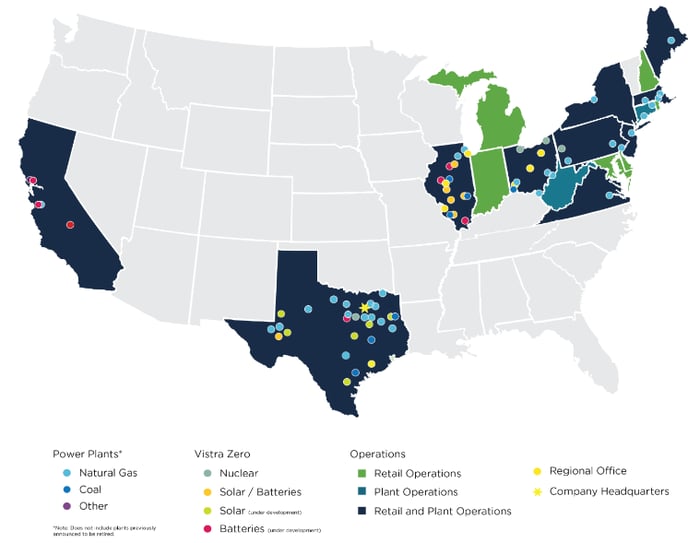
Image source: Vistra's Q1-2026 slide deck.
That's how it was able to secure direct deals with Amazon and the Facebook parent Meta Platforms to help both parties power their next-generation centers, ultimately justifying and supporting the establishment of new nuclear power facilities that could serve future customers beyond these two big ones.
The kicker: Vistra shares remain reasonably affordable at around 15 times this year's projected per-share earnings of $9.08, while the company's market cap itself is a fairly modest $50 billion. That's within reach for most prospective suitors.
To this end, which player might actually be interested enough to pull this trigger? Again, take any such prediction with a grain of salt. Nobody really knows.
If there was any outfit that would gain from such a deal simply because it doesn't have -- and can't necessarily build -- what Vistra brings to the table, it's the aforementioned Constellation Energy, which already has the biggest nuclear power fleet in the United States. In fact, it generates more nuclear power than the rest of the United States' utility companies combined, accounting for more than 80% of its total power production. It can most definitely find some synergies with Vistra's nuclear power development plans.
It's also worth noting that, following the Calpine tie-up, Constellation has a strong presence in Texas, California, and much of the Northeast, where Vistra also does. To the extent geography matters, the company would have little trouble integrating Vistra with its other operations, and vice versa, perhaps gaining access to a grid or connection it might not otherwise have.
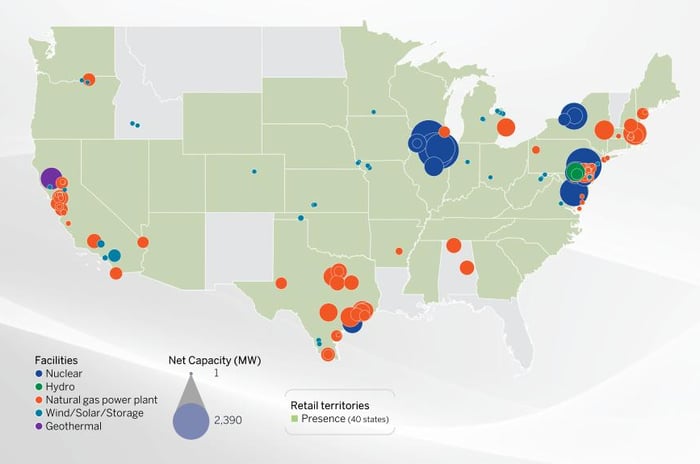
Image source: Constellation Energy/Calpine acquisition conference call slide deck.
There's also no denying that, as the nation's fifth-largest utility (by market cap and revenue), Constellation is better positioned financially than most to get such a deal done.
The one to beat
Once again, it can't be stressed enough that this is strictly a well-reasoned guess. This tie-up may or may not ever materialize. Others might materialize first. Anything's possible. And of course, betting on an acquisition alone is a lousy reason to own any stock.
This particular pairing does make a great deal of logical and logistical sense, though. It's a prospect that will be tough to top with any other proposed combination of utility companies anyway.
Should you buy stock in Vistra right now?
Before you buy stock in Vistra, consider this:
The Motley Fool Stock Advisor analyst team just identified what they believe are the 10 best stocks for investors to buy now… and Vistra wasn’t one of them. The 10 stocks that made the cut could produce monster returns in the coming years.
Consider when Netflix made this list on December 17, 2004... if you invested $1,000 at the time of our recommendation, you’d have $442,220!* Or when Nvidia made this list on April 15, 2005... if you invested $1,000 at the time of our recommendation, you’d have $1,230,114!*
Now, it’s worth noting Stock Advisor’s total average return is 926% — a market-crushing outperformance compared to 203% for the S&P 500. Don't miss the latest top 10 list, available with Stock Advisor, and join an investing community built by individual investors for individual investors.
See the 10 stocks »
*Stock Advisor returns as of June 11, 2026.
James Brumley has positions in Alphabet. The Motley Fool has positions in and recommends Alphabet, Amazon, Constellation Energy, EQT, Goldman Sachs Group, Meta Platforms, and NextEra Energy. The Motley Fool recommends Dominion Energy and Vistra. The Motley Fool has a disclosure policy.
Recommended Articles


