


Largest IPO in History SpaceX Set for Debut. Market Ignores “Cash Magnet Effect,” Philadelphia Semiconductor Index Surges Over 5%.
TradingKey - On June 11, SpaceX is set to list on the Nasdaq. According to people familiar with the matter, SpaceX's largest-ever IPO has attracted over $250 billion in investor subscription demand, which is 3.5 to 4 times its planned $75 billion fundraising target, with market enthusiasm far exceeding expectations.
The market is currently concerned that this record-breaking IPO will have a "liquidity-drain" effect on the stock market, significantly diverting funds from the secondary market, thereby creating phased valuation pressure on 2026's hottest AI trading sectors—the storage and CPU sectors, including Micron ( MU ), SanDisk ( SNDK ), Intel ( INTC) and AMD ( AMD) among other core targets—exerting phased valuation pressure.
That is, investors may raise funds to participate in the new round of tech IPOs by reducing their holdings in the aforementioned high-flying tech stocks.
However, judging from today's market performance, such concerns do not seem to have materialized. The Nasdaq 100 Index, representing tech stocks, performed strongly today, rising 1% to 28,835.35 as of press time.
The Philadelphia Semiconductor Index even surged over 5% at one point, with all 30 components advancing. Credo Technology (CRDO) rose 11.08%, KLA Corp (KLAC) gained 9.52%, Lam Research (LRCX) increased 8.61%, Astera Labs (ALAB) rose 8.16%, Applied Materials (AMAT) jumped 7.79%, Intel (INTC) climbed 7.27%, Arm Holdings (ARM) advanced 7.16%, and Marvell Technology (MRVL) gained 5.95%.
Based on the market action, it appears there has been no "rotation" response to the upcoming listing of the space company.
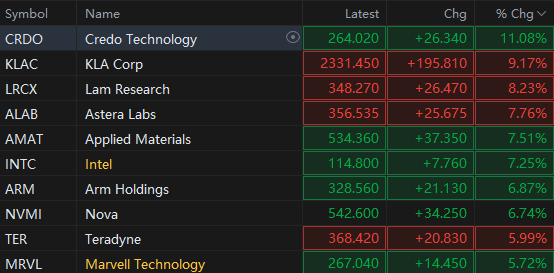
Goldman Sachs addressed these market concerns in its latest research, arguing that the record volume of U.S. stock issuance in 2026 will not end the bull market.
The firm stated that while IPO activity continues to heat up, it has not yet reached historical extremes. Approximately 100 IPOs are expected in the U.S. in 2026, which is close to the industry average of the past 25 years; by comparison, the number of IPOs exceeded 250 in 2021 and approached 400 in 1999 at the height of the dot-com bubble.
The firm noted that the scale of this new equity supply remains limited relative to the overall size of the U.S. stock market. Goldman Sachs estimates that total equity issuance by U.S. companies in 2026 will be approximately $700 billion, representing only about 1% of the total market capitalization of the Russell 3000 Index, which is largely in line with average annual supply levels from 2015 to 2019.
The firm further pointed out that large-scale corporate share buybacks will completely offset the impact of the new supply. Goldman Sachs expects total U.S. stock buybacks to reach $1 trillion in 2026, sufficient to cover all new stock issuances; meanwhile, M&A activity, international capital inflows, and household sector funds entering the market will provide additional support for incremental demand.
It should be noted that as the lock-up periods for this wave of IPO companies expire throughout 2027, the supply-demand balance of the U.S. stock market may face greater challenges at that time.
Recommended Articles


