


The SpaceX IPO is Just Days Away. Here's What History Says Will Happen Next.
Key Points
Investors are keen to get in on the ground floor of the biggest IPO in history.
The history of IPOs shows that the first day may not be the best time to get in on the action.
The SpaceX IPO is unique in many ways, and investors should understand what they're in for.
- 10 stocks we like better than Alphabet ›
This year is shaping up to be a historic in terms of companies going public. Artificial intelligence (AI) start-ups Anthropic and OpenAI plan their initial public offerings (IPOs) this year, but unquestionably, the biggest debut is expected to be SpaceX. The company is looking to raise $75 billion in its offering, which will dwarf previous records by a wide margin.
The hype machine is ramping up at dizzying proportions, and that's understandable. The chance to get in on the ground floor and ride the rocket maker to new heights is certainly a tempting proposition. So, should investors buy SpaceX on IPO day? Let's see what lessons we can glean from history.
Will AI create the world's first trillionaire? Our team just released a report on the one little-known company, called an "Indispensable Monopoly" providing the critical technology Nvidia and Intel both need. Continue »

Image source: Getty Images.
Ready for launch
Before we address the question at hand, it's worth looking at what the SpaceX offering will entail and what investors will get for their money.
In the company's latest S-1 filing with the Securities and Exchange Commission, Space Exploration Technologies Corp. (aka SpaceX) revealed it will offer 555,555,555 shares of Class A common stock at an IPO price of $135 per share, raising roughly $75 billion and valuing the company at $1.77 trillion. The stock will be listed on the Nasdaq exchange using the symbol "SPCX."
SpaceX has three distinct business segments: rocket launch, satellite internet, and artificial intelligence (AI).
The most high-profile of the three is the rocket launch business, which has launched roughly 650 Falcon rockets with a 99% success rate. It also pioneered "reusable" rockets, making space travel more cost-effective.
The company also boasts the largest network of broadband and mobile satellites in Low-Earth orbit, with approximately 9,600 Starlink satellites, delivering service to millions of customers in 164 countries.
Last but not least is the company's AI segment, including Grok AI, thanks to the recent merger with xAI. SpaceX has ambitious plans to build and launch solar-powered orbital data centers, which it believes will offer "far greater scale and efficiency than terrestrial alternatives."
Late last week, SpaceX revealed in a regulatory filing that it had reached a deal with Alphabet (NASDAQ: GOOGL) (NASDAQ: GOOG), under which the Google-parent will pay $920 million per month between Oct. 2026 and June 2029 for compute capacity, for a deal valued at $30 billion. This comes on the heels of a similar deal reached with Anthropic, which is paying SpaceX $1.25 billion per month.
The company's financial results are intriguing. In 2025, SpaceX generated revenue of $18.7 billion, up 33% year over year, but recorded a net loss of $4.9 billion under Generally Accepted Accounting Principles (GAAP). On an adjusted basis, the company's results look more appealing, with adjusted EBITDA of $6.6 billion, though this ignores stock-based compensation, depreciation, and amortization, among other very real business expenses.
These financials don't include the recently inked agreements, which will no doubt improve its financial position.
What history says
While there are plenty of reasons to be excited about the SpaceX IPO, a look at history can be instructional, as the past is rife with examples of stocks that fell significantly in the wake of their public offerings.
Sam Grelck, equity strategy analyst at Truist, reviewed data from the 30 biggest IPOs of the past 15 years, and his findings are telling. More than half of these stocks were underwater after the first week, and also at 12 months post-IPO, with 17 of 30 stocks in the red. The best-performing stock in the group was Palantir Technologies (NASDAQ: PLTR), which was up 153% after the first year but shed 53% of its value at one point during the year. Robinhood Markets (NASDAQ: HOOD) had the worst track record, losing 74% in the first year, after falling as much as 90%. The full data is illustrated in the chart below.
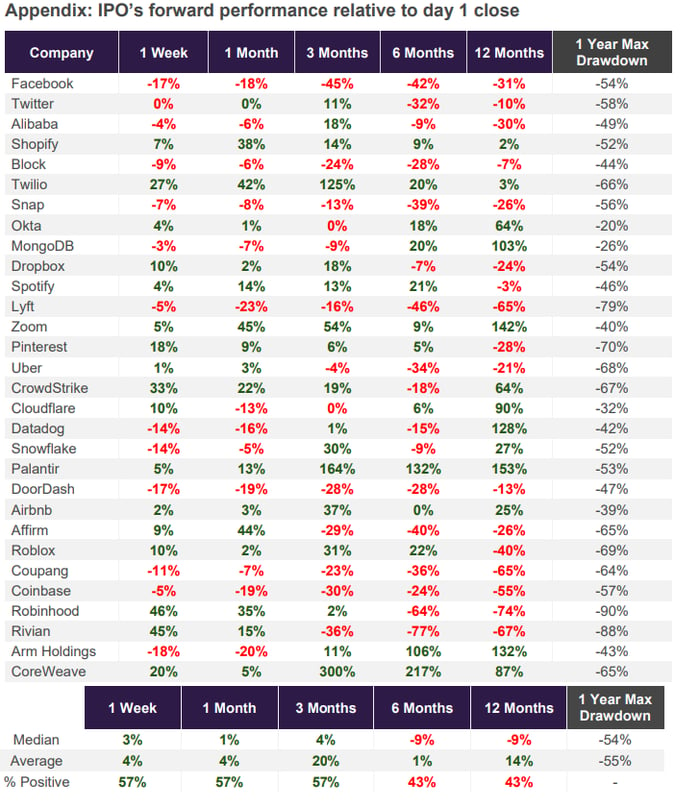
Image source: Truist.
In nearly every case, the first year was a rocky one for these newly listed companies, which serves as a stark reminder for investors. Recently minted stocks can be particularly volatile, so IPO investing isn't for the faint of heart.
A couple of other caveats for thoughtful investors. While the offering price is $135 per share, retail investors may not be able to get that price. The hype ahead of the SpaceX launch has reached a fever pitch, which could drive the stock price up from the moment it begins trading, causing investors to pay a much higher price.
Furthermore, while investors will be able to own SpaceX stock, make no mistake about who will be in control. Founder and CEO Elon Musk will control 82% of the company's voting power, leaving retail investors with little say in matters requiring shareholder approval.
Last, but certainly not least, if SpaceX achieves its $1.77 trillion valuation, the stock would be selling for roughly 95 times sales, a premium valuation to be sure.
For investors who are still determined to buy the SpaceX IPO, it should be a small part of a well-balanced portfolio. It may also be worth waiting for the inevitable stock price fall to buy at a more reasonable price.
Should you buy stock in Alphabet right now?
Before you buy stock in Alphabet, consider this:
The Motley Fool Stock Advisor analyst team just identified what they believe are the 10 best stocks for investors to buy now… and Alphabet wasn’t one of them. The 10 stocks that made the cut could produce monster returns in the coming years.
Consider when Netflix made this list on December 17, 2004... if you invested $1,000 at the time of our recommendation, you’d have $443,191!* Or when Nvidia made this list on April 15, 2005... if you invested $1,000 at the time of our recommendation, you’d have $1,258,838!*
Now, it’s worth noting Stock Advisor’s total average return is 941% — a market-crushing outperformance compared to 206% for the S&P 500. Don't miss the latest top 10 list, available with Stock Advisor, and join an investing community built by individual investors for individual investors.
See the 10 stocks »
*Stock Advisor returns as of June 8, 2026.
Danny Vena, CPA has positions in Alphabet, Cloudflare, Coupang, CrowdStrike, Datadog, Meta Platforms, MongoDB, Okta, Palantir Technologies, Shopify, Snowflake, and Twilio. The Motley Fool has positions in and recommends Airbnb, Alphabet, Block, Cloudflare, CrowdStrike, Datadog, DoorDash, Dropbox, Lyft, Meta Platforms, MongoDB, Okta, Palantir Technologies, Pinterest, Roblox, Shopify, Snowflake, Spotify Technology, Twilio, Uber Technologies, and Zoom Communications. The Motley Fool recommends Alibaba Group, Coinbase Global, and Coupang. The Motley Fool has a disclosure policy.
Recommended Articles


