


The Fed's Latest Inflation Forecast Just Got Uglier. Here's How It Might Affect Your Investments.
Key Points
Inflation is rearing its ugly head once again, forcing the Federal Reserve to rethink its monetary policy.
Higher interest rates should be a major headwind for equities, something we’re not seeing right now.
Investors should focus all their attention on building a diversified and durable portfolio.
- 10 stocks we like better than S&P 500 Index ›
All the attention continues to gravitate to artificial intelligence (AI). But with the ongoing geopolitical conflict in the Middle East, inflation is back in the spotlight.
The Federal Reserve's preferred measure of inflation is the personal consumption expenditures (PCE) price index. In April, it increased by 3.8% year over year, the highest since May 2023.
Will AI create the world's first trillionaire? Our team just released a report on the one little-known company, called an "Indispensable Monopoly" providing the critical technology Nvidia and Intel both need. Continue »
Federal Reserve Governor Lisa Cook contends that if inflation stays elevated, the central bank will have to consider raising interest rates at some point in 2026. This might come as a surprise to those who started the year thinking the Fed was going to cut rates.
Here's how this macroeconomic dynamic can affect your investment portfolio.
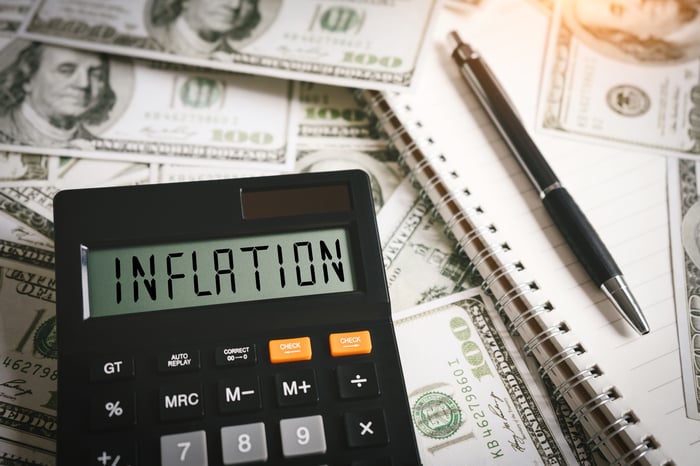
Image source: Getty Images.
Interest rates are like gravity
As with many things in the world of investing, we can turn to Warren Buffett for wisdom. The longtime head of Berkshire Hathaway once said that interest rates are like gravity to asset prices: Higher interest rates should pull valuations down, while lower interest rates should be a boon for assets.
Based on financial theory, this view makes sense. When interest rates are higher, investors can earn an adequate yield on cash-like vehicles, which reduces the incentive to put money in riskier opportunities, like the stock market.
There's a valuation component as well. Higher interest rates raise the discount rate that companies and stocks get valued with, which reduces the present value of their future cash flows.
This scenario should affect different companies in unique ways. A high-growth, money-losing enterprise that promises positive free cash flow far into the future should see its valuation get hit harder than a stable, mature, and profitable business.
Does it matter right now?
The PCE rose at a level not seen in nearly three years. And the Federal Reserve is hinting at possibly raising rates this year. Based on Buffett's logic, this is a terrible recipe for equity investors looking to grow their wealth.
However, the market isn't reflecting this perspective. The S&P 500 index has increased 8% in 2026 (as of June 5), now sitting slightly off its all-time high. The benchmark did fall throughout March, following the start of the Iran war on Feb. 28. But once April came, it started climbing.
As mentioned, the AI trade is sucking up a lot of capital and driving heightened enthusiasm among market participants. And we could have multiple trillion-dollar initial public offerings this year. This activity doesn't align with the state of inflation and interest rates.
Ultimately, investors should spend less time worrying about macroeconomic factors and instead focus on building a diversified portfolio that can perform well over the long term.
Should you buy stock in S&P 500 Index right now?
Before you buy stock in S&P 500 Index, consider this:
The Motley Fool Stock Advisor analyst team just identified what they believe are the 10 best stocks for investors to buy now… and S&P 500 Index wasn’t one of them. The 10 stocks that made the cut could produce monster returns in the coming years.
Consider when Netflix made this list on December 17, 2004... if you invested $1,000 at the time of our recommendation, you’d have $443,191!* Or when Nvidia made this list on April 15, 2005... if you invested $1,000 at the time of our recommendation, you’d have $1,258,838!*
Now, it’s worth noting Stock Advisor’s total average return is 941% — a market-crushing outperformance compared to 206% for the S&P 500. Don't miss the latest top 10 list, available with Stock Advisor, and join an investing community built by individual investors for individual investors.
See the 10 stocks »
*Stock Advisor returns as of June 8, 2026.
Neil Patel has no position in any of the stocks mentioned. The Motley Fool has positions in and recommends Berkshire Hathaway. The Motley Fool has a disclosure policy.
Recommended Articles


