


Pay-by-Bank Is Quietly Gaining Ground. Should Card Network Visa Investors Worry?
Key Points
While it's been available for some time now, the COVID-19 pandemic generated more interest in making electronic payments directly from a bank account.
Awareness of this alternative to credit cards remains modest, as does trust in the option.
Most consumers are hesitant to embrace pay-by-bank for the obvious reasons, but will this be the case forever?
- 10 stocks we like better than Visa ›
Sometimes it takes a while for them to surface. The fact of the matter is, though, competitors will always eventually take aim at a market's leaders, often with a superior solution.
That's what's happening within the payments arena right now. After years of chipping away at the dominance of cash and check-based payments, now credit card middlemen like Visa (NYSE: V) and Mastercard (NYSE: MA) are facing unexpected opponents. It's not mobile or digital wallets either; despite their once-strong hype, this option accounted for only about 1% of consumer purchase payments in the United States last year. No, this up-and-coming rival is "pay-by-bank" payments that let a merchant directly withdraw funds from a consumer's bank account, bypassing card payment networks and, subsequently, their higher processing fees.
Will AI create the world's first trillionaire? Our team just released a report on the one little-known company, called an "Indispensable Monopoly" providing the critical technology Nvidia and Intel both need. Continue »
But is this alternative an actual threat to credit and debit card companies?
Slowly but surely
There is measurable usage of this option already, for the record, unsurprisingly solidified by the COVID-19 pandemic. Its usage is still relatively modest, though, making up less than 14% of last year's total consumer transactions.
Still, that's about 50% more than this option's pre-pandemic utilization. It's a trend worth noting.
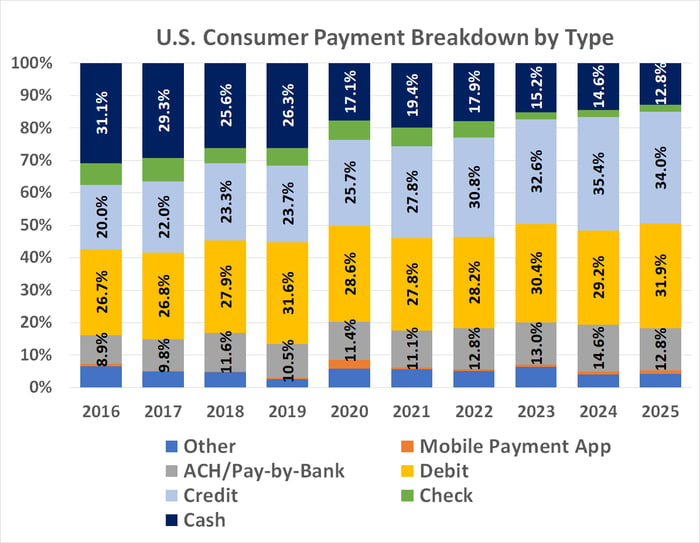
Data source: U.S. Federal Reserve. Chart by author.
It's also worth noting, however, that this form of direct bank payments stopped growing last year, ultimately ceding share back to debit cards, and a slight uptick in mobile payment apps (although the Federal Reserve notes that roughly one-fourth of digital wallets use their owner's bank accounts as their primary source of payment funding).
Nevertheless, pay-by-bank isn't something Visa's and Mastercard's shareholders should worry about just yet, and probably not anytime soon.
Stumbling blocks
Even if you don't know precisely why direct transfers aren't a threat to credit card networks, your educated guesses are likely on target.
Chief among these is a lack of trust in supplying a third-party with bank account specifics, like an account number. Although some consumers might trust a payee like their local water company with such information, they're not so lax with other merchants that might be more difficult to track down should a problem arise.

Image source: Getty Images.
Credit cards also offer something else that encourages their continued usage. As the Federal Reserve's 2025 dive into the matter explains, "despite the absence of direct pay-by-bank usage fees, customers may be attached to alternative payment methods -- most notably credit cards -- because of the myriads of spending rewards they offer."
On that note, while pay-by-bank transactions are typically free for the customer, the merchant still pays a small fee. Accepting these payments also means equipping a store or shop to do so, which can be an additional unwanted cost.
Then there's just the sheer inconvenience of switching. If nothing else, plastic is easy to use.
Be aware, but don't be afraid
It's nothing to ignore, to be clear. There may well come a time when pay-by-bank disrupts the credit card network duopoly the way mobile/digital wallets were expected to.
That time isn't now, though, or in the foreseeable future. Visa's total transaction count grew a little over 8% last quarter, while Mastercard's was up just a little bit more than that. Both seem to be holding up just fine against their young competition, even if only due to the inconvenience of switching.
Should you buy stock in Visa right now?
Before you buy stock in Visa, consider this:
The Motley Fool Stock Advisor analyst team just identified what they believe are the 10 best stocks for investors to buy now… and Visa wasn’t one of them. The 10 stocks that made the cut could produce monster returns in the coming years.
Consider when Netflix made this list on December 17, 2004... if you invested $1,000 at the time of our recommendation, you’d have $439,632!* Or when Nvidia made this list on April 15, 2005... if you invested $1,000 at the time of our recommendation, you’d have $1,316,532!*
Now, it’s worth noting Stock Advisor’s total average return is 959% — a market-crushing outperformance compared to 210% for the S&P 500. Don't miss the latest top 10 list, available with Stock Advisor, and join an investing community built by individual investors for individual investors.
See the 10 stocks »
*Stock Advisor returns as of June 4, 2026.
James Brumley has no position in any of the stocks mentioned. The Motley Fool has positions in and recommends Mastercard and Visa. The Motley Fool has a disclosure policy.
Recommended Articles


