


SanDisk Stock Forecast: Can a $42B Backlog Push SNDK to New Highs?
TradingKey - SanDisk Corporation (NASDAQ: SNDK) is at $1,784 as of June 4, trading inside a broad, ascending blue channel on the 2H chart, with the RSI clocking in at 58.80 in neutral-bullish territory, absent a bearish divergence. MA50 and MA100 serve as a dynamic support below, and the key to sustaining the upper channel targets of $1,859 to $1,921 is the channel floor’s support level of $1,690 to $1,697.
Today’s is the fourth in the series since the initial May 15 coverage piece: The article series has covered the initial Q3 FY2026 beat at $1,382; the May consolidation and the subsequent descending channel and now it is back at the new highs in the ascending channel. The core fundamentals have not changed, Q3 revenues of $5.95 billion, Q4 guided $7.75 to $8.25 billion, and a contracted backlog of $42 billion. At this price level, $1,784, the question becomes whether the ascending channel is about to hold, or is it going to need a retest of the lower channel support line?
SanDisk at $1,784 After Fourth Article: What Has Changed and What Has Not?
The fundamental story at $1,784 is the same as it was at $1,382 in May: SanDisk’s Q3 FY2026 beat stands among the most decisive in recent semiconductor memory history; the contracted backlog of $42 billion provides multi-year revenue visibility; Q4 guidance of $7.75 to $8.25 billion implies quarter-over-quarter sequential acceleration. What has changed in the price action context is that the May 15 article was covering the initial retest of the ascending trendline line following the initial post-earnings pop.
The May 22 series covered the formation of a descending channel and the dual long/short setup with entry in the $1,436 to $1,467 price band. The stock resolved the descending channel to the upside, confirmed the ascending trendline support, and has now marched higher to $1,784, a new high for the post-earnings trend to confirm the May consolidation phase as a bullish accumulation zone.
Also, the business model transformation argument has received another leg of confirmation since the Q3 print: CEO David Goeckeler’s strategic pivot from the spot-market for NAND products to multi-year contracted revenues, the $42 billion backlog, forms the structural business re-rating argument. NAND pricing cycles are measured in quarter-years; contracted, multi-year supply agreements are measured in years. The re-rating of SNDK from the semiconductor memory commodity pricing multiple to a contracted revenue visibility multiple continues as the market slowly re-price the company’s fundamentals and that is the reflection of its steady rally from the $1,043 April lows to $1,784 on June 4.
Any Q4 Data Centre guidance number that points to a deceleration from 645% year-over-year growth reported by Q3 or any hints that the demand curve of the AI SSDs to be supplied to the hyperscalers is about to plateau, remain a key risk to the thesis.
The $42B Backlog and Why SanDisk Isn’t Just a Cyclical Play Anymore
What I want to call out most is the structural change that happened in SanDisk, and that is the shift from spot pricing for NAND to multi-year contracts for supply of their storage. Under spot, the cycles of NAND pricing would have been in a spot where the revenue and margins could’ve seen massive swings, where SanDisk margins could swing from 78% to less than 20% in a year. Under the contract, a customer agrees to purchase a quantity of NAND at a particular price and over a particular length of time, which is essentially the $42B backlog of aggregate orders. Revenue is predictable, margins can be forecast, and a multiple of software or infrastructure gets applied instead of a multiple of commodity semis.
The AI data centre storage market was the thing that enabled this. The AI training clusters hyperscalers were building in the 100,000-GPU range required NAND supply guarantees. No AI-optimised SSD, no AI datacentre training runs. If that training run is billion-dollar in cost, that’s a real big deal. That gave a big incentive for hyperscalers to commit to volume and price on contracts that provided the visibility to allow capital planning at SanDisk.
Samsung and SK Hynix and Micron are all going after the same thing, but SanDisk is the one that got there first with the high-bandwidth AI-optimised storage products that the hyperscalers want, and that allows SanDisk the high backlog, high contracted ASPs, and high margins over and above the commodity NAND cycle ever produced.
SNDK Technical Setup – $1,784 is Inside Ascending Channel, Support $1,690, Targets $1,859 and $1,921
On the 2H, SNDK at $1,784 is inside the wide ascending blue channel with clean higher highs and higher lows. Both the MA50 and MA100 are clearly below the price and provide a solid dynamic support base. The RSI is at 58.80 and is neutral-bullish without showing any bearish divergence. Volume increases on green candles show steady accumulation on the part of institutions, and it’s not exhaustion.
The lower edge of the channel at $1,690 to $1,697 is a key support level; as long as SNDK doesn’t close below, the channel is intact and can be acted upon. Otherwise, the analysis would need to be adjusted. The higher edges of the channel and extension targets are $1,859 and $1,921. Going long above $1,800 would give a buy signal on a break of near-term resistance with defined support at the floor of the channel.
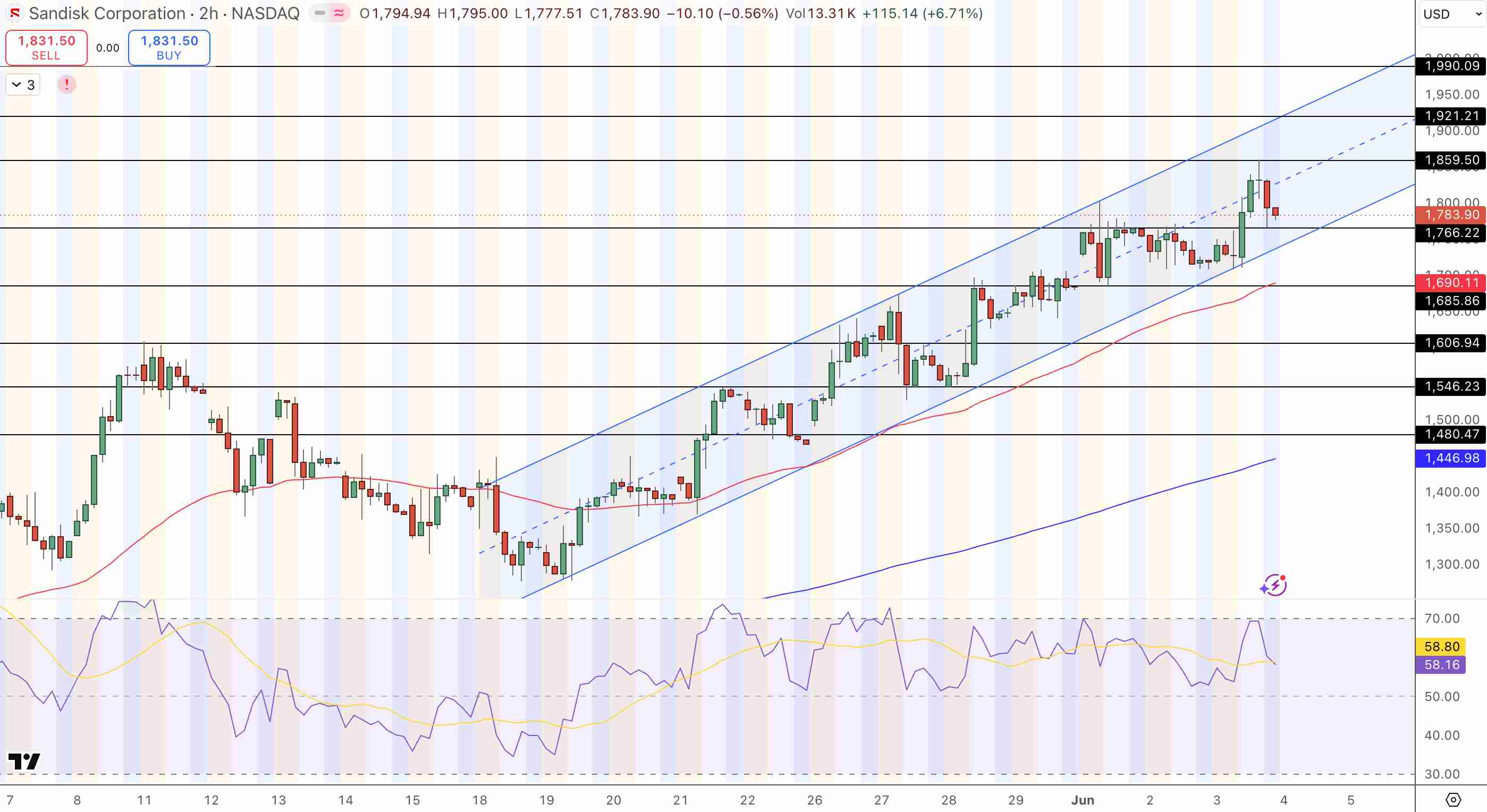
TRADE SETUP
- Entry: Long above $1,800 – near-term resistance cleared
- Target 1: $1,859 – channel extension
- Target 2: $1,921 – upper channel boundary
- Support: $1,690–$1,697 – lower channel boundary, must hold
- Stop Loss: Daily close below $1,690 – channel structure fails
Why is SanDisk trading at $1,784 now, when its price was just around $1,000 earlier in 2026?
SNDK has climbed over 600% from its 2025 bottom, driven both by a NAND supercycle and a major business model pivot. Q3 FY2026 revenues came in at $5.95 billion, up 251% year-over-year, beating expectations of $4.8 billion. Revenue for the Data Centre segment expanded 645%, and the company reported an adjusted gross margin of 78.4%. The firm has now guided Q4 revenues to between $7.75 billion and $8.25 billion.
SanDisk's chief executive, David Goeckeler, has transformed the firm from a pure spot-market NAND producer into a provider of several-year contracted supply arrangements. SanDisk now has a $42 billion backlog, providing a level of earnings visibility that has never been achieved in the history of NAND companies.
What constitutes SanDisk's backlog of $42 billion, and why is it significant?
The $42 billion backlog consists of multi-year supply contracts signed with enterprises and large "hyperscale" customers. Those customers have agreed to purchase certain quantities of AI-optimized solid state drives at given prices for many years moving forward.
The business model shift means that SanDisk no longer depends on the commodity NAND spot market, where margins may be as high as 78% one year and lower than 20% the next. Instead, it operates on a contracted-revenue model with pricing and volumes agreed upon in advance. The stock has since started to be valued as a contracted-revenue story and not as a commodity NAND story.
What is the pivotal technical level for SNDK in June of 2026?
The key technical level is the lower limit of the upward-sloping blue channel between $1,690 and $1,697. A daily close below $1,690 that remains persistent would invalidate this blue channel and indicate the need for a more protracted consolidation or even a move down to test for lower support before the uptrend can continue.
In terms of targets, a daily close above the blue channel will see the stock moving towards the $1,859 and $1,921 zones. The fourth-quarter 2026 earnings, which should be released at the end of July, is the next fundamental event that will show whether or not the $42 billion backlog is indeed able to convert to the $7.75 billion to $8.25 billion revenues forecast for fourth-quarter 2026.
Conclusion
SanDisk at $1,784 is inside a blue ascending channel with RSI neutral/bullish, no divergence on the downside, and the 50- and 100-day MAs as support zones below the current price point. The investment case, comprised of Q3 beating $5.95 billion in revenues, a $42 billion contracted backlog, Q4 guidance of $7.75 billion to $8.25 billion, and a business model change from commoditized NAND sales to AI storage contracts, is intact and getting increasingly validated as the stock sets new highs.
A break-out from the $1,800 point will target the $1,859 and $1,921 levels. A stop-loss of sorts would be the $1,690 low limit of the channel. Fourth-quarter earnings at the end of July is the next major event that might move the needle. For now, however, the two biggest factors to watch are pricing movements in the broader NAND market and any comments about hyperscalers' capex spending on AI infrastructure.
Recommended Articles


