


Is Joby Aviation Stock Your Ticket to Becoming a Millionaire?
Key Points
Joby makes electric vertical take-off and landing (eVTOL) aircraft and is in the hunt for FAA certification.
It successfully demonstrated its air taxi in New York City, the city's first ever point-to-point eVTOL flight.
The stock has potential, but plenty of unknowns, including unit economics, remain for this new field.
- 10 stocks we like better than Joby Aviation ›
If, on April 27, 2026, you were in Manhattan or thereabouts, you might have seen something odd whizzing through the cloudy skies. If you weren't prepared to see a new aircraft being tested above New York City, you might have thought it was a big drone, or some combination of helicopter and plane. If you were prepared, you would have recognized the unmistakable shape and motion of Joby Aviation's (NYSE: JOBY) air taxi.
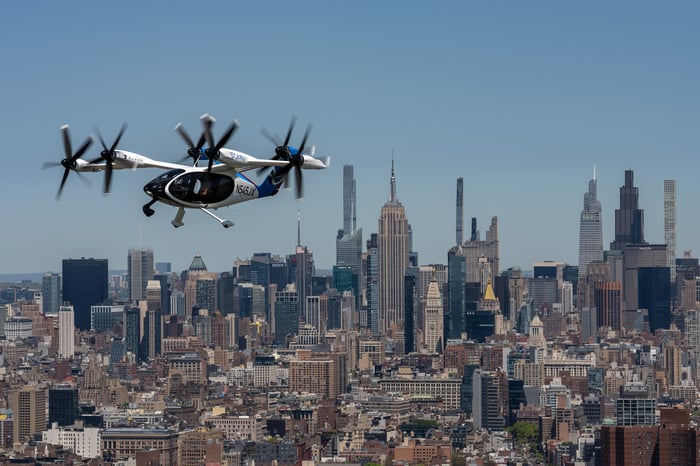
Image source: Joby Aviation.
Will AI create the world's first trillionaire? Our team just released a report on the one little-known company, called an "Indispensable Monopoly" providing the critical technology Nvidia and Intel both need. Continue »
The six-rotor aircraft -- part of a new class of craft known as electric vertical takeoff and landing (eVTOL) -- soared from John F. Kennedy airport to multiple heliports in Manhattan, marking the first-ever point-to-point eVTOL demonstration in New York City.
The craft was piloted but carried no passengers (Joby doesn't have the FAA certification for that yet). Yet for pre-commercialized Joby, the success of that demonstration pushed it closer to realizing its ambitious goal, the goal of operating air taxis on a frequent basis like an Uber Technologies of the skies.
Joby Aviation stock, although below its opening price for 2026, has lifted over 30% since its successful Manhattan test. Still trading nearly 50% below its recent 52-week high, is Joby making a comeback, and, if so, could the swing upward mint new millionaires?
Its aircraft is flying, but the business model has yet to take flight
The recent demonstration of Joby's sleek, quiet, all-electric aircraft is part of a broader push to get its eVTOLs certified by the Federal Aviation Administration (FAA), an ambition it shares with rival air taxi hopefuls like Archer Aviation. The absence of this certification, which prevents it from putting paying passengers in the air, is Joby's main obstacle today, although a heavy focus on it may obscure other challenges waiting behind the hurdle.
One of those is related to the actual cost of manufacturing eVTOLs. Although the unit economics of each aircraft are anyone's guess at this point, its components suggest a hefty upfront cost. A list of potential expenses could include, for instance, battery packs, avionics systems, electric motors and actuators, electricity, pilot wages, and insurance. That doesn't include the infrastructural costs either, like vertiports and charging stations.
It's important to keep potential operating costs in mind, because steep manufacturing expenses could erode margin and turn a promising aircraft business into one struggling to turn its first profits. It could also push the ticket prices so high that eVTOLs become more premium service, less mass transportation.
Joby's got the cash to get its operations humming, possibly enough to ramp up production pending that FAA certification. Its balance sheet at the end of March was fortified with about $2.5 billion in cash and investments. The company even managed to eke out about $24 million in revenue, helped by its Blade Air Mobility acquisition.
Today's share price of $11 to $12 a pop reflects an optimistic future for Joby, yet one riddled with uncertainty over regulatory approval, unit economics, and questionable demand for air taxi services. As such, Joby Aviation sits in that uncomfortable space between massive upside and very real potential downside. It could turn a sizable investment into a million or more, but I would continue to treat it as a high-risk, high-reward play in a capital-intensive industry.
Should you buy stock in Joby Aviation right now?
Before you buy stock in Joby Aviation, consider this:
The Motley Fool Stock Advisor analyst team just identified what they believe are the 10 best stocks for investors to buy now… and Joby Aviation wasn’t one of them. The 10 stocks that made the cut could produce monster returns in the coming years.
Consider when Netflix made this list on December 17, 2004... if you invested $1,000 at the time of our recommendation, you’d have $449,393!* Or when Nvidia made this list on April 15, 2005... if you invested $1,000 at the time of our recommendation, you’d have $1,366,006!*
Now, it’s worth noting Stock Advisor’s total average return is 983% — a market-crushing outperformance compared to 212% for the S&P 500. Don't miss the latest top 10 list, available with Stock Advisor, and join an investing community built by individual investors for individual investors.
See the 10 stocks »
*Stock Advisor returns as of June 3, 2026.
Steven Porrello has positions in Archer Aviation and Joby Aviation. The Motley Fool has positions in and recommends Uber Technologies. The Motley Fool has a disclosure policy.
Recommended Articles


