


Should You Forget the $2 Trillion SpaceX IPO and Buy This $7 Space Stock Instead?
Key Points
SpaceX is targeting a valuation of $2 trillion for its upcoming IPO.
As the SpaceX IPO looms, several space stocks have witnessed soaring share prices.
Virgin Galactic stock has jumped more than 200% in recent weeks.
- 10 stocks we like better than Virgin Galactic ›
With a targeted valuation of $2 trillion, SpaceX could become the largest IPO in history. As SpaceX's public debut inches closer, investor excitement around the space exploration economy might have just reached a fever pitch.
Among the biggest beneficiaries of space stocks in recent months is Virgin Galactic (NYSE: SPCE). Despite the company's operational struggles and persistent cash burn, Virgin Galactic's shares have gone parabolic in recent trading sessions -- rising from roughly $2 to more than $7 (as of June 1).
Will AI create the world's first trillionaire? Our team just released a report on the one little-known company, called an "Indispensable Monopoly" providing the critical technology Nvidia and Intel both need. Continue »
This disconnect between business fundamentals and price action raises important questions about market psychology and the risks that come with momentum investing.

Image source: Getty Images.
Why is Virgin Galactic stock going up?
The most plausible explanation behind Virgin Galactic's unexpected rise boils down to basic confusion. SpaceX is expected to list on the Nasdaq under the ticker symbol "SPCX." This is just one letter away from Virgin Galactic's ticker, "SPCE."
It's highly likely that some retail investors are mistakenly funneling capital into the wrong name. In fast-moving markets -- especially around high-profile events like an IPO -- mix-ups like this can easily create sharp price jolts that are unrelated to a company's underlying prospects.
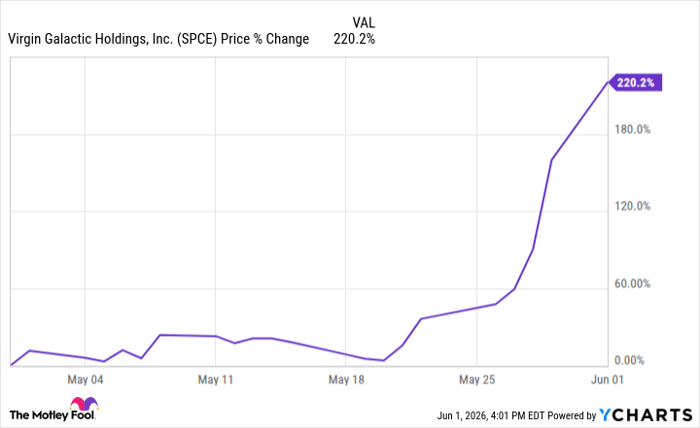
SPCE data by YCharts
Adding fuel to the fire is the popularity of meme trading. Some narratives suggest that a successful SpaceX IPO could lift stocks across the broader commercial space industry -- essentially providing a halo effect to adjacent names like Virgin Galactic.
In reality, Virgin Galactic and SpaceX operate in distinct segments. SpaceX primarily focuses on reusable orbital rockets and satellite internet connectivity, while Virgin Galactic is pursuing niche, suborbital space tourism.
Virgin Galactic is a struggling business
Make no mistake: Virgin Galactic is hemorrhaging cash as it works through the capital-intensive and technically demanding process of scaling commercial space tourism.
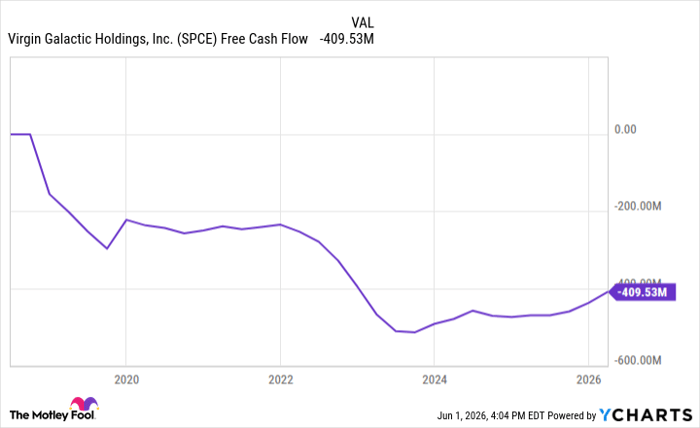
SPCE Free Cash Flow data by YCharts
Indeed, SpaceX has also posted significant operating losses in recent years. But even so, at least the company has built a respectable backlog of government contracts and demonstrated repeated technological success with Starship and Starlink. By contrast, Virgin Galactic has yet to prove it can generate consistent revenue and sustainable free cash flow.
Is Virgin Galactic stock a buy?
While momentum investing can deliver outsize short-term gains, it also comes with substantial risks. During rallies like this, stock prices are usually driven by fleeting narratives detached from intrinsic value. This setup often creates sharp reversals once enthusiasm cools down.
Investors who chase pronounced moves and ignore underlying business fundamentals almost always end up holding the bag once sentiment flips. It's important not to let emotional decision-making or the fear of missing out replace disciplined financial analysis and appropriate risk assessment.
Against this backdrop, Virgin Galactic's newfound price action is not an invitation to buy; rather, it is a cautionary example of how swiftly markets can replace concrete substance with a compelling story. Ultimately, Virgin Galactic is a stock best left to day traders rather than long-term investors focused on wealth creation and capital preservation.
Should you buy stock in Virgin Galactic right now?
Before you buy stock in Virgin Galactic, consider this:
The Motley Fool Stock Advisor analyst team just identified what they believe are the 10 best stocks for investors to buy now… and Virgin Galactic wasn’t one of them. The 10 stocks that made the cut could produce monster returns in the coming years.
Consider when Netflix made this list on December 17, 2004... if you invested $1,000 at the time of our recommendation, you’d have $449,393!* Or when Nvidia made this list on April 15, 2005... if you invested $1,000 at the time of our recommendation, you’d have $1,366,006!*
Now, it’s worth noting Stock Advisor’s total average return is 983% — a market-crushing outperformance compared to 212% for the S&P 500. Don't miss the latest top 10 list, available with Stock Advisor, and join an investing community built by individual investors for individual investors.
See the 10 stocks »
*Stock Advisor returns as of June 3, 2026.
Adam Spatacco has no position in any of the stocks mentioned. The Motley Fool has no position in any of the stocks mentioned. The Motley Fool has a disclosure policy.
Recommended Articles


