


3 Outstanding Dividend Stocks to Buy on the Dip and Hold for 10 Years
Key Points
Walmart's post-earnings drop is a buying opportunity, given its prospects and attractive dividend program.
Visa and Mastercard face some challenges, but they still have large addressable markets.
Both have increased their payouts substantially over the past 10 years.
- 10 stocks we like better than Walmart ›
Given the issues that broader equities and the economy have faced this year, it may be a particularly opportune time to consider investing in dividend stocks. Strong dividend-paying companies tend to have resilient and reliable businesses that allow them to deliver decent financial results while still paying, and, potentially, growing their payouts, even amid headwinds. With that said, let's consider three dividend stocks that look attractive right now: Walmart (NASDAQ: WMT), Visa (NYSE: V), and Mastercard (NYSE: MA). They may not be performing too well, but their prospects remain exciting. Let me explain.

Image source: Getty Images.
Will AI create the world's first trillionaire? Our team just released a report on the one little-known company, called an "Indispensable Monopoly" providing the critical technology Nvidia and Intel both need. Continue »
1. Walmart
Walmart's shares dropped after it released its first quarter 2027 results, for the period ending April 30. The company's performance was pretty strong. Revenue grew by a healthy 7.3% year over year to $177.8 billion. The retail giant's adjusted earnings per share climbed 8.2% year over year to $0.66.
Why, then, did Walmart's stock drop? The company's second-quarter guidance came in below analyst estimates. On the one hand, that is not that surprising. Between rising oil prices and fears of a recession, many consumers will likely tighten their purse strings. Meanwhile, Walmart stock trades at 39.7x forward earnings even after the decline.
For a stock this expensive -- the average forward price-to-earnings ratio of consumer staples stocks is 22.2 -- expectations are high, and any perceived issue is often met with a brutal sell-off. That's what we saw after Walmart's earnings release.
That said, the stock remains a highly attractive pick for long-term investors. Here are three reasons why. First, even though it will go through a challenging period, Walmart is likely to navigate them better than most of its peers in the retail industry. Walmart tends to offer competitive prices, both in-store and on its e-commerce platform. This is one of the company's key competitive advantages.
Second, Walmart's e-commerce business offers the company attractive long-term opportunities, especially as retail commerce continues to shift to online channels. Walmart is one of the leading e-commerce players in the U.S. Sales in this division continue to grow much faster than the rest of the business. In its latest period, e-commerce sales climbed 26% year over year.
Beyond the fact that e-commerce tends to carry higher margins than the brick-and-mortar model, Walmart's e-commerce segment could also help it ramp up other high-margin opportunities, notably advertising and third-party seller services. That could lead to stronger profits and margins down the line. Third, Walmart has a phenomenal dividend track record. The company is a Dividend King. That's a corporation with 50 (or more) consecutive annual payout raises.
Walmart's streak isn't at risk even in the current environment. And in the long run, it could deliver superior returns, especially with the dividend reinvested.
Visa and Mastercard
Visa and Mastercard have a bit of a duopoly. Both companies process debit and credit card transactions through their payment networks, a niche with few direct competitors. However, they have encountered headwinds in recent years, including increased regulatory scrutiny, which, some investors fear, makes their prospects somewhat uncertain. Visa's shares are down 11% over the past 12 months, while Mastercard's have declined 14%.
Despite their challenges, they remain solid long-term holdings due to their significant competitive advantage. Mastercard and Visa built a duopoly from network effects: The value of their ecosystems increases with use. Consider Visa, the bigger of the two (in terms of total debit and credit cards in circulation).
There are millions of cards worldwide bearing Visa's logo. It's only natural for merchants to accept it as a payment method; otherwise, they would almost certainly lose some business. And the more merchants accept Visa, the more attractive it is to consumers. Newcomers in the field with smaller merchant and consumer ecosystems can hardly compete. This dynamic explains why it's difficult to break the duopoly.
Further, both companies have significant growth runways. Visa might be the larger of the two, but Mastercard has greater exposure to less developed markets where credit card penetration tends to be lower. That means higher risk, but also, arguably, higher upside potential. Visa and Mastercard could also benefit from the ongoing switch to e-commerce. Their total addressable market is over $11 trillion, which is miles above their combined annual revenue. Lastly, both have increased their dividend substantially over the past decade.
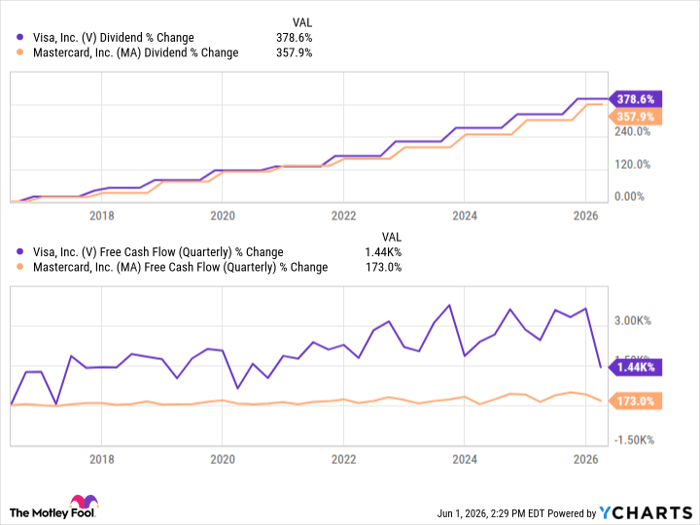
V Dividend data by YCharts
They generate significant and growing free cash flow that can help them maintain their dividend programs intact. That, combined with their growth opportunities, makes them top stocks to hold through the next 10 years (and beyond).
Should you buy stock in Walmart right now?
Before you buy stock in Walmart, consider this:
The Motley Fool Stock Advisor analyst team just identified what they believe are the 10 best stocks for investors to buy now… and Walmart wasn’t one of them. The 10 stocks that made the cut could produce monster returns in the coming years.
Consider when Netflix made this list on December 17, 2004... if you invested $1,000 at the time of our recommendation, you’d have $462,983!* Or when Nvidia made this list on April 15, 2005... if you invested $1,000 at the time of our recommendation, you’d have $1,375,447!*
Now, it’s worth noting Stock Advisor’s total average return is 995% — a market-crushing outperformance compared to 212% for the S&P 500. Don't miss the latest top 10 list, available with Stock Advisor, and join an investing community built by individual investors for individual investors.
See the 10 stocks »
*Stock Advisor returns as of June 3, 2026.
Prosper Junior Bakiny has positions in Mastercard, Visa, and Walmart. The Motley Fool has positions in and recommends Mastercard, Visa, and Walmart. The Motley Fool has a disclosure policy.
Recommended Articles


