


Better Memory Chip Stock: Sandisk vs. Micron
Key Points
Each operates in the memory industry, but with different types of exposure.
Both companies are rapidly growing, bolstered by huge demand.
Based on fiscal 2027 projections, their valuations look quite similar.
- 10 stocks we like better than Sandisk ›
Memory chips are a major market opportunity right now. There is huge demand and little supply, so the price of memory chips is soaring. That allows memory chip producers like Sandisk (NASDAQ: SNDK) and Micron Technology (NASDAQ: MU) to cash in on the rise, and both of them have done just that -- and then some.
But which is the better stock to buy today? Let's take a look.
Will AI create the world's first trillionaire? Our team just released a report on the one little-known company, called an "Indispensable Monopoly" providing the critical technology Nvidia and Intel both need. Continue »

Image source: Getty Images.
Micron is the more leveraged company
Micron is entirely focused on producing memory chips. It has products ranging from memory used in PCs to high-bandwidth memory used in data centers. While data centers mostly use NAND flash memory for larger storage, consumer products and GPUs tend to use DRAM memory. The DRAM memory market is a bit more volatile than NAND, but they both display cyclicality. However, the DRAM market is in a far greater supply crunch.
Sandisk is only focused on NAND memory. This still makes it more exposed to data centers, although it isn't as affected by soaring DRAM prices, which can also easily crash if the supply crunch ends. This makes Micron more leveraged to the current soaring DRAM prices, but makes Sandisk a bit less volatile. It's up to the investor to decide whether they want ultimate upside or a bit less volatility, but I think the majority will elect for less volatility.
Winner: Sandisk
Both companies are seeing strong growth
Both companies saw major demand for their products last quarter.
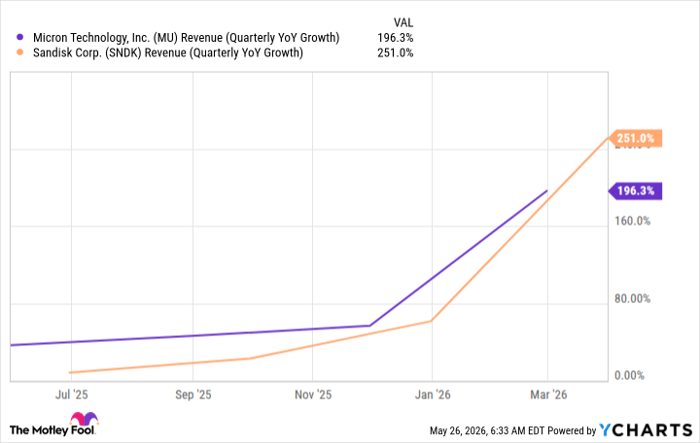
MU Revenue (Quarterly YoY Growth) data by YCharts
It's hard to complain about either company tripling its revenue, so calling a winner here is impossible. For Sandisk, analysts expect about 330% revenue growth over the next two quarters and 117% growth for fiscal 2027, ending in June 2027. For Micron, analysts expect about 250% to 260% growth over the next two quarters and 57% growth expected in fiscal 2027, ending August 2027.
That gives the growth edge to Sandisk, even though Micron's results aren't too shabby, either.
Winner: Sandisk
Micron appears to be cheaper
The evaluation part of this analysis is difficult. As mentioned above, Micron is more leveraged to DRAM memory, which is far more cyclical than NAND memory. As a result, the market doesn't assign a full valuation premium to Micron's stock. While NAND memory is cyclical, it doesn't display quite as volatile price movements as DRAM, so its valuation is a bit more akin to other tech stocks.
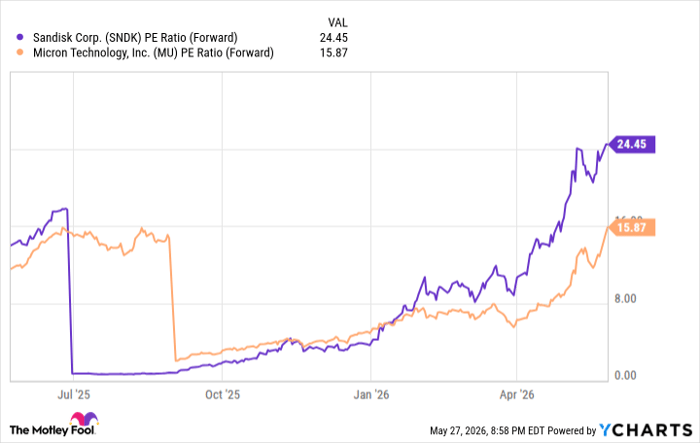
SNDK PE Ratio (Forward) data by YCharts
The question is, what is a fair valuation for each company? The market is having a difficult time answering that question as well, because there have been volatile price movements in both stocks. If we look at fiscal 2027 projections, the disparity between the two companies disappears again.
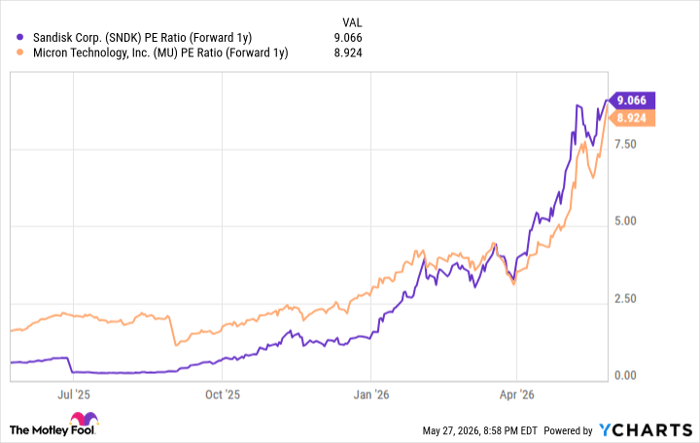
SNDK PE Ratio (Forward 1y) data by YCharts
This reflects Sandisk's faster growth projections, which make it the superior stock to own.
Winner: Sandisk
Sandisk ran away with this one
It all boils down to which company will be more affected when supply catches up to demand. This could happen as soon as next year for Micron, which won't bode well for its long-term growth rate. Sandisk is in much better shape and is expected to grow faster, so it gets the nod as the better investment.
With data center expenditures expected to rise again in the next year and throughout the end of the decade, Sandisk makes for a solid stock pick now, even after its initial run.
Should you buy stock in Sandisk right now?
Before you buy stock in Sandisk, consider this:
The Motley Fool Stock Advisor analyst team just identified what they believe are the 10 best stocks for investors to buy now… and Sandisk wasn’t one of them. The 10 stocks that made the cut could produce monster returns in the coming years.
Consider when Netflix made this list on December 17, 2004... if you invested $1,000 at the time of our recommendation, you’d have $463,900!* Or when Nvidia made this list on April 15, 2005... if you invested $1,000 at the time of our recommendation, you’d have $1,294,401!*
Now, it’s worth noting Stock Advisor’s total average return is 978% — a market-crushing outperformance compared to 211% for the S&P 500. Don't miss the latest top 10 list, available with Stock Advisor, and join an investing community built by individual investors for individual investors.
See the 10 stocks »
*Stock Advisor returns as of June 1, 2026.
Keithen Drury has no position in any of the stocks mentioned. The Motley Fool has positions in and recommends Micron Technology. The Motley Fool has a disclosure policy.
Recommended Articles


