


This Super Software Stock Has Almost Doubled Since I Bought It in April. Here's Why It Has Room to Run.
Key Points
Atlassian stock slumped to as low as $57 in April, but it has since almost doubled.
The company is squashing concerns that artificial intelligence (AI) is a threat to its business.
Atlassian stock still has plenty of room to run based on its current valuation.
- 10 stocks we like better than Atlassian ›
Atlassian (NASDAQ: TEAM) developed a suite of software products designed to foster collaboration and productivity for its enterprise customers. There is Jira, which helps software development teams manage their projects, and then there is Confluence, which is a digital town square where employees can discuss work and share operational updates.
Atlassian stock was trading at over $300 at the beginning of 2025, until Wall Street formed the view that artificial intelligence (AI) was about to decimate the software industry. As a result, by April this year, the stock had fallen to as low as $57.
Will AI create the world's first trillionaire? Our team just released a report on the one little-known company, called an "Indispensable Monopoly" providing the critical technology Nvidia and Intel both need. Continue »
That's when I got interested, and I added it to my portfolio at around $58. I don't have a crystal ball; I simply felt Wall Street was overreacting to the potential threat of AI, especially because Atlassian was successfully using it to make more money. The stock has since rocketed 83% higher and closed at $107 on Friday, May 29. Here's why I think significantly more upside is ahead.

Image source: Getty Images.
AI is actually helping Atlassian's business
Wall Street thought AI was a threat to software companies for two reasons. First, analysts thought tools such as Anthropic's Claude Code would allow businesses to develop their own versions of products such as Jira and Confluence, making companies like Atlassian redundant. Second, if AI resulted in widespread job losses, the Street felt software companies with seat-based revenue models would lose a chunk of their income.
To counter the first issue, Atlassian doesn't just sell software. It provides the security, infrastructure, and technical support required to deploy Jira and Confluence successfully. These things cost a ton of money to set up and maintain, which is only profitable at scale. In other words, the average business might be able to clone Jira and Confluence using an AI coding assistant, but preventing data breaches and maintaining uptime is a whole other challenge.
Plus, Atlassian developed its own AI platform called Rovo, which comes with an entire suite of features to enhance the capabilities of Jira and Confluence. It includes an advanced search tool that can instantly locate information from across the organization, even if it isn't stored within the Atlassian ecosystem. Rovo can also serve as a coding assistant to help software developers accelerate their workflows, which is the ultimate addition to a product like Jira.
More than 350,000 businesses worldwide use Atlassian, so the company has a treasure trove of data with which to improve its AI models. This advantage makes Rovo more useful than most generic AI assistants, which further entrenches the Atlassian software ecosystem deeper into each organization.
Now, on to Wall Street's second concern.
A surprise acceleration in revenue growth
Atlassian generated $1.8 billion in total revenue during its fiscal 2026 third quarter (ended March 31), which blew away Wall Street's estimate of $1.7 billion. It was a 32% increase from the year-ago period, marking a sharp acceleration from the 23% growth the company delivered three months earlier in the second quarter. That alone squashed concerns that AI was causing a loss in revenue for software companies.
In fact, Atlassian said annual recurring revenue (ARR) from Rovo customers grew at twice the pace of ARR from non-Rovo customers. So, again, AI is proving to be a massive tailwind for this company, not a threat.
To ease concerns even further, Atlassian launched a new pricing option for customers on May 6. It's called Flex, and it allows enterprises to set a budget they can allocate to any Atlassian products during their contract period, without having to negotiate new terms. The company calls it a value-based pricing model, because customers are paying based on what they use, not how many seats, or users, they might have within a specific time frame.
Flex will make it significantly easier for new customers to get up and running with Atlassian, which could drive further momentum at the top line. Cybersecurity giant CrowdStrike launched a similar flexible subscription option in 2023, and it continues to fuel an acceleration in the company's revenue growth to this day.
Why Atlassian still has room to run
Despite the blistering gains in Atlassian stock since April, it's still trading at a price-to-sales (P/S) ratio of just 4.5 -- far below its three-year average of 10.7, and even further below last year's peak of 17.5.
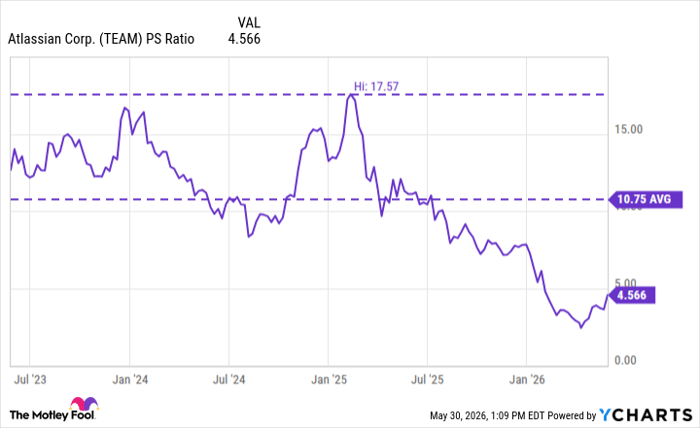
TEAM PS Ratio data by YCharts
Atlassian stock would have to soar by 137% from last Friday's close just to match its three-year average P/S ratio, which I think is entirely possible considering the company's accelerating revenue growth. That would result in a stock price of $255.
But I intend to hold the stock beyond that point, because I think the company is entering an era of faster growth and innovation as it capitalizes on the AI opportunity over the next few years.
Should you buy stock in Atlassian right now?
Before you buy stock in Atlassian, consider this:
The Motley Fool Stock Advisor analyst team just identified what they believe are the 10 best stocks for investors to buy now… and Atlassian wasn’t one of them. The 10 stocks that made the cut could produce monster returns in the coming years.
Consider when Netflix made this list on December 17, 2004... if you invested $1,000 at the time of our recommendation, you’d have $463,900!* Or when Nvidia made this list on April 15, 2005... if you invested $1,000 at the time of our recommendation, you’d have $1,294,401!*
Now, it’s worth noting Stock Advisor’s total average return is 978% — a market-crushing outperformance compared to 211% for the S&P 500. Don't miss the latest top 10 list, available with Stock Advisor, and join an investing community built by individual investors for individual investors.
See the 10 stocks »
*Stock Advisor returns as of June 1, 2026.
Anthony Di Pizio has positions in Atlassian. The Motley Fool has positions in and recommends Atlassian and CrowdStrike. The Motley Fool has a disclosure policy.
Recommended Articles


