


Surprise! This Company, Already Set to Make History, May Be Next to Join the Trillion-Dollar Club.
Key Points
Today’s biggest technology companies have progressively reached beyond $1 trillion in market value in recent years.
They include a selection of profitable, well-established businesses.
- 10 stocks we like better than Nvidia ›
Many of the tech giants that have become household names -- from Amazon to Nvidia -- are members of the trillion-dollar club. This isn't a real club with membership features and dues, but instead a group of market giants that are each worth more than $1 trillion. Micron Technology was the latest to enter just days ago.
The question is always: Which player will be next? Surprise! It could be a company that isn't even publicly traded yet. I'm talking about Elon Musk's SpaceX, which is planning on an initial public offering in a few weeks. The rocket launch giant is aiming for a valuation of nearly $2 trillion -- and if that takes shape, it will make history as the biggest IPO ever.
Will AI create the world's first trillionaire? Our team just released a report on the one little-known company, called an "Indispensable Monopoly" providing the critical technology Nvidia and Intel both need. Continue »
Let's take a closer look at this exciting tech and industrial giant that may be next to join the trillion-dollar club.

Image source: Getty Images.
The early days of the trillion-dollar club
So, first, a quick note about the trillion-dollar environment in general and the importance of valuation. Through the early days of 2018, today's tech giants each had a market value of less than $1 trillion -- Apple became the first trillion-dollar company, at least for a moment, when it reached beyond that level during one trading session later that year.
Progressively, as of 2020, other tech giants now known as the Magnificent Seven reached $1 trillion in market cap, and since that time, each one has surpassed that level -- in fact, Nvidia became the first $4 trillion company last year and today tops $5 trillion as the world's biggest company.
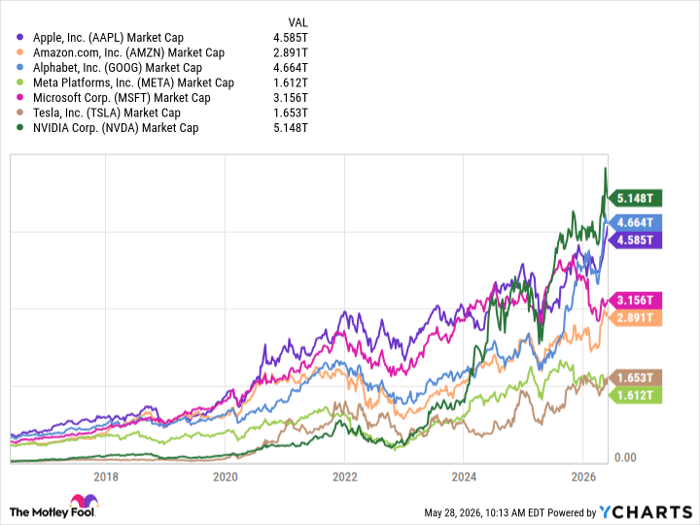
AAPL Market Cap data by YCharts
Should you rush to buy shares of a company that's just reached $1 trillion in market value? Not necessarily. This doesn't mean the stock will continue to rise and offer you a great return. That said, today's trillion-dollar companies have one thing in common: They've built their successes over time and established strong, profitable businesses. For that reason, each one of these players may be a good stock to buy and hold.
A company such as SpaceX, though an interesting buy for aggressive investors who can handle some risk, differs from today's trillion-dollar club members because it's still in its early growth stages. SpaceX might launch with a valuation close to $2 trillion, but many challenges lie ahead -- and they could determine whether the company actually maintains such a valuation and grows.
SpaceX's businesses
SpaceX, which includes a rocket launch business, a satellite internet service, and an AI business, isn't profitable right now -- and actually is burning through a lot of cash to build out its AI capabilities. Capital expenditures for the AI arm totaled more than $12 billion last year, and SpaceX reported a net loss of about $4.9 billion. It's also important to note that SpaceX's other businesses are pretty capital-intensive too. In the quarter, capex for the space and connectivity units topped $3 billion and $4 billion, respectively, and this spending for each has been on the rise over the past three years.
Meanwhile, the company is delivering significant growth, with annual revenue soaring to $18 billion from $10 billion in 2023. And if SpaceX reaches even some of its goals -- for example, reusable rocket Starship launching payload delivery in the second half of this year -- the company could deliver significant growth over time.
So what does this mean for you as an investor? While investors may look at today's trillion-dollar stocks as long-established players that may suit a variety of portfolios, SpaceX falls into a different category. It's an exciting company and may represent a fantastic opportunity for aggressive investors. But it isn't necessarily the best choice for all investors. Its success depends on reaching various goals, many of which depend on new technology, and to reach these goals, SpaceX must invest considerably.
All of this means this company -- which may be next to join the trillion-dollar club upon its IPO -- may be best suited to the most aggressive of growth investors.
Should you buy stock in Nvidia right now?
Before you buy stock in Nvidia, consider this:
The Motley Fool Stock Advisor analyst team just identified what they believe are the 10 best stocks for investors to buy now… and Nvidia wasn’t one of them. The 10 stocks that made the cut could produce monster returns in the coming years.
Consider when Netflix made this list on December 17, 2004... if you invested $1,000 at the time of our recommendation, you’d have $463,900!* Or when Nvidia made this list on April 15, 2005... if you invested $1,000 at the time of our recommendation, you’d have $1,294,401!*
Now, it’s worth noting Stock Advisor’s total average return is 978% — a market-crushing outperformance compared to 211% for the S&P 500. Don't miss the latest top 10 list, available with Stock Advisor, and join an investing community built by individual investors for individual investors.
See the 10 stocks »
*Stock Advisor returns as of May 31, 2026.
Adria Cimino has positions in Amazon and Tesla. The Motley Fool has positions in and recommends Alphabet, Amazon, Apple, Meta Platforms, Micron Technology, Microsoft, Nvidia, and Tesla. The Motley Fool has a disclosure policy.
Recommended Articles


