


Arm vs. Qualcomm: Consistent Growth vs. Revenue Volatility
Key Points
Qualcomm is the larger business by revenue, but Arm shows a more consistent growth trajectory.
Over the last eight quarters, Qualcomm has experienced wide quarter-over-quarter fluctuations in growth, while Arm has generally reported higher quarterly growth rates.
Investors should watch if Qualcomm's AI strategy accelerates its growth over the next few years.
- 10 stocks we like better than Arm Holdings ›
Arm Holdings (NASDAQ:ARM) and Qualcomm (NASDAQ:QCOM) are two established chip companies with more opportunities opening up due to artificial intelligence (AI). Everything from cars to consumer devices will be transformed by this technology, driving growing demand for chips.
While Arm has grown its revenue at higher rates over the past few years, Qualcomm is worth watching as it shifts its business to tackle the huge opportunity opening up in consumer devices.
Arm: Steady Upward Revenue Momentum
Arm architects, develops, and licenses central processing units (CPUs) products and related foundational technologies for original equipment manufacturers globally.
In the first quarter of 2026, revenue grew 20% year over year. Its business model is centered on licensing and royalties from its chip designs, resulting in a healthy 21% net income margin for the quarter.
Qualcomm: Managing High Revenue Fluctuations
Qualcomm develops and commercializes foundational wireless technologies, providing integrated circuits and system software for global communications networks.
Revenue growth has been slowing over the past year, and fell 3.5% year over year in the first quarter. This comes amid a strategic shift away from the handset market to pursue better prospects in automotive, the Internet of Things, and data center segments. It reported a net income margin of nearly 70% for the quarter.
Why Revenue Matters for Retail Investors
Revenue is the most fundamental measure of a company’s performance. Changes over time can give investors insights into a business’s competitive position and growth potential.
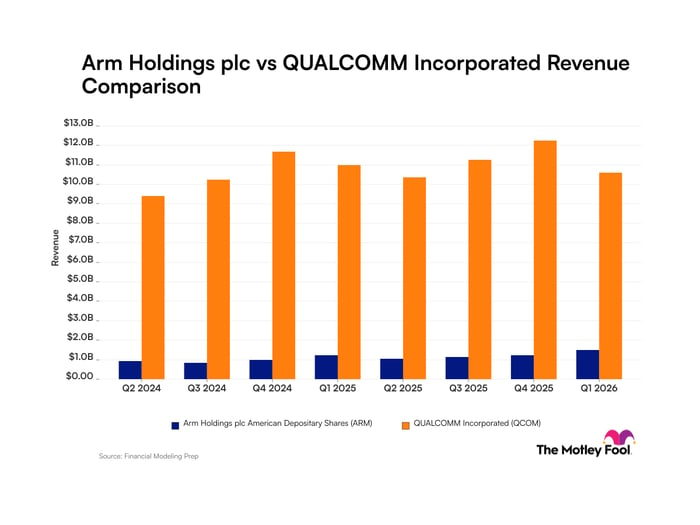
Image source: The Motley Fool.
Quarterly Revenue for Arm and Qualcomm
| Quarter (Period End) | Arm Revenue | Qualcomm Revenue |
|---|---|---|
| Q2 2024 | $939.0 million (period ended June 2024) | $9.4 billion (period ended June 2024) |
| Q3 2024 | $844.0 million (period ending Sept. 2024) | $10.2 billion (period ending Sept. 2024) |
| Q4 2024 | $983.0 million (period ended Dec. 2024) | $11.7 billion (period ended Dec. 2024) |
| Q1 2025 | $1.2 billion (period ended March 2025) | $11.0 billion (period ended March 2025) |
| Q2 2025 | $1.1 billion (period ended June 2025) | $10.4 billion (period ended June 2025) |
| Q3 2025 | $1.1 billion (period ended Sept. 2025) | $11.3 billion (period ended Sept. 2025) |
| Q4 2025 | $1.2 billion (period ended Dec. 2025) | $12.3 billion (period ended Dec. 2025) |
| Q1 2026 | $1.5 billion (period ended March 2026) | $10.6 billion (period ended March 2026) |
Data source: Company filings. Data as of May 28, 2026.
Foolish Take
Comparing revenue growth between two companies in the same industry, in this case, semiconductors, can usually point investors to the better investment. It’s no surprise that Arm stock has significantly outperformed Qualcomm over the past three years, rising almost 600% compared to Qualcomm’s roughly 123% return.
Qualcomm is a profitable company with a long history of delivering growth. Still, Arm is seeing its chip designs used in several markets, including automotive, which are becoming increasingly computerized.
Arm is positioned to benefit from the growth in AI agents, where CPUs are in high demand. Meanwhile, Qualcomm is currently transitioning its lineup to focus on the opportunities in data centers and AI-powered consumer devices, including smart glasses, which it believes could become as widely adopted as smartphones.
Given Qualcomm’s strategic shift underway, it will be worth watching to see whether it can accelerate revenue growth over the next few years, or if Arm continues to grow faster and narrows the revenue gap.
Should you buy stock in Arm Holdings right now?
Before you buy stock in Arm Holdings, consider this:
The Motley Fool Stock Advisor analyst team just identified what they believe are the 10 best stocks for investors to buy now… and Arm Holdings wasn’t one of them. The 10 stocks that made the cut could produce monster returns in the coming years.
Consider when Netflix made this list on December 17, 2004... if you invested $1,000 at the time of our recommendation, you’d have $463,900!* Or when Nvidia made this list on April 15, 2005... if you invested $1,000 at the time of our recommendation, you’d have $1,294,401!*
Now, it’s worth noting Stock Advisor’s total average return is 978% — a market-crushing outperformance compared to 211% for the S&P 500. Don't miss the latest top 10 list, available with Stock Advisor, and join an investing community built by individual investors for individual investors.
See the 10 stocks »
*Stock Advisor returns as of May 30, 2026.
John Ballard has no position in any of the stocks mentioned. The Motley Fool has positions in and recommends Qualcomm. The Motley Fool has a disclosure policy.
Recommended Articles


