


The AI Play Nobody Saw Coming -- and It Comes With a Lucrative Dividend
Key Points
Ford's stock has had a rare surge this month as Wall Street is waking up to its AI play.
Ford Energy is targeting at least 20 gigawatt-hours of annual production capacity.
Ford Energy could yield roughly $3 billion in incremental revenue for the automaker.
- 10 stocks we like better than Ford Motor Company ›
Once considered the land of the dinosaurs, where capital went to wither away, the automotive industry is quickly evolving to be anything but. Automakers such as Tesla drove the industry toward mainstream electric vehicle (EV) adoption. Software-defined vehicles are becoming a trend, and we've heard endless hype surrounding driverless vehicles and robotaxi ambitions.
Along with all that, Ford Motor Company (NYSE: F) is the newest way to play the boom in artificial intelligence (AI), and it even comes with a hefty dividend to boot.
Will AI create the world's first trillionaire? Our team just released a report on the one little-known company, called an "Indispensable Monopoly" providing the critical technology Nvidia and Intel both need. Continue »
Wait. Ford and AI?
Last Friday seemed to be a bit of a wake-up call for Wall Street as Ford's shares jumped nearly 10%, testing its highest close since August 2022. Most of Ford's recent surge can be traced back to the company's Ford Energy business announcement, which is increasingly being seen and valued as a power generation and AI infrastructure play.
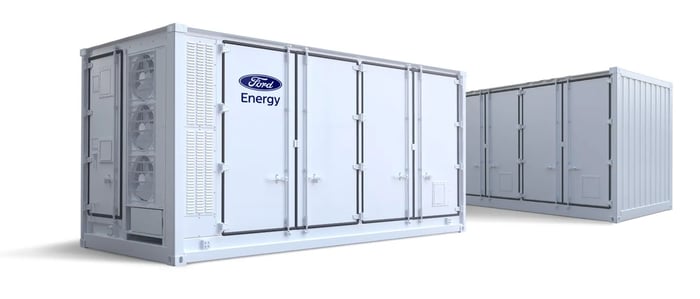
Image source: Ford Motor Company, Ford Energy.
For almost a year, Ford has operated nearly silently, building out supply chains and manufacturing sites and preparing to meet growing domestic demand for energy storage. Ford Energy operations cover the full battery cell manufacturing process, including the production of electrode coils, as well as module and container assembly, and sales and service.
That led Ford Energy to debut its flagship product, the Ford Energy DC block -- a standardized 20-foot containerized battery energy storage system. Ford Energy has prepared its flagship product to meet the metrics that are critical to customers: a predictable 20-year lifetime performance, ease of service, and thermal stability.
If this seems out of left field for some investors, remember that the rapid acceleration in AI requires massive amounts of power and has nearly zero tolerance for downtime. Massive data centers rely on Tesla Megapacks, or perhaps one day Ford Energy, or similar solutions for uninterrupted backup power and to handle grid spikes.
Even Tesla's in-house AI operations, such as the enormous compute clusters built at Giga Texas, can be powered directly by Tesla Megapacks. Using AI companies and commercial sites can essentially flip the switch from being energy drains to something closer to profit centers, buying and storing power when it's cheap and turning supplier when the price is right.
That's all well and good, but what's in it for investors?
Ford Energy has higher margins
Ford Energy is targeting at least 20 gigawatt-hours (GWh) of annual production capacity, which analysts have contended could yield roughly $3 billion in incremental revenue. As for the bottom line, when operating at a targeted 25% gross margin, Ford Energy is expected to be profitable on an EBIT basis before 2028.
But wait, there's more. One of the underlying strategies with Ford Energy is its ability to drive margin through federal manufacturing subsidies by producing U.S.-made cells. Doing so will enable Ford to recapture roughly $45 per kWh, helping to offset production costs. Further, along with Ford Pro's subscription services that also boast high margins, it should help the more than century-old automaker unlock better valuations from Wall Street.
What it all means for Ford investors
Ford Energy seems like a brilliant idea, almost a no-brainer, for both the automaker and its investors. For investors, you're getting an automaker on the brink of unlocking better valuations through its work on higher-margin Ford Pro subscription services, new revenue streams, and bottom-line potential through Ford Energy, among other developments.
Another bonus for investors is that while waiting for Ford Energy to impact the bottom line and/or valuations, the Detroit icon also offers a juicy 4% dividend yield in the meantime. Further, Ford often distributes special dividends when cash flow is better than expected, making its dividend even more lucrative than it appears on paper. Ford Energy is the latest way the automaker is trying to unlock growth, valuation, and higher margins. Investors would be wise to keep an eye on this development.
Should you buy stock in Ford Motor Company right now?
Before you buy stock in Ford Motor Company, consider this:
The Motley Fool Stock Advisor analyst team just identified what they believe are the 10 best stocks for investors to buy now… and Ford Motor Company wasn’t one of them. The 10 stocks that made the cut could produce monster returns in the coming years.
Consider when Netflix made this list on December 17, 2004... if you invested $1,000 at the time of our recommendation, you’d have $465,733!* Or when Nvidia made this list on April 15, 2005... if you invested $1,000 at the time of our recommendation, you’d have $1,313,467!*
Now, it’s worth noting Stock Advisor’s total average return is 985% — a market-crushing outperformance compared to 211% for the S&P 500. Don't miss the latest top 10 list, available with Stock Advisor, and join an investing community built by individual investors for individual investors.
See the 10 stocks »
*Stock Advisor returns as of May 29, 2026.
Daniel Miller has positions in Ford Motor Company. The Motley Fool has positions in and recommends Tesla. The Motley Fool has a disclosure policy.
Recommended Articles


