


Snowflake Soars 36% After Stellar Q1 FY2027 Earnings - Is It Time to Buy SNOW at $239?
TradingKey - Snowflake Q1 FY2027: $1.05B revenue +29% YoY, product revenue +31%, RPO +28% to $4.8B. 36% breakout above multi-month descending trendline. SNOW at $239. Target $261–$280.
Shares of Snowflake (NYSE: SNOW) rocketed 36% on May 29 after the company’s first-quarter fiscal 2027 earnings shattered every single expectation. Revenue came in at $1.05 billion, up 29% from a year ago. Product revenue, the crucial consumption number, climbed 31%. Remaining performance obligations jumped 28% to $4.8 billion, and adjusted operating income reached $68 million as operating margins continued their upward trajectory. The result? Chief Executive Sridhar Ramaswamy noted that AI-driven workloads now represent a growing and faster-growing proportion of the platform’s total consumption.
SNOW is no longer just moving; it has decisively pierced the multi-month downward-sloping blue trendline that had started from the 280.33 high with a large bullish engulfing candle, and a surge in trading volume. SNOW erased its 220-204 resistance area all at once with one trade. 2025-2026’s downward trend structure in SNOW has ended.
First Quarter Results Fiscal 2027: The 36% Upside Rally, And Why This Won’t Be A Brief Rebound
The numbers announced first quarter have ended a long time of analyst frustrations over both slowing growth and deteriorating margins. The important number for SNOW is the 31% growth for product revenue, the consumption-based metric measuring actual platform usage as opposed to contract signings. Consumption growth is extremely difficult to fake. It is generated from workloads executed by end users. This figure of 31% indicates that SNOW is winning not only contracts but is winning actual enterprise usage of its data and AI capabilities. CEO Sridhar Ramaswamy, who assumed command of Frank Slootman in early 2024, has transformed the product roadmap to include Cortex AI and the Iceberg open table, and the acceleration of consumption in the first quarter is proof that the new approach is actually yielding results.
The $4.8 billion remaining performance obligations, up 28%, are the measure of future revenue on SNOW’s balance sheet. It is the revenue that has been booked but not yet recognized: the contracted amounts due for the coming 12 to 24 months in the future. 28% of growth of RPO in conjunction with 31% of growth in product revenue means both present consumption as well as the future order backlog are in a growth pattern. It is exactly that dual growth dynamic that separates an initial earnings beat from a genuine change in the stock’s long-term valuation. The $68 million of adjusted operating income may not seem like much when you consider it in isolation, but it does provide assurance that the company is able to maintain the margin expansion as growth accelerates, resolving the trade-off between growth and profit that has been weighing down the SNOW shares for the past two years.
The AI investment cycle is all about the compute: GPU chips from Nvidia, the server rooms at the major cloud providers, the communications infrastructure. There’s the part that has gotten less attention: the data. The infrastructure that’s the key to any enterprise-scale LLM or generative AI deployment is the governed, queryable, real-time data repository. Snowflake Data Cloud serves that need for thousands of global top enterprises. The platform’s cross-cloud operation, a capability that operates equally on AWS, Azure, or Google Cloud without vendor lock-in, makes it the go-to choice for the multi-cloud setup. The most large companies utilize a multi-cloud deployment model. Snowflake’s Cortex AI capability set makes this possible: allowing companies to deploy AI applications directly against a governed data store in the Snowflake platform. This is not about moving data into an AI pipeline outside the company and then processing it. This keeps data within the governed boundary. It is fast. It doesn’t cost you extra when you try to do it at scale. Sridhar Ramaswamy rebuilt Snowflake’s product to incorporate both Cortex AI plus Iceberg, the new open table standard for allowing Snowflake data to be queried by other engines without having to move the data out entirely. These two changes address two of Snowflake’s most common criticisms: the system was too expensive and too proprietary. The acceleration in consumption growth during first quarter indicates the criticisms have been effectively countered.
The Snow 36% Rally Above A Declining Trendline: The Price Targets Of $261 And $280.
On a daily chart, SNOW has delivered a large bullish engulfing candle along with heavy volume to close off the multi-month downward-sloping trendline originating from the $280.33 highs and to clear off the entire resistance region from 220.26 to 204.31. SNOW’s breakout from 184.69, the floor of the channel, all the way to 239.20, is a structural trend change, not a short-term rebound. We’ve seen the RSI enter an overbought region on SNOW, which is normal after a 36% up day.
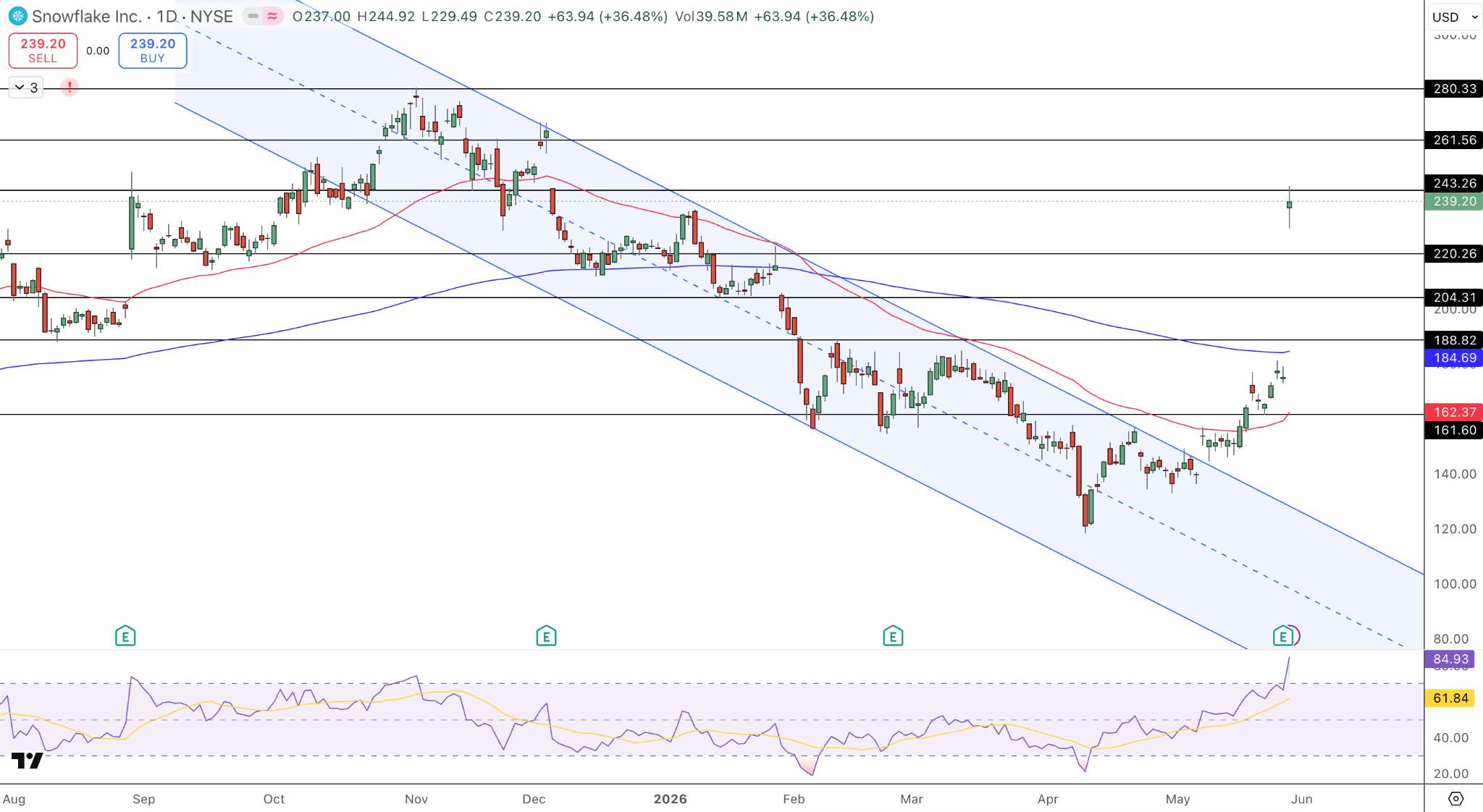
SNOW Price Chart - Source: Tradingview
After a trendline breakout of this size, however, overbought RSI is actually a signal of a trend that will continue rather than a trend that will stop: we saw the same RSI pattern when Intel, IBM, and Palantir hit their major trendline breakouts at the same period this year. All moving averages are still trading below SNOW, which supports the continuation of the upside. First, we’ll head for 261.56, and then for the starting point of the descending trendline at $280.33.
Trade Setup:
- Entry: Buy above $243.26.
- Target 1: $261.56.
- Target 2: $280.33.
- Stop loss: The close of the day is below $220.26.
Why Did Snowflake Stock Surge 36% On May 29?
SNOW jumped 36% on May 29 following a quarter that blew past expectations on every count. Revenue topped $1.05 billion, up 29% year over year; product revenue accelerated 31%; RPO expanded 28% to $4.8 billion; and non-GAAP operating income reached $68 million, with margins continuing to widen. CEO Sridhar Ramaswamy pointed to rising AI-driven workloads as a growing portion of consumption on Snowflake's platform. Accelerating consumption growth and rising RPO at once signalled current momentum and pipeline health, sparking a breakout of a trendline that had been developing since the $184.69 lows.
What Does Snowflake Do And How Is It An AI Play?
Snowflake's Data Cloud is a cloud-neutral platform that functions identically on AWS, Azure, and Google Cloud. It serves as the governed data platform of the enterprise in which customers can store, query, and share data with their organization. For AI, Snowflake's Cortex AI layer enables enterprises to build and deploy their applications on Snowflake with access to their governed data, removing the cost of removing and moving data outside the Snowflake platform for AI pipelines. And because Snowflake is cloud neutral and uses the open table format Iceberg, Snowflake is the natural platform for data that is used for AI applications across multiple clouds, most of them enterprise.
What Does Snowflake Do And How Is It An AI Play?
Snowflake is a technical continuation trade. A 36% breakout above a multi-month downtrend on high volume suggests a structural reversal rather than a one-day spike on small volume. After a breakout, RSI will likely become overbought, but this is more often a sign of a pause before the trend is resumed than the end of a move. Snowflake should find support above $243.26, the first pullback. Then targets include $261.56, then $280.33. A stop is below $220.26. Product revenue growth of 31%, 28% RPO growth, and accelerating AI data consumption provide a strong fundamental narrative for the re-rating. But as the move has compressed the shorter-term return on the upside, waiting for that pullback to $243 is probably where we would find the best trade.
The Bottom Line
Snowflake's move of 36% on May 29 wasn't short covering or a one-day pop. It is the final blow on a two-year downtrend after a fundamental inflection on the growth of product revenue (31%), RPO (28%), and expanding margins, as AI consumption continues to accelerate on Snowflake. This downtrend began at $280 and should be tested for support at $243.26. Once support is established, the targets are $261.56 and $280.33. Snowflake has turned the corner under Ramaswamy and the question is how fast the AI data-layer opportunity can scale.
Recommended Articles


