


Billionaire Phillipe Laffont Recently Sold Oracle, Tesla, and Nvidia and Purchased a Stock Down 94% Since Its IPO in 2020
Key Points
Laffont is one of several prominent hedge fund founders who worked for Tiger Management in the 1990s.
His fund, Coatue, initiated a new position in an electric vehicle company whose stock has been hammered.
- 10 stocks we like better than Lucid Group ›
Philippe Laffont is part of an elite group of investors who cut their teeth at Julian Robertson's legendary fund, Tiger Management, in the 1990s, widely viewed as one of the trailblazers of the hedge fund industry and one that also delivered incredible returns.
Many of Robertson's protege's, such as Laffont, are known as Tiger cubs and went on to launch their own funds to great success, which is why many are now billionaires. Laffont's fund, Coatue Management, had over $29 billion in assets at the end of the first quarter. Due to its success and heavy tech focus, many investors are always curious to see what Laffont and his team are buying and selling each quarter.
Will AI create the world's first trillionaire? Our team just released a report on the one little-known company, called an "Indispensable Monopoly" providing the critical technology Nvidia and Intel both need. Continue »
Recent filings showed that Coatue was selling stocks such as Oracle, Tesla, and Nvidia but buying another stock down 94% since its initial public offering (IPO) in 2020. Let's review some of these latest moves.

Image source: Getty Images.
Selling some of the tech giants
Coatue likely wasn't the only fund selling some of the tech giants in the first quarter of the year, as many investors began questioning the valuations of artificial intelligence (AI) companies.
The fund dumped its entire Oracle stake in the quarter, which had a tough Q1. As most investors know, Oracle is heavily dependent on contracts with OpenAI, which has $1.4 trillion in data center commitments over the next seven to eight years, leading many investors to wonder whether it can meet all those obligations.
Media outlets reported in April that OpenAI had missed key revenue targets. Oracle also increased its fiscal 2026 capital expenditure (capex) guidance to $50 billion earlier this year.
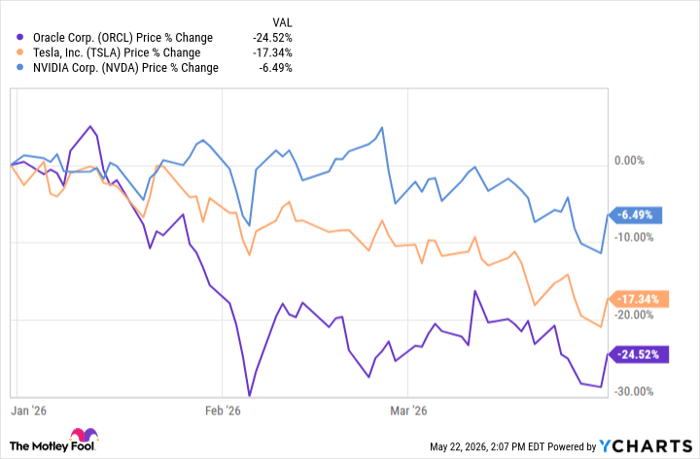
ORCL data by YCharts.
Coatue also trimmed its Tesla stake by 96% in the quarter. The electric vehicle (EV) and autonomous driving company sold off after CEO Elon Musk seemed to adopt a more cautious tone about how quickly Tesla would roll out its robotaxi fleet nationwide. Tesla also raised its capex guidance for its AI initiatives, leading analysts to believe free cash flow will be challenged this year.
Finally, Coatue slashed its Nvidia stake by 31% in Q1. I actually thought Nvidia performed well in Q1 on earnings and forward guidance, but since Nvidia is the leader in AI, any doubts about the industry are likely to affect the chip giant.
Buying a beaten-down EV stock
In Q1, Coatue initiated a new position in the EV company Lucid Group (NASDAQ: LCID), snapping up over 295,300 shares valued at $2.8 million. The carmaker has struggled mightily since going public and is down 94% from its September 2020 IPO. Lucid is also down nearly 48% this year alone.
The luxury EV maker is currently operating in a tough EV market. The Trump administration has removed many of the incentives for EVs, including a $7,500 federal EV tax credit. But more than that, Lucid has always struggled financially. The company has taken on significant debt, has high cash burn, and continues to pile up losses. The company has also had to raise capital to support its balance sheet, thereby diluting shareholders.
Laffont and Coatue aren't the only ones buying the dip. Citigroup analyst Michael Ward has a $14 price target on the stock, implying more than a double from Lucid's current share price of under $6. Ward sees the company soon reaching an inflection point, with new leadership in place, new products going live, and the company's robotaxi partnership with Uber Technologies.
It also looks like Coatue purchased several renewable-themed stocks in Q1, so Lucid could be part of this thesis. Renewables have been beaten down, and there could be a renewed focus on the sector, especially after seeing what happened during the Iran war when passage through the Strait of Hormuz came to a standstill. This could lead investors and energy officials in the U.S. to view renewables as more important to national defense.
Given that Coatue took a relatively small position in Lucid, Laffont and his team are likely making a more speculative bet at this time. I don't think investors should do anything more than that until the company shows further proof it can turn things around.
Should you buy stock in Lucid Group right now?
Before you buy stock in Lucid Group, consider this:
The Motley Fool Stock Advisor analyst team just identified what they believe are the 10 best stocks for investors to buy now… and Lucid Group wasn’t one of them. The 10 stocks that made the cut could produce monster returns in the coming years.
Consider when Netflix made this list on December 17, 2004... if you invested $1,000 at the time of our recommendation, you’d have $472,852!* Or when Nvidia made this list on April 15, 2005... if you invested $1,000 at the time of our recommendation, you’d have $1,317,207!*
Now, it’s worth noting Stock Advisor’s total average return is 984% — a market-crushing outperformance compared to 210% for the S&P 500. Don't miss the latest top 10 list, available with Stock Advisor, and join an investing community built by individual investors for individual investors.
See the 10 stocks »
*Stock Advisor returns as of May 27, 2026.
Bram Berkowitz has no position in any of the stocks mentioned. The Motley Fool has positions in and recommends Nvidia, Oracle, Tesla, and Uber Technologies. The Motley Fool has a disclosure policy.
Recommended Articles


