


AI Frenzy Sweeps the Globe, but Did TSMC April Revenue Hit the Brakes?
TradingKey - May 8, TSMC ( TSM) disclosed revenue data for April 2026. Although the monthly growth rate has slowed, cumulative data suggests that the robust growth momentum for the full year remains intact.
Data shows that monthly consolidated revenue reached NT$410.726 billion, a slight decrease of 1.1% month-on-month but a 17.5% increase year-on-year.
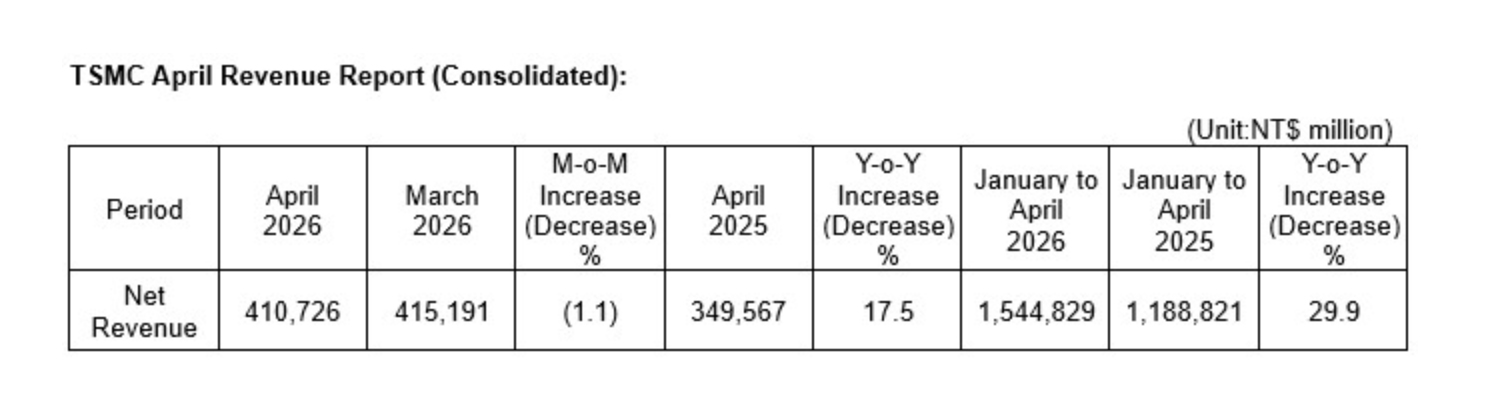
TSMC's April revenue saw a slight month-on-month decline, primarily due to the high base effect of March. In March of this year, the company's monthly revenue hit a record high of NT$415.19 billion, surging 30.7% month-on-month and 45.2% year-on-year, driving first-quarter revenue above the NT$1 trillion mark for the first time. The pullback in April's figures is to some extent a seasonal adjustment, but its monthly scale still ranks second in history, and the 17.5% year-on-year growth rate remains in a high range.
From a cumulative perspective, the revenue scale of nearly NT$1.55 trillion for the January-April period maintained a year-on-year growth rate of around 30%, fully reflecting the growth resilience of the company's business. Compared to single-month fluctuations, cumulative revenue better reflects TSMC's true operating conditions; especially against the backdrop of exploding demand for AI chips, the long-term growth logic remains unchanged.
TSMC's Taiwan-listed shares closed down 0.87% on the day at NT$2,290.
AI Demand Becomes Core Support Engine
The core driver of TSMC's earnings growth is the demand for computing chips driven by the explosion of the global AI industry.
Since the beginning of this year, Alphabet ( GOOGL ), Amazon ( AMZN ), Meta ( META ), Microsoft ( MSFT) and other tech giants have collectively announced over $725 billion in AI capital expenditures. As the core foundry for leading chip companies such as Nvidia ( NVDA) and AMD ( AMD) and other top-tier chip firms, TSMC has directly benefited from this wave.
Currently, TSMC's advanced process and advanced packaging capacities are fully utilized. In addition to popular AI chips like GPUs and ASICs, the rise of agentic AI has driven a significant recovery in CPU demand, and major clients such as Intel have also adjusted their product structures to increase the shipment proportion of AI-related chips. According to Intel, its shipment ratio of GPUs to CPUs has shifted from the previous 8:1 to 4:1, highlighting the growth potential of CPU demand in the AI era.
Based on an optimistic outlook for the AI industry, TSMC has raised its full-year revenue guidance for 2026 and stated that its annual capital expenditure will approach the upper end of the $52 billion to $56 billion forecast range. This level of capital expenditure will primarily be used to expand capacity for advanced processes such as 2nm to meet the continuously growing demand for AI chips.
From the perspective of quarterly performance expectations, TSMC expects second-quarter revenue to reach $39 billion to $40.2 billion. At an exchange rate of 31.7 TWD to the USD, this equates to approximately NT$1.236 trillion to NT$1.274 trillion. Based on the median, revenue in May and June is expected to challenge historical monthly highs, further solidifying the foundation for full-year growth.
TSMC partners with Sony.
Meanwhile, the latest reports indicate that TSMC and Sony Semiconductor Solutions signed a memorandum of understanding (MoU) on the 8th to establish a joint venture in Kumamoto, Japan, for the joint development of next-generation image sensor chips.
The Japanese government will provide Sony with subsidies of up to 60 billion yen (approximately NT$12 billion) to support the construction of its image sensor factory in Kumamoto Prefecture.
However, Sony and TSMC have not explicitly clarified whether the aforementioned government subsidies directly correspond to the proposed joint venture, only stating that both parties will conduct further consultations regarding potential investments in the venture. These investments will be implemented in phases based on market demand and are contingent upon receiving support from the Japanese government.
According to reports, TSMC's Kumamoto plant in Japan currently utilizes 22/28nm and 12/16nm process technologies, with a second plant expected to begin mass production in 2027 and advance to the 6nm process. This partnership focuses not only on image sensors for consumer electronics but also aims to explore Physical AI applications in fields such as automotive and robotics, further broadening TSMC's business scope.
Recommended Articles


