


Amazon Just Announced Fantastic News for Investors: Should You Buy?
Key Points
Amazon just enabled third parties to use its e-commerce delivery service for goods not sold through its platform.
This is another example of the company grinding more revenue out of its existing infrastructure, which should lead to more margin expansion.
- These 10 stocks could mint the next wave of millionaires ›
Amazon (NASDAQ: AMZN) has done it again. The e-commerce giant keeps expanding the boundaries of its shipping business, and it just announced a new service that could further supercharge its growth: full third-party shipping assistance. Instead of only shipping items sold through its own e-commerce ecosystem, it will now allow other companies to use its delivery and supply chain network for their needs.
This could be a game-changer that brings fast shipping to all online retailers in the United States. Amazon's stock was rising on the news, and with shares at an all-time high, its market cap is now $2.9 trillion. Should you join the party and invest in Amazon today?
Will AI create the world's first trillionaire? Our team just released a report on the one little-known company, called an "Indispensable Monopoly" providing the critical technology Nvidia and Intel both need. Continue »
Fast shipping for all
The story of Amazon has been about building scale in e-commerce shipping, but only for items sold through its own marketplace, not elsewhere. The company is now launching Amazon Supply Chain Services, pitching its robust fulfillment network -- comprising more than 100 aircraft, 80,000 trailers, and 24,000 freight containers -- to retailers outside the Amazon ecosystem. This includes not only fast shipping to customers, but also the freight delivery of raw materials to a retailer's own manufacturing facilities.
There's an immense revenue opportunity here. For example, logistics giant United Parcel Service alone did $89 billion in revenue over the last 12 months. Amazon is not going to dethrone UPS tomorrow, but it could become a huge threat to it if it can deliver items for other retailers as quickly as it does for itself.
Amazon has invested tens of billions of dollars into its delivery infrastructure to enable rapid shipping. It's now deploying levers to steadily expand the revenue it can generate from this network, which should lead to higher profit margins. Its operating margin in the North American retail segment hit 7.3% over the last 12 months, a record high.

Image source: Getty Images.
A profit-margin story
Amazon's revenue is already immense, totaling $743 billion over the last 12 months. Its top line should see steady growth in the years ahead.
But the real story is its potential to expand its profit margins, and that goes beyond its logistics initiatives. Advertising revenue grew 22% year over year on a constant-currency basis last quarter. Cloud computing at Amazon Web Services (AWS) grew 28% year over year, and now has an operating margin of 35% on $137 billion in net sales.
Amazon's higher-margin segments are growing faster than its consolidated business, which should lead to expansion of consolidated operating margins. Operating margin was just 12% over the last 12 months; I believe the metric has plenty of room to keep expanding.
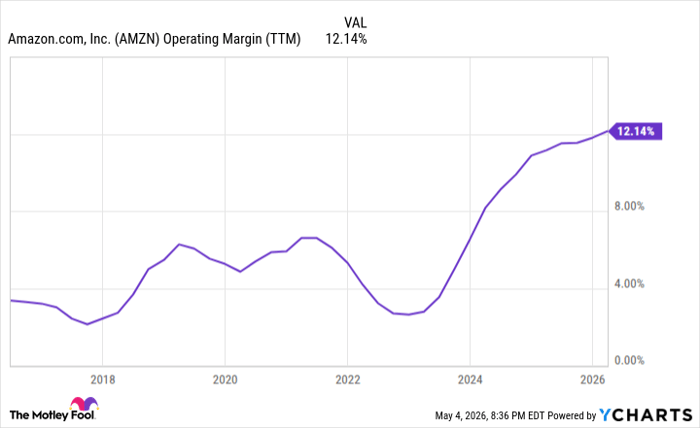
AMZN Operating Margin (TTM) data by YCharts.
Time to buy Amazon stock?
With greater leverage across its delivery services and growth in advertising and AWS revenue, Amazon's operating margin could grow from 12% to close to 20% in the next few years. The company is especially well positioned to benefit from the artificial intelligence (AI) revolution; demand for computing power through AWS is rising at a torrid pace.
Total revenue should keep growing steadily; it would only need to grow at 10% annually over the next three years to reach $1 trillion (and net sales grew 17% last quarter). An 18% operating margin on $1 trillion in revenue would give it $180 billion in operating earnings. That would be twice as much as the $90 billion in trailing 12-month operating income it has today.
Right now, Amazon has a market cap of $2.9 trillion, and the stock trades at 16 times my forward earnings estimate. This is not overly cheap for a megacap stock. But as long as its profit margins keep expanding at a greater scale, I think investors will do just fine owning Amazon shares over the next five years.
Don’t miss this second chance at a potentially lucrative opportunity
Ever feel like you missed the boat in buying the most successful stocks? Then you’ll want to hear this.
On rare occasions, our expert team of analysts issues a “Double Down” stock recommendation for companies that they think are about to pop. If you’re worried you’ve already missed your chance to invest, now is the best time to buy before it’s too late. And the numbers speak for themselves:
- Nvidia: if you invested $1,000 when we doubled down in 2009, you’d have $539,083!*
- Apple: if you invested $1,000 when we doubled down in 2008, you’d have $54,747!*
- Netflix: if you invested $1,000 when we doubled down in 2004, you’d have $476,034!*
Right now, we’re issuing “Double Down” alerts for three incredible companies, available when you join Stock Advisor, and there may not be another chance like this anytime soon.
See the 3 stocks »
*Stock Advisor returns as of May 7, 2026.
Brett Schafer has no position in any of the stocks mentioned. The Motley Fool has positions in and recommends Amazon and United Parcel Service. The Motley Fool has a disclosure policy.
Recommended Articles


