


If You're Building a Retirement Portfolio, This Financial Stock Belongs in It
Key Points
Retirement stocks should be durable through different economic environments.
They should also appreciate over time or generate reliable passive income.
- 10 stocks we like better than Bank of America ›
There are many different investment strategies out there. Some people day trade, some are more active traders, and many are long-term investors, seeking to invest conservatively but also aggressively enough over the long term to build a strong pot of savings for retirement.
Stocks in your retirement portfolio, especially if you still have a 10-to-20-year runway before retirement, need to appreciate or generate annual recurring passive income while also having strong balance sheets so they can navigate a tougher market, which is likely to show up every once in a while when holding stocks through the economic cycle.
Will AI create the world's first trillionaire? Our team just released a report on the one little-known company, called an "Indispensable Monopoly" providing the critical technology Nvidia and Intel both need. Continue »
Here's one financial stock that meets all of these criteria and absolutely belongs in your retirement portfolio.

Image source: Getty Images.
A triple threat for your retirement portfolio
The financial stock I am referring to is Bank of America (NYSE: BAC), the second-largest bank in the U.S. by assets. Like most large banks, Bank of America took its fair share of punches during the Great Recession in 2008. But nearly two decades later, Bank of America and the entire U.S. banking system are in much better shape.
Bank of America has now built a fortress balance sheet, with robust levels of capital and liquidity, and over the past five years has navigated some pretty difficult environments, including the COVID-19 pandemic and the 2023 banking crisis.
Bank of America has also built out a full slate of banking businesses that have all become top performers, including retail banking, commercial banking, asset and wealth management, and investment banking.
The combination of these businesses has given the bank greater durability because they perform differently under various economic and interest rate conditions, typically offsetting weakness in one business with strength in another.
Furthermore, Bank of America has a solid dividend that's poised to grow.
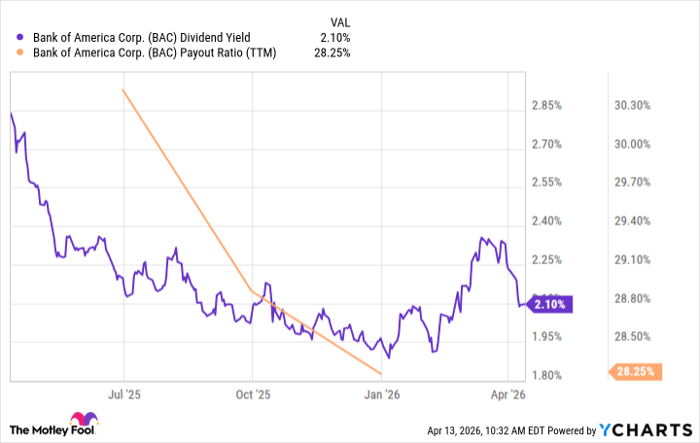
BAC Dividend Yield data by YCharts
A 2% yield is solid, but the payout ratio is even better, below 30%, providing plenty of runway to keep growing the dividend. While the stock's long-term returns could be better, I believe they'll improve over time.
Banking regulators are preparing to finalize regulatory capital requirements, which should give Bank of America greater flexibility and visibility into the amount of long-term capital it will need to hold. This could also allow the bank to do more lending, and banks may be poised to recapture market share as private credit now faces issues.
Ultimately, I see Bank of America as a triple threat: The bank is considered too big to fail and has a fortress balance sheet, it has a solid dividend, and I also think large bank stocks will generate better returns over time as the regulatory environment becomes clearer.
Should you buy stock in Bank of America right now?
Before you buy stock in Bank of America, consider this:
The Motley Fool Stock Advisor analyst team just identified what they believe are the 10 best stocks for investors to buy now… and Bank of America wasn’t one of them. The 10 stocks that made the cut could produce monster returns in the coming years.
Consider when Netflix made this list on December 17, 2004... if you invested $1,000 at the time of our recommendation, you’d have $556,335!* Or when Nvidia made this list on April 15, 2005... if you invested $1,000 at the time of our recommendation, you’d have $1,160,572!*
Now, it’s worth noting Stock Advisor’s total average return is 975% — a market-crushing outperformance compared to 193% for the S&P 500. Don't miss the latest top 10 list, available with Stock Advisor, and join an investing community built by individual investors for individual investors.
See the 10 stocks »
*Stock Advisor returns as of April 15, 2026.
Bank of America is an advertising partner of Motley Fool Money. Bram Berkowitz has no position in any of the stocks mentioned. The Motley Fool has no position in any of the stocks mentioned. The Motley Fool has a disclosure policy.
Recommended Articles


