


3 Monster Stocks to Hold for the Next 10 Years
Key Points
Joby Aviation has established an early mover’s advantage in the eVTOL market.
BYD, China’s top automaker, also became the world’s largest EV maker two years ago.
Rocket Lab is launching more rockets for space exploration and satellite missions.
- 10 stocks we like better than Joby Aviation ›
Inflation, elevated interest rates, geopolitical conflicts, and other macro headwinds have driven many investors away from speculative stocks over the past year. But if you can tune out that noise and intend to hold your stocks for at least the next decade, then there are still plenty of buying opportunities in this choppy market.
Let's examine three of those stocks with monster growth potential: Joby Aviation (NYSE: JOBY), BYD (OTC: BYDDY), and Rocket Lab (NASDAQ: RKLB). Each of these companies faces near-term challenges, but they could also have plenty of room to expand.
Will AI create the world's first trillionaire? Our team just released a report on the one little-known company, called an "Indispensable Monopoly" providing the critical technology Nvidia and Intel both need. Continue »
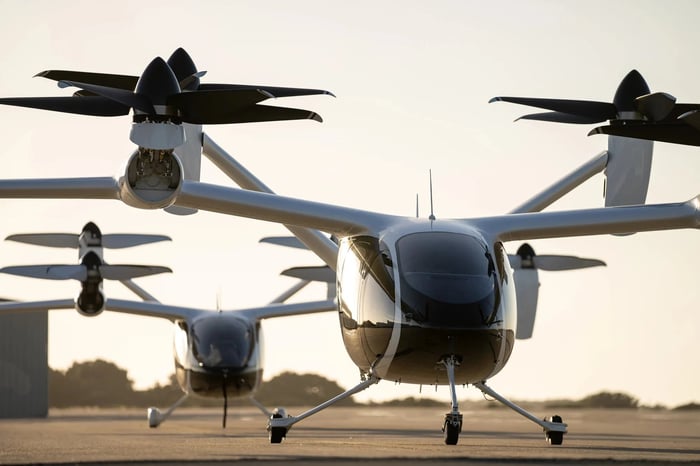
Image source: Joby Aviation.
The eVTOL maker: Joby Aviation
Joby Aviation develops electric vertical take-off and landing (eVTOL) aircraft. Its first eVTOL, the S4, carries a single pilot and four passengers, travels up to 150 miles on a single charge, and reaches a maximum speed of 200 miles per hour. Unlike other eVTOLs, which use separate propellers for lifting and cruising, the S4 uses lighter tilt-rotor propellers that alternative between lifting and cruising modes. That difference enables the S4 to fly faster and farther than its rivals.
Joby is already backed by prominent investors and customers, such as Toyota, Delta Air Lines, and Uber. However, its first commercial flights haven't been approved in the U.S. and Dubai yet. But once it finally starts ferrying passengers, analysts expect its revenue to soar from $53 million in 2025 to $459 million in 2028.
Joby's stock might seem pricey at 18 times its 2028 sales, but Fortune Business Insights expects the global eVTOL market to expand at a 36.8% CAGR from 2026 to 2034. If Joby maintains its early mover advantage, it could easily justify its lofty valuations.
The EV maker: BYD
BYD is China's largest automaker and the world's top EV maker. In 2022, it stopped producing gas-only vehicles and aggressively expanded its lineup of battery-powered EVs and plug-in hybrid EVs. It differentiates itself from its competitors by producing its own lithium iron phosphate (LFP) batteries, which are safer, cheaper, and more power-efficient than conventional lithium-ion batteries, as well as motors, chips, and power electronics. That vertically integrated model boosted its margins and profits as it ramped up its production.
BYD faces fierce competition in the cooling EV market, but analysts still expect its revenue and net income to grow at 13% and 24% CAGRs, respectively, from 2025 to 2028. It plans to continue expanding in Southeast Asia, Latin America, and Europe to reduce its dependence on China, expand its fast-charging network across China, increase its production capacity, and attract more buyers with fresh AI and driver-assistance features in its mid-range vehicles.
BYD's stock trades at less than one times this year's sales, presumably because the cooling EV market, trade war, tariffs, and other macro headwinds are compressing its valuations. But after those headwinds dissipate, it could soar as it's revalued as a growing EV maker again.
The rocket maker: Rocket Lab
Rocket Lab produces reusable orbital rockets. It's launched its Electron rocket, which carries smaller payloads than SpaceX's Falcon rockets, 85 times so far. It plans to launch its second rocket, the Neutron, to carry much heavier payloads by the end of 2026.
Its customers include NASA, the U.S. Space Development Agency (SDA), the Swedish National Space Agency, Capella Space, Kinéis, and BlackSky. Over the long term, it plans to evolve into an "end-to-end" space services company by expanding its higher-margin Space Systems segment (which produces spacecraft, satellites, and subsystems), expanding its Photon satellite bus platform, which shifts satellites into their correct orbits, and helping smaller companies deliver their payloads into space.
From 2025 to 2028, analysts expect Rocket Lab's revenue to grow at a 37% CAGR, driven by new space exploration missions and the growth of the low-earth orbit (LEO) satellite market. Its stock might seem pricey at 48 times this year's sales, but it could have plenty of room to run.
Should you buy stock in Joby Aviation right now?
Before you buy stock in Joby Aviation, consider this:
The Motley Fool Stock Advisor analyst team just identified what they believe are the 10 best stocks for investors to buy now… and Joby Aviation wasn’t one of them. The 10 stocks that made the cut could produce monster returns in the coming years.
Consider when Netflix made this list on December 17, 2004... if you invested $1,000 at the time of our recommendation, you’d have $556,335!* Or when Nvidia made this list on April 15, 2005... if you invested $1,000 at the time of our recommendation, you’d have $1,160,572!*
Now, it’s worth noting Stock Advisor’s total average return is 975% — a market-crushing outperformance compared to 193% for the S&P 500. Don't miss the latest top 10 list, available with Stock Advisor, and join an investing community built by individual investors for individual investors.
See the 10 stocks »
*Stock Advisor returns as of April 14, 2026.
Leo Sun has no position in any of the stocks mentioned. The Motley Fool has positions in and recommends BlackSky Technology, Rocket Lab, and Uber Technologies. The Motley Fool recommends BYD Company and Delta Air Lines. The Motley Fool has a disclosure policy.
Recommended Articles


