


The Bull Case for Constellation Energy: Here's Where It Could Be in 3 Years
Key Points
U.S. electricity demand is expected to grow steadily, primarily driven by the power needs of data centers.
Constellation Energy is the largest nuclear power operator in the U.S., with assets in high-growth areas.
Constellation has secured power agreements with major tech companies, including Microsoft and Meta.
- 10 stocks we like better than Constellation Energy ›
Electricity demand is expected to grow rapidly over the next decade. According to Bank of America, U.S. electricity demand is projected to grow 2.5% annually, or five times faster than the previous decade's growth rate, driven by the expansion of data centers.
Constellation Energy (NASDAQ: CEG) is well-positioned to capitalize on this trend. With its strong presence in the energy sector and a massive nuclear footprint, Constellation's ability to meet the growing demand of data centers bodes well for its future outlook.
Will AI create the world's first trillionaire? Our team just released a report on the one little-known company, called an "Indispensable Monopoly" providing the critical technology Nvidia and Intel both need. Continue »
Here's what investors have to look forward to from the utility provider over the next three years.
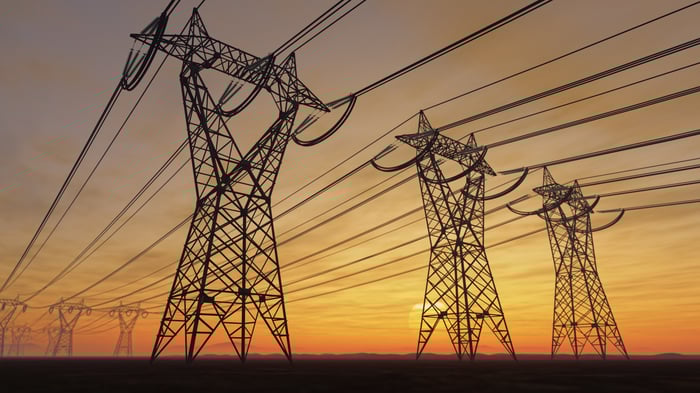
Image source: Getty Images.
Constellation Energy has a huge nuclear fleet
Nuclear energy is gaining favor, especially among hyperscalers who appreciate its zero-carbon emissions and ability to provide reliable, baseload power 24/7.
Constellation Energy's advantage is its massive nuclear footprint. With a fleet of 21 reactors, Constellation is the largest nuclear power operator in the United States. Many of its power facilities are located in the PJM Interconnection region (Mid-Atlantic and Midwest), which is experiencing rapid growth in artificial intelligence (AI) data centers.
Inference used by AI is incredibly power-hungry, and global data center power demand is expected to double by 2030. According to some estimates, data centers in the U.S. could consume as much as 12% of domestic electricity by 2028, up from 4.6% in 2023.
In the PJM region, peak demand is forecast to grow by 35 gigawatts in the next five years. Growth in the region will likely lead to more colocation and behind-the-meter deals with major hyperscalers. Over the past couple of years, Constellation has secured power purchase agreements with major hyperscalers, including Microsoft and Meta Platforms.
What to expect over the next three years
Constellation plans to restart the Crane Clean Energy Center (formerly Three Mile Island Unit 1) around 2027 to 2028 as part of its agreement with Microsoft. In addition, its agreement with Meta for the Clinton Clean Energy Center in Illinois will take effect in June 2027, and the company plans to add 30 megawatts (MW) of capacity to this facility by the 2030s. It also plans to add 9,350 MW of capacity over the next five years through license extensions and uprates (upgrades to existing reactors).
Regulatory risks are one factor to keep in mind. Tech companies must "bring their own power" and are committed to funding the construction of new generation and paying for grid upgrades directly, rather than having these costs socialized across the general public's utility bills. Potential regulations or price caps could impact Constellation and how much it can charge for its existing energy infrastructure.
That said, Constellation Energy is targeting base earnings-per-share growth of 20% or more through 2029, and analysts project its non-GAAP earnings per share could reach $19.79 by 2029. Management has also committed to growing its annual dividend by 10%.
The stock is trading at 19.8 times this year's projected earnings, which is expensive for a utility provider. However, if you are bullish on the long-term outlook for data centers and their energy needs, Constellation Energy is a utility provider in an excellent position to meet this growing demand.
Should you buy stock in Constellation Energy right now?
Before you buy stock in Constellation Energy, consider this:
The Motley Fool Stock Advisor analyst team just identified what they believe are the 10 best stocks for investors to buy now… and Constellation Energy wasn’t one of them. The 10 stocks that made the cut could produce monster returns in the coming years.
Consider when Netflix made this list on December 17, 2004... if you invested $1,000 at the time of our recommendation, you’d have $536,003!* Or when Nvidia made this list on April 15, 2005... if you invested $1,000 at the time of our recommendation, you’d have $1,116,248!*
Now, it’s worth noting Stock Advisor’s total average return is 946% — a market-crushing outperformance compared to 190% for the S&P 500. Don't miss the latest top 10 list, available with Stock Advisor, and join an investing community built by individual investors for individual investors.
See the 10 stocks »
*Stock Advisor returns as of April 9, 2026.
Bank of America is an advertising partner of Motley Fool Money. Courtney Carlsen has positions in Constellation Energy and Microsoft. The Motley Fool has positions in and recommends Constellation Energy, Meta Platforms, and Microsoft. The Motley Fool has a disclosure policy.
Recommended Articles


