

Vanguard S&P 500 ETF vs. Vanguard Total Stock Market ETF: Which Is More Likely to Survive a Stock Market Crash or Recession?

Source The Motley Fool

Key Points

  • With recession fears ramping up, investing in the right places is key.

  • The two ETFs share many similarities, but there are a few key differences to consider.

  • The right choice for you will depend largely on personal preferences.

  • 10 stocks we like better than Vanguard S&P 500 ETF ›

Major market indexes are still shaky, as uncertainty around oil prices and the war in the Middle East continues to rattle the global economy. Now more than ever, it's crucial to invest in strong stocks and funds that can withstand volatility.

The Vanguard S&P 500 ETF (NYSEMKT: VOO) and the Vanguard Total Stock Market ETF (NYSEMKT: VTI) are incredibly popular and powerful funds. While they can both be strong choices for a wide variety of portfolios, here's how each might stand up to a potential recession or market crash.

Will AI create the world's first trillionaire? Our team just released a report on the one little-known company, called an "Indispensable Monopoly" providing the critical technology Nvidia and Intel both need. Continue »
Bear figurine against a stock market chart.

Image source: Getty Images.

Key differences that could impact your bottom line

The S&P 500 ETF and Total Stock Market ETF are similar in many ways. They're both broad-market funds that encompass a wide variety of stocks across all industries, offering impressive diversification that's tough to beat.

However, while the S&P 500 ETF holds only around 500 large-cap stocks, the Total Stock Market ETF includes over 3,500 stocks from small-cap to large-cap. This leads to a few important distinctions:

  • Difference in diversification: With around seven times as many holdings, the Total Stock Market ETF has the edge in terms of pure diversification. Generally speaking, a wider variety of stocks can help reduce the risk that a single stock or industry will significantly affect performance.
  • Large-cap stability: While the S&P 500 ETF is narrower, larger companies tend to be more stable than their smaller counterparts. Small- and mid-cap stocks can be shakier during periods of economic instability, and the S&P 500 ETF excludes these investments entirely.
  • Heavy tilt toward tech: Tech giants make up a significant portion of the S&P 500, giving this ETF a slightly stronger tech tilt -- though the difference is subtle. Both ETFs have the same top 10 holdings, but the technology sector makes up 33% of the S&P 500 ETF's portfolio compared to 31% for the Total Stock Market ETF.

So what does all this mean? Each fund carries unique advantages and drawbacks, creating a different set of risks.

The S&P 500 ETF offers greater stability with its large-cap focus, but because it's slightly more tech-heavy, it could experience larger drawdowns if the tech industry is hit hard. The Total Stock Market ETF offers maximum diversification, but that also means investing in many smaller companies that could be more vulnerable to volatility.

What history says about risk

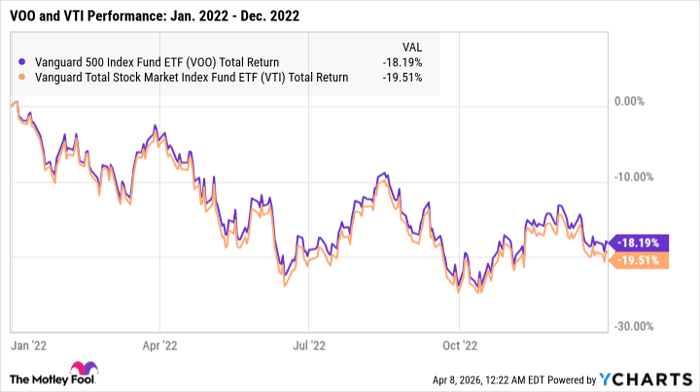
Throughout the most recent bear market in 2022, the ETFs experienced similar levels of volatility -- with the S&P 500 dipping by around 18% and the Total Stock Market ETF falling by roughly 19%.
VOO Total Return Level Chart

VOO Total Return Level data by YCharts

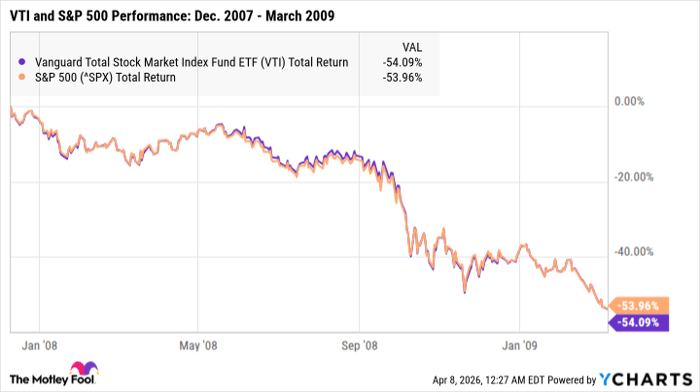
The Vanguard S&P 500 ETF was launched in 2010, so there's no historical data on its performance throughout the Great Recession. However, because it tracks the S&P 500 and aims to mirror its returns, it's safe to assume its performance would have been closely aligned with the index's.

Between late 2007 and 2009, the Total Stock Market ETF experienced a drawdown almost identical to that of the S&P 500. In terms of risk, then, the two ETFs offer very similar profiles, based on historical data.
VTI Total Return Level Chart

VTI Total Return Level data by YCharts

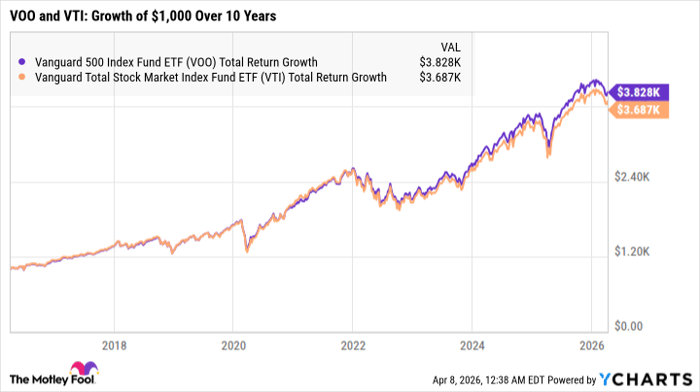
In terms of performance, the funds are also fairly similar. While the S&P 500 ETF has edged ahead of the Total Stock Market ETF -- one advantage of the fund's heavier tech focus -- their 10-year total returns are roughly in line.

If you'd invested $1,000 in each of these funds a decade ago, you'd have around $3,800 in total with the S&P 500 ETF versus just under $3,700 with the Total Stock Market ETF.
VOO Total Return Level Chart

VOO Total Return Level data by YCharts

Which is the better buy?

Both funds are well positioned to withstand volatility, with strong long-term track records of weathering recessions and bear markets.

If the tech industry continues to thrive over time, the S&P 500's slightly stronger emphasis on this sector could result in marginally higher returns. For investors who are nervous about tech stocks right now, though, the Total Stock Market ETF's broader diversification could help ease some of those concerns.

Neither ETF is necessarily better than the other, and they're both strong choices. The right one for your portfolio will probably come down to subtle differences in individual preferences.

Should you buy stock in Vanguard S&P 500 ETF right now?

Before you buy stock in Vanguard S&P 500 ETF, consider this:

The Motley Fool Stock Advisor analyst team just identified what they believe are the 10 best stocks for investors to buy now… and Vanguard S&P 500 ETF wasn’t one of them. The 10 stocks that made the cut could produce monster returns in the coming years.

Consider when Netflix made this list on December 17, 2004... if you invested $1,000 at the time of our recommendation, you’d have $532,929!* Or when Nvidia made this list on April 15, 2005... if you invested $1,000 at the time of our recommendation, you’d have $1,091,848!*

Now, it’s worth noting Stock Advisor’s total average return is 928% — a market-crushing outperformance compared to 186% for the S&P 500. Don't miss the latest top 10 list, available with Stock Advisor, and join an investing community built by individual investors for individual investors.

See the 10 stocks »

*Stock Advisor returns as of April 9, 2026.

Katie Brockman has positions in Vanguard S&P 500 ETF and Vanguard Total Stock Market ETF. The Motley Fool has positions in and recommends Vanguard S&P 500 ETF and Vanguard Total Stock Market ETF. The Motley Fool has a disclosure policy.

Disclaimer: For information purposes only. Past performance is not indicative of future results.
placeholder
Bitcoin CME gaps at $35,000, $27,000 and $21,000, which one gets filled first?Prioritize filling the $27,000 gap and even try higher.
Author  FXStreet
Aug 22, 2023
Prioritize filling the $27,000 gap and even try higher.
placeholder
Natural Gas sinks to pivotal level as China’s demand slumpsNatural Gas price (XNG/USD) edges lower and sinks to $2.56 on Monday, extending its losing streak for the fifth day in a row. The move comes on the back of China cutting its Liquified Natural Gas (LNG) imports after prices rose above $3.0 in June. It
Author  FXStreet
Jul 01, 2024
Natural Gas price (XNG/USD) edges lower and sinks to $2.56 on Monday, extending its losing streak for the fifth day in a row. The move comes on the back of China cutting its Liquified Natural Gas (LNG) imports after prices rose above $3.0 in June. It
placeholder
Bitcoin briefly loses 2025 gains as crypto plunges over the weekend.Bitcoin experienced a sharp decline this weekend, briefly erasing its 2025 gains and dipping below its year-opening value of $93,507. The cryptocurrency fell to a low of $93,029 on Sunday, representing a 25% drop from its all-time high in October. Although it has rebounded slightly to around $94,209, the pressures on the market remain significant. The downturn occurred despite the reopening of the U.S. government on Thursday, which many had hoped would provide essential support for crypto markets. This year initially appeared promising for cryptocurrencies, particularly after the inauguration of President Donald Trump, who has established the most pro-crypto administration thus far. However, ongoing political tensions—including Trump's tariff strategies and the recent government shutdown, lasting a historic 43 days—have contributed to several rapid price pullbacks for Bitcoin throughout the year. Market dynamics are also being influenced by Bitcoin whales—investors holding large amounts of Bitcoin—who have been offloading portions of their assets, consequently stalling price rallies even as positive regulatory developments emerge. Despite these sell-offs, analysts from Glassnode argue that this behavior aligns with typical patterns seen among long-term investors during the concluding stages of bull markets, suggesting it is not indicative of a mass exodus. Notably, Bitcoin is not alone in its struggles, as Ethereum and Solana have also recorded declines of 7.95% and 28.3%, respectively, since the start of the year, while numerous altcoins have faced even steeper losses. Looking ahead, questions linger regarding the viability of the four-year cycle thesis, particularly given the increasing institutional support and regulatory frameworks now in place in the crypto landscape. Matt Hougan, chief investment officer at Bitwise, remains optimistic, suggesting a potential Bitcoin resurgence in 2026 driven by the “debasement trade” thesis and a broader trend toward increased adoption of stablecoins, tokenization, and decentralized finance. Hougan emphasized the soundness of the underlying fundamentals, pointing to a positive outlook for the sector in the longer term.
Author  Mitrade
Nov 17, 2025
Bitcoin experienced a sharp decline this weekend, briefly erasing its 2025 gains and dipping below its year-opening value of $93,507. The cryptocurrency fell to a low of $93,029 on Sunday, representing a 25% drop from its all-time high in October. Although it has rebounded slightly to around $94,209, the pressures on the market remain significant. The downturn occurred despite the reopening of the U.S. government on Thursday, which many had hoped would provide essential support for crypto markets. This year initially appeared promising for cryptocurrencies, particularly after the inauguration of President Donald Trump, who has established the most pro-crypto administration thus far. However, ongoing political tensions—including Trump's tariff strategies and the recent government shutdown, lasting a historic 43 days—have contributed to several rapid price pullbacks for Bitcoin throughout the year. Market dynamics are also being influenced by Bitcoin whales—investors holding large amounts of Bitcoin—who have been offloading portions of their assets, consequently stalling price rallies even as positive regulatory developments emerge. Despite these sell-offs, analysts from Glassnode argue that this behavior aligns with typical patterns seen among long-term investors during the concluding stages of bull markets, suggesting it is not indicative of a mass exodus. Notably, Bitcoin is not alone in its struggles, as Ethereum and Solana have also recorded declines of 7.95% and 28.3%, respectively, since the start of the year, while numerous altcoins have faced even steeper losses. Looking ahead, questions linger regarding the viability of the four-year cycle thesis, particularly given the increasing institutional support and regulatory frameworks now in place in the crypto landscape. Matt Hougan, chief investment officer at Bitwise, remains optimistic, suggesting a potential Bitcoin resurgence in 2026 driven by the “debasement trade” thesis and a broader trend toward increased adoption of stablecoins, tokenization, and decentralized finance. Hougan emphasized the soundness of the underlying fundamentals, pointing to a positive outlook for the sector in the longer term.
placeholder
WTI Price Forecast: Seems vulnerable near $90.50 as technical breakdown comes into playWest Texas Intermediate (WTI) – the benchmark US Crude Oil price – plummets to a nearly two-week trough during the Asian session on Wednesday in reaction to news that the US and Iran have agreed to a two-week ceasefire.
Author  FXStreet
Yesterday 01: 48
West Texas Intermediate (WTI) – the benchmark US Crude Oil price – plummets to a nearly two-week trough during the Asian session on Wednesday in reaction to news that the US and Iran have agreed to a two-week ceasefire.
placeholder
Gold remains depressed as skepticism over US-Iran truce supports USDGold (XAU/USD) once again shows some resilience below the $4,700 mark during the Asian session on Thursday, and for now, seems to have stalled the previous day's retracement slide from a three-week high.
Author  FXStreet
8 hours ago
Gold (XAU/USD) once again shows some resilience below the $4,700 mark during the Asian session on Thursday, and for now, seems to have stalled the previous day's retracement slide from a three-week high.
goTop
quote