


Trump Proposes $1.5 Trillion Defense Budget, Which Defense Stocks Are Worth Investing In?
TradingKey - Donald Trump recently unveiled a $1.5 trillion defense budget proposal, focusing on three key areas: space defense, shipbuilding, and missile systems. Following the announcement, the market immediately interpreted it as a signal for a new growth cycle in the defense industry, drawing attention to relevant U.S. defense and aerospace stocks. For investors, this is not just a budget proposal, but a preemptive signal for the direction of U.S. defense spending over the next few years.
Data reveals that this budget for fiscal year 2027 boosts defense spending to $1.5 trillion, a significant leap from the previous year, with priorities including the "Golden Dome" missile defense system, F-35 fighter jets, new warships, and Virginia-class nuclear submarines. However, as a budget proposal, it must still navigate lengthy congressional negotiations, and the final approved amount may not fully align with the request.
Budget first; markets have already begun pricing it in.
The defense sector showed early weakness today before rebounding, as intraday buying gradually absorbed the gap in expectations brought by the budget proposal.
By the close, the defense ETF ITA recorded a gain of nearly 4%, RTX and L3Harris ( LHX) rose approximately 2.8% and 2.2% respectively, while Huntington Ingalls ( HII) also climbed about 2.2%, General Dynamics ( GD) edged slightly higher, LMT rose marginally, with only Northrop Grumman ( NOC) pulling back slightly.
This market performance suggests that capital is not merely chasing temporary sentiment; rather, it is gradually treating Trump's $1.5 trillion defense budget as a sustainable mid-term investment theme.
Furthermore, this budget round is not just a general increase in defense spending, but very explicitly allocates funds toward several key areas: space missile defense, interceptor systems, fighter jets, ships, and submarines.
Reuters reported in mid-March that the budget estimate for Golden Dome has been raised to $185 billion, with Lockheed Martin (LMT), RTX, and NOC listed as prime contractors; this segment corresponds to missile warning, space sensors, interceptors, and command and control systems, representing the areas most capable of directly advancing defense technology sophistication.
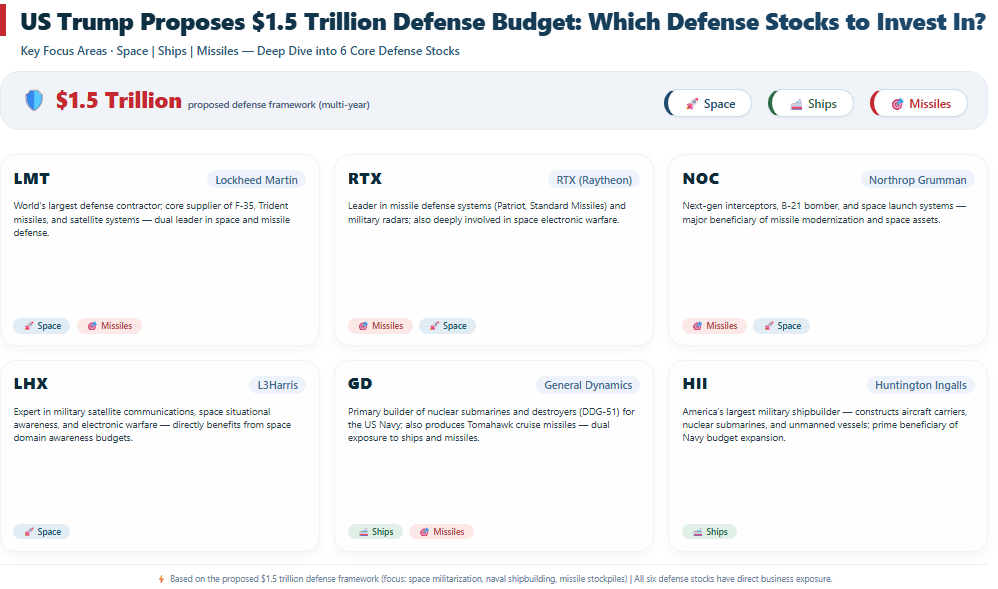
Space and Missiles: Who Benefits Most Among LMT, RTX, NOC, and LHX?
When breaking down the "space, naval, and missiles" segments, the missile defense supply chain emerges as the most direct beneficiary.
LMT is a veteran in F-35s and missile defense, with a presence already in Golden Dome; MOC leans more toward the B-21 stealth bomber and space sensors, having secured Golden Dome prototype contracts in the past.
From an investor's perspective, LMT and NOC are the most obvious "top-of-mind" companies in this budget cycle, though their paths differ: LMT acts as a versatile prime contractor, while NOC focuses on high-end strategic systems.
Regarding valuation, LMT currently trades at a P/E ratio of approximately 29.2x, while NOC is at 23.6x. LMT's higher valuation suggests the market has already priced in its certainty and policy benefits; NOC is relatively cheaper, but significant execution volatility—evidenced by recent profit forecast cuts for the B-21 program—means its potential depends on a stable production ramp-up.
RTX's investment thesis centers on "upside potential and coverage." It is positioned to capture demand from missile interception and sensors in Golden Dome, as well as the inventory replenishment and missile reconstruction cycles.
According to Reuters, RTX’s Raytheon business has secured major missile production contracts, including the Tomahawk; coupled with Golden Dome's space defense spending, RTX is one of the most comprehensive beneficiaries of this budget. However, with a P/E ratio near 40x, it is not cheap, suggesting the market has already factored in high expectations.
L3Harris (LHX) holds a more unique position. While not a pure "prime contractor" play, it has established entry points in rocket engines, communications, sensing, and space-related operations.
Reports indicate the Pentagon is investing $1 billion into L3Harris’s rocket engine business, highlighting that missile production and propulsion systems are a key pillar of military spending growth. LHX's P/E of approximately 41.5x is also high, making it a high-beta thematic stock rather than a discounted core defense holding.
Ships and Submarines: More Tangible Opportunities for GD and HII, but at a Slower Pace
Another very clear theme in the budget is shipbuilding, specifically Virginia-class nuclear submarines. GD and HII are the most direct beneficiaries.
According to Reuters, the budget will prioritize support for Virginia-class submarines and new naval vessel procurement; recently, GD’s Electric Boat subsidiary secured a $1.3 billion contract modification for Virginia-class submarines, indicating that orders are transitioning from concepts into actual projects.
GD is currently trading at a P/E ratio of approximately 22.5x, similar to NOC, representing a relatively balanced level within the defense sector. Its challenge lies not in valuation but in its delivery pace and project cycles, which are longer than those of missile companies; however, the benefit is clear—once submarine projects are finalized, orders tend to be more stable with higher revenue visibility.
In contrast, HII is projected to have negative free cash flow in 2026, and its operating margin guidance for shipbuilding is only 5.5% to 6.5%, making it the type of company that benefits from policy tailwinds but faces significant execution pressure.
Which investments offer the most value in this budget cycle?
If ranked solely by "budget certainty + valuation + realization speed," GD would be the first choice. The reason is simple: GD directly captures submarine and naval ship orders, its valuation is not expensive, and real contracts have already been secured recently, making it the type of stock where "cash flow is visible as soon as the budget is finalized."
LMT would be the second choice because it is very direct in both the F-35 and Golden Dome lines, but its valuation is no longer cheap; it represents high certainty rather than high value.
RTX is an option with higher upside potential, but its price already clearly reflects some optimistic expectations.
NOC is better suited for long-term project recovery. Specifically, if the B-21 and space defense programs continue to progress smoothly, there will be room for secondary upward revisions; however, in the short term, its trajectory is not as smooth as those of LMT and RTX.
LHX has a narrative of event-driven catalysts and business expansion, but its current valuation is not low. Furthermore, it is more of a mid-stream player; the market will view it as a "good company," but not necessarily the most direct winner of this budget.
HII most resembles a value recovery play; it is cheap, but if free cash flow and delivery pace do not improve, "cheap" may simply remain cheap.
The critical issue is the actual scale of budget implementation.
Finally, it is worth noting that the true significance of this $1.5 trillion defense budget lies not in whether defense stocks will rise, but in the fact that it clearly outlines U.S. military spending priorities for the coming years: missile defense, submarines, fighter jets, and space systems.
However, a budget proposal is, after all, only a proposal. Congressional negotiations, cuts to non-defense spending, and potential constraints on dividends and buybacks for defense contractors could all cause the final implementation amount and timing to shift.
At the same time, the Trump administration aims to compress non-defense spending, and the market has already begun to worry whether policy will require defense firms to reinvest more cash into capacity expansion rather than returning it to shareholders.
Therefore, this is not a simple broad-based rally for defense stocks, but a classic structural rerating. Companies that can directly capture orders from the Golden Dome and submarines are most likely to benefit first, while those with already expensive valuations are primarily waiting for the next round of earnings validation.
For investors, what is truly worth monitoring is not the budget itself, but how Congress modifies it, how the Pentagon allocates funds, and which companies ultimately secure the contracts.
Recommended Articles


