


Prediction: The AI Bubble Is Readying to Pop, With These 4 Factors Tipping Off Investors
Key Points
Artificial intelligence is the hottest trend since the advent and proliferation of the internet three decades ago.
Although the dot-com bubble and AI revolution have their differences, they share one stark similarity.
Historical headwinds and the Fed could stand in the way of Wall Street's AI-driven rally.
- 10 stocks we like better than Nvidia ›
Roughly 30 years ago, the advent and proliferation of the internet changed corporate America forever. It opened new doors for businesses that didn't previously exist, as well as gave rise to the retail investor revolution by tearing down the information barrier that had existed between Wall Street and Main Street for over a century.
For decades, investors have waited, often impatiently, for the next technological leap forward to take shape. Artificial intelligence (AI) has answered that call, and foundational AI stocks, such as Nvidia (NASDAQ: NVDA), have ascended to the heavens.
Will AI create the world's first trillionaire? Our team just released a report on the one little-known company, called an "Indispensable Monopoly" providing the critical technology Nvidia and Intel both need. Continue »

Image source: Getty Images.
Analysts at PwC foresee AI creating over $15 trillion in global economic value by the turn of the decade. Even if this estimate is only somewhat in the ballpark, it demonstrates how profound an opportunity AI is from a hardware and applications standpoint.
But at the same time, investors have been down this road before with next-big-thing innovations and have been burned. While it may appear that nothing stands in the way of the rise of AI and investor riches, a confluence of four factors points to the AI bubble bursting in the not-too-distant future.
1. Every game-changing technology has endured a bubble-bursting event
In some ways, the dot-com bubble of 2000 and the evolution of artificial intelligence are nothing alike. Many of today's foundational AI companies have sustainable moats that extend beyond AI hardware and/or applications.
For instance, Nvidia's graphics processing units (GPUs) were generating robust profits from PC gaming and enterprise data centers long before AI was the hottest thing since sliced bread. Having profitable operating segments to fall back on is a marked difference from the late 1990s and early 2000s, which saw most internet-based companies losing money hand over fist.
But there's one glaring similarity that can't be overlooked: the optimization curve.
Although businesses adopted the internet with open arms, it took more than half a decade for companies to learn how to optimize it to boost sales and profits. The same is almost certain to be true of AI. While Nvidia's GPU sales are through the roof, most businesses aren't remotely close to optimizing AI solutions/applications.
It takes time for game-changing technologies to mature. Unfortunately, investors consistently overestimate the optimization of innovations.
2. AI and stock market valuations are historically pricey
In addition to history pointing to an eventual AI bubble-bursting event, valuations, both for AI stocks and the broader market, signal trouble ahead.
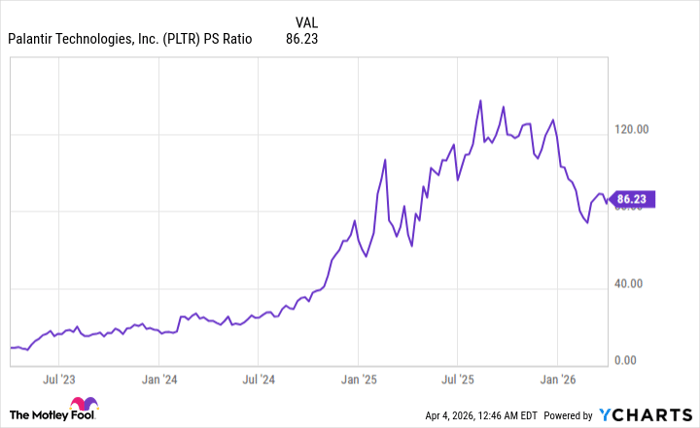
For example, AI data-mining specialist Palantir Technologies (NASDAQ: PLTR) has, arguably, been an even hotter commodity for investors than Nvidia. Shares of Palantir have skyrocketed by more than 2,200% since the start of 2023, with its Gotham and Foundry software-as-a-service platforms enjoying sustainable moats.
PLTR PS Ratio data by YCharts.
But history has shown that price-to-sales (P/S) ratios above 30 aren't sustainable for companies on the leading edge of next-big-thing trends. Palantir entered 2026 with a P/S ratio over 100 and closed out April 2 with a P/S ratio of 86. This is a level that screams, "bubble!"
It's a somewhat similar story for the broader market. The S&P 500's (SNPINDEX: ^GSPC) Shiller Price-to-Earnings (P/E) Ratio entered the year above 40, marking its second-priciest valuation since January 1871. Prior occurrences of the Shiller P/E topping 40 were followed by declines of 49% (the dot-com bubble) and 25% (the 2022 bear market).
If history rhymes, once again, and the stock market rolls over, companies with premium valuations (i.e., most AI stocks) would likely be among the hardest hit.
3. Waning hardware scarcity will weigh on AI superstars
The third sign that the artificial intelligence bubble is near its bursting point concerns hardware scarcity.
One of the biggest tailwinds for Nvidia has been the scarcity of AI GPUs. Though the superior compute capabilities of Hopper, Blackwell, and Blackwell Ultra have afforded Nvidia premium pricing power, enterprise GPU demand has handily outpaced supply and truly lit a fire under its pricing power and gross margin.

Image source: Getty Images.
We've observed a similar dynamic play out with memory stocks, such as Micron Technology. A limited supply of high-bandwidth memory (HBM), coupled with Taiwan Semiconductor Manufacturing's monthly ceiling for chip-on-wafer-on-substrate capacity, has sent HBM prices into the stratosphere.
However, this AI hardware scarcity won't last forever. For instance, many of Nvidia's top customers by net sales are developing AI chips to use in their data centers. Even though these internally developed GPUs are no match for Nvidia's hardware, they're notably cheaper and more readily accessible. This is a recipe to minimize the hardware scarcity that's fueled otherworldly pricing power for Wall Street's AI superstars.
4. A monetary policy shift can undo the parabolic climb of AI stocks
Last but not least, the Federal Reserve has the ability to put the kibosh on Wall Street's seemingly unstoppable AI rally.
Since September 2024, the nation's central bank has lowered the federal funds target rate six times. Lower interest rates make borrowing cheaper for businesses, spurring hiring, acquisitions, and innovation. With regard to AI, it makes building multibillion-dollar data centers more enticing.
But there's a realistic chance that the Fed's rate-easing cycle is about to be stopped in its tracks.
US Inflation Rate data by YCharts.
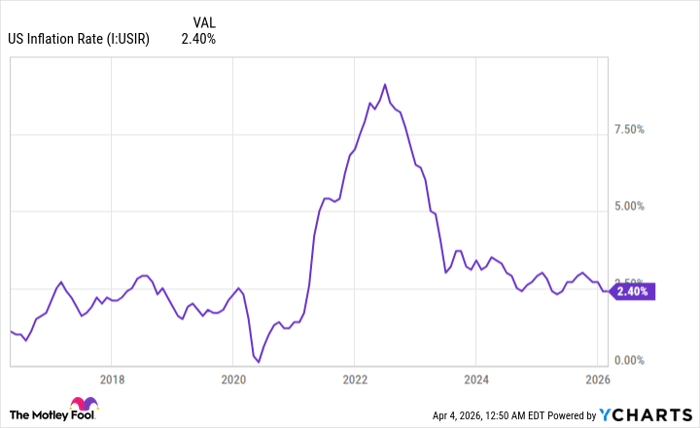
The Iran war precipitated the largest energy supply disruption in history. Crude oil prices have soared over the last six weeks, which is going to have a noticeable effect on the U.S. inflation rate. According to estimates from the Federal Reserve Bank of Cleveland's Inflation Nowcasting tool, the trailing 12-month inflation rate is estimated to jump to 3.25% in March from a reported 2.40% in February.
In other words, the central bank has virtually no incentive to lower interest rates and might even consider rate hikes before the end of the year. However, the expectation of lower lending rates has been baked into stock valuations.
If the Federal Reserve changes its tune, it could mark an abrupt end to Wall Street's parabolic AI stock rally.
Should you buy stock in Nvidia right now?
Before you buy stock in Nvidia, consider this:
The Motley Fool Stock Advisor analyst team just identified what they believe are the 10 best stocks for investors to buy now… and Nvidia wasn’t one of them. The 10 stocks that made the cut could produce monster returns in the coming years.
Consider when Netflix made this list on December 17, 2004... if you invested $1,000 at the time of our recommendation, you’d have $533,522!* Or when Nvidia made this list on April 15, 2005... if you invested $1,000 at the time of our recommendation, you’d have $1,089,028!*
Now, it’s worth noting Stock Advisor’s total average return is 930% — a market-crushing outperformance compared to 185% for the S&P 500. Don't miss the latest top 10 list, available with Stock Advisor, and join an investing community built by individual investors for individual investors.
See the 10 stocks »
*Stock Advisor returns as of April 8, 2026.
Sean Williams has no position in any of the stocks mentioned. The Motley Fool has positions in and recommends Micron Technology, Nvidia, Palantir Technologies, and Taiwan Semiconductor Manufacturing. The Motley Fool has a disclosure policy.
Recommended Articles


