


Nvidia Stock Just Presented Investors With a Once-in-a-Decade Buying Opportunity
Key Points
Nvidia supplies the world's best data center chips for artificial intelligence (AI) workloads.
It's about to start shipping its most powerful chips ever, which is expected to accelerate revenue.
The stock is currently cheaper than the S&P 500 on a forward basis for the first time in 13 years.
- 10 stocks we like better than Nvidia ›
The S&P 500 index has plunged almost 9% from its January all-time high amid ongoing geopolitical tensions in the Middle East. With oil prices soaring, Wall Street is worried about a slowdown in the U.S. economy and in corporate earnings.
Some individual tech stocks have declined even more sharply than the S&P 500, including Nvidia (NASDAQ: NVDA) which is currently down 20% from its record high. While the company could be impacted by economic uncertainty in the short term, demand for its data center chips is likely to remain rock-solid in the medium and long term, given their critical role in artificial intelligence (AI) development.
Will AI create the world's first trillionaire? Our team just released a report on the one little-known company, called an "Indispensable Monopoly" providing the critical technology Nvidia and Intel both need. Continue »
Nvidia stock is currently cheaper than the S&P 500 on a forward price-to-earnings (P/E) basis for the first time in 13 years, presenting investors with a potential once-in-a-decade buying opportunity. Here's why they might want to grab it with both hands.

Image source: Nvidia.
All eyes on Vera Rubin
Nvidia's primary data center chips are called graphics processing units (GPUs). They are designed for parallel processing, which means they are great at handling multiple tasks simultaneously, making them ideal for data-intensive workloads like AI training and AI inference.
Its current flagship GPU is the GB300, which is based on the company's Blackwell architecture. The GB300 offers up to 50 times more performance (in certain configurations) than Nvidia's original AI data center GPU, the H100, which was launched in 2022. This highlights how fast the company is innovating.
But Nvidia is taking another step forward this year with its new Vera Rubin platform. It includes the Rubin GPU and the Vera CPU, combined with upgraded networking equipment for even faster processing speeds. Nvidia says the platform will be so powerful that developers will be able to train AI models using 75% fewer GPUs, leading to an incredible 90% reduction in inference token costs.
Tokens are slivers of data generated by an AI model in response to a prompt. They can be words, symbols, or images, and they require computing power to generate, which costs money. That is why most AI providers charge their users based on their token consumption. Bringing down inference token costs will encourage more usage while increasing profit margins for AI companies.
As a result, Nvidia CFO Colette Kress expects every cloud provider and AI developer to deploy Vera Rubin chips. Samples recently started shipping to customers, with mass production scheduled for the second half of this year.
Wall Street expects another blockbuster year of growth
Nvidia's 2026 fiscal year ended on Jan. 25. The company generated a record $215.9 billion in revenue, which was up 65% from the previous year. Its data center business alone accounted for $193.7 billion of that revenue, and it grew by 68%.
But in the current 2027 fiscal year, Wall Street believes Nvidia's overall revenue growth will accelerate to 71%, with almost $370 billion expected to flow through the door (according to Yahoo! Finance). That estimate suggests there could be incredible demand for Vera Rubin chips.
At the bottom line, Nvidia generated adjusted non-GAAP (generally accepted accounting principles) earnings of $4.77 per share during fiscal 2026, and Wall Street expects that figure to soar by 74% to $8.29 per share in fiscal 2027. These figures are central to the company's valuation story, which we will explore below.
Nvidia is trading at a once-in-a-decade valuation
Based on Nvidia's fiscal 2026 earnings, its stock is trading at a P/E ratio of 34.7, a steep discount to its 10-year average of 61.6. But based on the company's expected fiscal 2027 earnings, its stock is trading at a forward P/E ratio of just 20.5. For some perspective, the S&P 500 is currently trading at a forward P/E ratio of 20.7, so Nvidia is currently cheaper than the benchmark index -- for the first time in more than a decade.
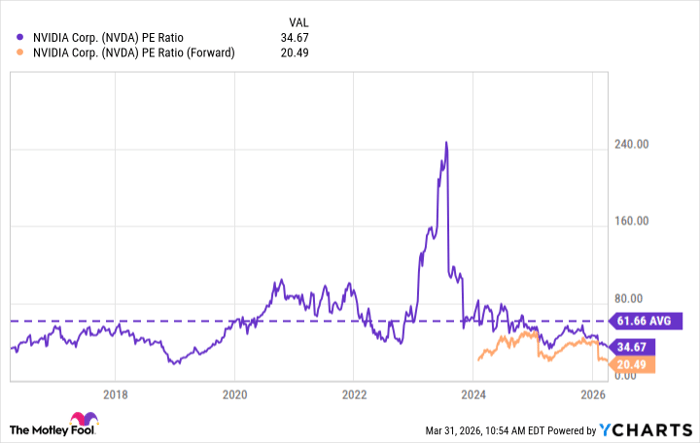
NVDA PE Ratio data by YCharts
Therefore, this appears to be a rare buying opportunity for investors. In terms of potential upside from here, Nvidia stock would have to soar by 200% by the end of fiscal 2027 (which concludes on Jan. 31, 2027) just to trade in line with its 10-year average P/E ratio of 61.6. Of course, that assumes Wall Street's fiscal 2027 earnings estimate is accurate.
I think Nvidia will meet or even exceed expectations. CEO Jensen Huang recently said the world was spending around $400 billion per year on classical computing infrastructure in the past, and to highlight the opportunity at hand, he asserted that AI workloads require a thousand times more computing capacity.
As a result, Huang believes data center operators could be spending up to $4 trillion per year on AI infrastructure by 2030, creating an enormous addressable market.
Should you buy stock in Nvidia right now?
Before you buy stock in Nvidia, consider this:
The Motley Fool Stock Advisor analyst team just identified what they believe are the 10 best stocks for investors to buy now… and Nvidia wasn’t one of them. The 10 stocks that made the cut could produce monster returns in the coming years.
Consider when Netflix made this list on December 17, 2004... if you invested $1,000 at the time of our recommendation, you’d have $533,522!* Or when Nvidia made this list on April 15, 2005... if you invested $1,000 at the time of our recommendation, you’d have $1,089,028!*
Now, it’s worth noting Stock Advisor’s total average return is 930% — a market-crushing outperformance compared to 185% for the S&P 500. Don't miss the latest top 10 list, available with Stock Advisor, and join an investing community built by individual investors for individual investors.
See the 10 stocks »
*Stock Advisor returns as of April 7, 2026.
Anthony Di Pizio has no position in any of the stocks mentioned. The Motley Fool has positions in and recommends Nvidia. The Motley Fool has a disclosure policy.
Recommended Articles


