

After a Monster Run, Is Micron Still Worth Owning?

Source The Motley Fool

Key Points

  • Shares of Micron have skyrocketed more than 300% over the last year.

  • Micron's rally is supported by robust demand for memory and storage solutions amid an AI infrastructure supercycle.

  • While Micron faces new risks from big tech, the stock could still be an attractive opportunity for the right investor.

  • 10 stocks we like better than Micron Technology ›

Micron Technology (NASDAQ: MU) has delivered one of the most explosive rallies in the semiconductor sector in recent months. Over the last year, Micron stock has soared 324% -- handily trouncing larger artificial intelligence (AI) chip peers like Nvidia, Advanced Micro Devices, Taiwan Semiconductor Manufacturing, and Broadcom.

The catalyst? Memory and storage are the new bottlenecks amid surging AI capacity demand. Yet after such a parabolic rise, smart investors are wondering whether Micron's growth wave still has room to run or if the stock has peaked and is already priced to perfection.

Will AI create the world's first trillionaire? Our team just released a report on the one little-known company, called an "Indispensable Monopoly" providing the critical technology Nvidia and Intel both need. Continue »

Micron headquarters with logo on sign out front.

Image source: Micron Technology.

Why did Micron stock surge last year?

Micron's ascent was not fueled by vague hype narratives. Rather, the company plays a very specific, albeit increasingly important, role in the AI chip value chain.

Model training clusters built around graphics processing units (GPUs) and AI accelerators require massive volumes of ultra-fast memory layered alongside general-purpose chip processors. Concurrently, hyperscalers are doubling down on inference servers and high-capacity solid-state drives (SSDs) to store their vast libraries of training data.

The once-cyclical memory market has suddenly started to look like a growth engine poised to ride multiyear secular tailwinds supported by accelerating AI infrastructure. This means that Micron's high-bandwidth memory (HBM) products are swiftly transitioning from a "nice to have" to a "must-have."

As such, Micron is commanding enormous pricing power for its DRAM and NAND products -- fueling robust revenue growth in tandem with a widening gross margin.
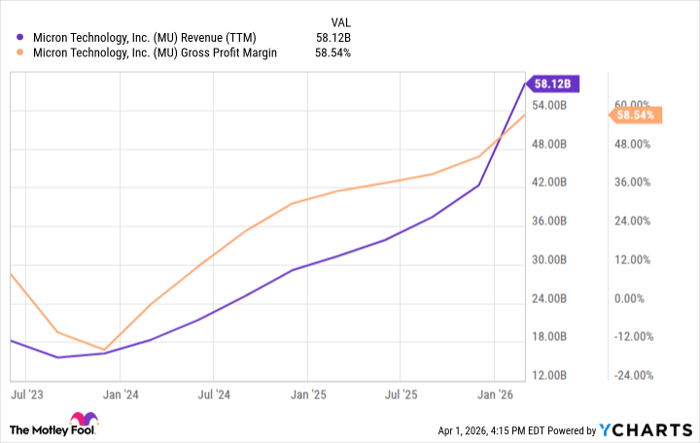
MU Revenue (TTM) Chart

Data by YCharts.

How sustainable is the AI memory chip supercycle?

Memory demand has traditionally reacted to upgrade cycles with PCs and smartphones. AI demand is structurally different as it's tied to exponential growth in model sizes and data volume.

Each new generation of models requires orders of magnitude more data parameters and training tokens than its predecessor. Meanwhile, scaling inference demands low-latency access to these vast workloads.

These dynamics create a floor under memory consumption trends that did not exist previously. So long as big tech continues committing hundreds of billions to AI infrastructure annually, the memory supercycle should remain in an elevated uptrend.

Is Micron stock a buy?

While demand for memory solutions appears durable, there is a notable risk when it comes to investing in Micron stock. And I'm not talking about chasing momentum before a massive sell-off.

Alphabet's recent breakthrough in lossless data compression has caused dramatic selling pressure in Micron stock over the last week. Google's TurboQuant algorithm has demonstrated how software efficiency can substitute for hardware scale without sacrificing model training data or accuracy.

The bear narrative is that the need for NAND and DRAM could begin to erode as Google's new compression ability reduces the level of raw data that is required to be stored and transferred between GPU clusters.

Nevertheless, I still view Micron as a high-conviction opportunity amid ongoing AI infrastructure build-outs. The caveat, of course, is that investors must be able to stomach volatility. While Micron's monster run was real, I expect the stock's next leg higher will be much harder won.

Should you buy stock in Micron Technology right now?

Before you buy stock in Micron Technology, consider this:

The Motley Fool Stock Advisor analyst team just identified what they believe are the 10 best stocks for investors to buy now… and Micron Technology wasn’t one of them. The 10 stocks that made the cut could produce monster returns in the coming years.

Consider when Netflix made this list on December 17, 2004... if you invested $1,000 at the time of our recommendation, you’d have $532,066!* Or when Nvidia made this list on April 15, 2005... if you invested $1,000 at the time of our recommendation, you’d have $1,087,496!*

Now, it’s worth noting Stock Advisor’s total average return is 926% — a market-crushing outperformance compared to 185% for the S&P 500. Don't miss the latest top 10 list, available with Stock Advisor, and join an investing community built by individual investors for individual investors.

See the 10 stocks »

*Stock Advisor returns as of April 5, 2026.

Adam Spatacco has positions in Alphabet and Nvidia. The Motley Fool has positions in and recommends Advanced Micro Devices, Alphabet, Micron Technology, Nvidia, and Taiwan Semiconductor Manufacturing. The Motley Fool recommends Broadcom. The Motley Fool has a disclosure policy.

Disclaimer: For information purposes only. Past performance is not indicative of future results.
placeholder
Bitcoin CME gaps at $35,000, $27,000 and $21,000, which one gets filled first?Prioritize filling the $27,000 gap and even try higher.
Author  FXStreet
Aug 22, 2023
Prioritize filling the $27,000 gap and even try higher.
placeholder
Bitcoin briefly loses 2025 gains as crypto plunges over the weekend.Bitcoin experienced a sharp decline this weekend, briefly erasing its 2025 gains and dipping below its year-opening value of $93,507. The cryptocurrency fell to a low of $93,029 on Sunday, representing a 25% drop from its all-time high in October. Although it has rebounded slightly to around $94,209, the pressures on the market remain significant. The downturn occurred despite the reopening of the U.S. government on Thursday, which many had hoped would provide essential support for crypto markets. This year initially appeared promising for cryptocurrencies, particularly after the inauguration of President Donald Trump, who has established the most pro-crypto administration thus far. However, ongoing political tensions—including Trump's tariff strategies and the recent government shutdown, lasting a historic 43 days—have contributed to several rapid price pullbacks for Bitcoin throughout the year. Market dynamics are also being influenced by Bitcoin whales—investors holding large amounts of Bitcoin—who have been offloading portions of their assets, consequently stalling price rallies even as positive regulatory developments emerge. Despite these sell-offs, analysts from Glassnode argue that this behavior aligns with typical patterns seen among long-term investors during the concluding stages of bull markets, suggesting it is not indicative of a mass exodus. Notably, Bitcoin is not alone in its struggles, as Ethereum and Solana have also recorded declines of 7.95% and 28.3%, respectively, since the start of the year, while numerous altcoins have faced even steeper losses. Looking ahead, questions linger regarding the viability of the four-year cycle thesis, particularly given the increasing institutional support and regulatory frameworks now in place in the crypto landscape. Matt Hougan, chief investment officer at Bitwise, remains optimistic, suggesting a potential Bitcoin resurgence in 2026 driven by the “debasement trade” thesis and a broader trend toward increased adoption of stablecoins, tokenization, and decentralized finance. Hougan emphasized the soundness of the underlying fundamentals, pointing to a positive outlook for the sector in the longer term.
Author  Mitrade
Nov 17, 2025
Bitcoin experienced a sharp decline this weekend, briefly erasing its 2025 gains and dipping below its year-opening value of $93,507. The cryptocurrency fell to a low of $93,029 on Sunday, representing a 25% drop from its all-time high in October. Although it has rebounded slightly to around $94,209, the pressures on the market remain significant. The downturn occurred despite the reopening of the U.S. government on Thursday, which many had hoped would provide essential support for crypto markets. This year initially appeared promising for cryptocurrencies, particularly after the inauguration of President Donald Trump, who has established the most pro-crypto administration thus far. However, ongoing political tensions—including Trump's tariff strategies and the recent government shutdown, lasting a historic 43 days—have contributed to several rapid price pullbacks for Bitcoin throughout the year. Market dynamics are also being influenced by Bitcoin whales—investors holding large amounts of Bitcoin—who have been offloading portions of their assets, consequently stalling price rallies even as positive regulatory developments emerge. Despite these sell-offs, analysts from Glassnode argue that this behavior aligns with typical patterns seen among long-term investors during the concluding stages of bull markets, suggesting it is not indicative of a mass exodus. Notably, Bitcoin is not alone in its struggles, as Ethereum and Solana have also recorded declines of 7.95% and 28.3%, respectively, since the start of the year, while numerous altcoins have faced even steeper losses. Looking ahead, questions linger regarding the viability of the four-year cycle thesis, particularly given the increasing institutional support and regulatory frameworks now in place in the crypto landscape. Matt Hougan, chief investment officer at Bitwise, remains optimistic, suggesting a potential Bitcoin resurgence in 2026 driven by the “debasement trade” thesis and a broader trend toward increased adoption of stablecoins, tokenization, and decentralized finance. Hougan emphasized the soundness of the underlying fundamentals, pointing to a positive outlook for the sector in the longer term.
placeholder
ECB Policy Outlook for 2026: What It Could Mean for the Euro’s Next MoveWith the ECB likely holding rates steady at 2.15% and the Fed potentially extending cuts into 2026, EUR/USD may test 1.20 if Eurozone growth proves resilient, but weaker growth and an ECB pivot could pull the pair back toward 1.13 and potentially 1.10.
Author  Mitrade
Dec 26, 2025
With the ECB likely holding rates steady at 2.15% and the Fed potentially extending cuts into 2026, EUR/USD may test 1.20 if Eurozone growth proves resilient, but weaker growth and an ECB pivot could pull the pair back toward 1.13 and potentially 1.10.
placeholder
Gold Price Forecast: XAU/USD opens lower around $4,450 on fears of widening Iran conflictsGold price (XAU/USD) opens over 1% lower to near $4,445.00 on Monday, as oil prices have rallied further on fears of further widening of conflicts in the Middle East. WTI Oil price is up almost 3% above $102.50 in the opening trade, increasing fears of higher inflation expectations globally.
Author  FXStreet
Mar 30, Mon
Gold price (XAU/USD) opens over 1% lower to near $4,445.00 on Monday, as oil prices have rallied further on fears of further widening of conflicts in the Middle East. WTI Oil price is up almost 3% above $102.50 in the opening trade, increasing fears of higher inflation expectations globally.
placeholder
Silver Price Forecast: XAG/USD falls to near $72.00 amid fading safe-haven demandSilver price (XAG/USD) continues to lose ground after registering tiny losses in the previous day, trading around $72.90 during the Asian hours on Thursday. The safe-haven demand for the precious metal fades amid rising optimism over Middle East peace.
Author  FXStreet
Apr 02, Thu
Silver price (XAG/USD) continues to lose ground after registering tiny losses in the previous day, trading around $72.90 during the Asian hours on Thursday. The safe-haven demand for the precious metal fades amid rising optimism over Middle East peace.
goTop
quote