


Why the Iran War Has Created a Buying Opportunity for Renewables
Key Points
Due to issues in the Strait of Hormuz, oil prices have skyrocketed.
This will likely prompt the U.S. to focus more in the future on domestic energy production, including renewables.
- These 10 stocks could mint the next wave of millionaires ›
The war in Iran, which escalated in a matter of weeks, has shown just how complex wars can be. They never go as planned, especially because all parties involved have a say, and one can never predict how the other will act.
While no one doubted that the U.S. and Israel had an advantage over Iran from a military perspective, the conflict has proven difficult because Iran has used tactics to wage war on the global economy as a result of their influence over oil.
Will AI create the world's first trillionaire? Our team just released a report on the one little-known company, called an "Indispensable Monopoly" providing the critical technology Nvidia and Intel both need. Continue »
Here's why the aftermath of this conflict could make a strong case for buying renewable energy stocks.
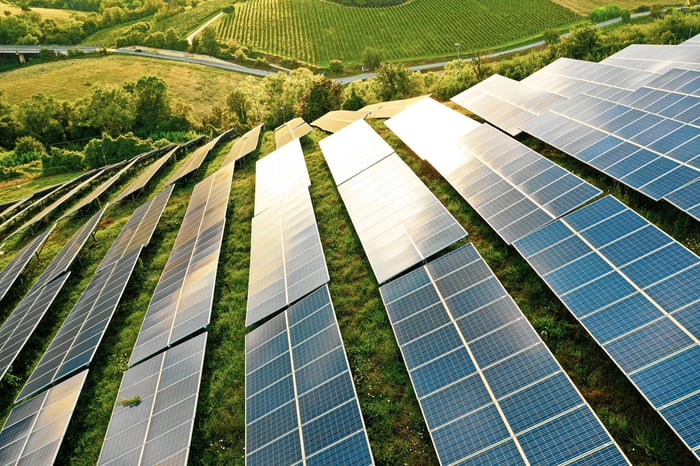
Image source: Getty Images.
The world will want less reliance on foreign oil
If there's been a weak spot for the U.S. in the war in Iran and broader Middle East conflict, it's been the world's reliance on foreign oil, much of which lies in the Middle East.
Once the conflict began, the Islamic Revolutionary Guard Corps (IRGC) essentially halted traffic through the Strait of Hormuz, which borders Iran. The Strait of Hormuz is a 20- to 30-milewide body of water through which 20% of the world's oil flows daily in normal times. After the war broke out, the IRGC threatened to attack ships not approved for passage by Tehran.
This effectively brought activity to a standstill because oil companies didn't want to risk ships and crews being attacked when passing through. That's why crude oil has risen above $100 per barrel on several occasions in recent weeks. Furthermore, other energy assets in the Middle East, such as natural gas facilities, have also been damaged and could take years to rebuild. That adds to the stress on broader energy markets.
Energy costs are also embedded in so many other areas of the economy that higher prices end up serving as a tax on consumers while raising the cost of doing business for businesses. Higher oil prices came at a bad time for the U.S. economy, which has been trying to escape elevated inflation and exacerbated affordability issues since the pandemic.
This should bolster the case for reducing reliance on the global oil supply chain and increasing energy production that can be completely done in the U.S. Renewable clean energy sources, such as solar, wind, and other electrification methods, are an obvious choice.
"Renewables and its associated technologies are now commonly perceived as an energy security tool, no longer only a way to combat pollution and climate change, but a geopolitical asset supported by pragmatism rather than idealism," Gonzalo Escribano, a senior fellow for energy and climate at the Madrid-based Elcano Royal Institute, told CNBC in an email. "Even among governments and citizens with little concern for environmental issues."
Reasons to buy renewables
While renewable energy is by no means a new concept, there is still significant runway in the sector. According to the U.S. Energy Information Administration, renewable energy made up about 9% of total primary energy production in 2024. Natural gas and petroleum still accounted for 38% and 35% of production, respectively.
Furthermore, the Trump administration has not emphasized renewable energy and has removed many government incentives for renewables, such as the federal tax credit for electric vehicles.
Still, the sector has performed well, primarily because artificial intelligence (AI) has driven tremendous demand for power to fuel the massive data centers and other infrastructure needed to support the new groundbreaking technology.
The iShares Global Clean Energy ETF and the Invesco Solar ETF are up roughly 54% and 75%, respectively, over the past year, although both are still down significantly over the past five years.
I believe what has happened in recent weeks in the Iran war could place a new emphasis on renewable energy. It should get much more attention if deemed of national security importance, which I think is hard to dispute at this point.
Where to invest $1,000 right now
When our analyst team has a stock tip, it can pay to listen. After all, Stock Advisor’s total average return is 914%* — a market-crushing outperformance compared to 184% for the S&P 500.
They just revealed what they believe are the 10 best stocks for investors to buy right now, available when you join Stock Advisor.
See the stocks »
*Stock Advisor returns as of April 2, 2026.
Bram Berkowitz has no position in any of the stocks mentioned. The Motley Fool has no position in any of the stocks mentioned. The Motley Fool has a disclosure policy.
Recommended Articles


