


Oracle Stock Hasn't Been This Cheap in 3 Years -- But Is It a Buy Right Now?
Key Points
Oracle is building some of the most powerful and most cost-efficient AI data centers in the industry, and demand is through the roof.
The company has a record $553 billion order backlog from AI developers who are waiting for more data center capacity to come online.
But Oracle stock has plummeted by 57% since last September, as investors worry about the company's rising debts and the reliability of one key customer.
- 10 stocks we like better than Oracle ›
The stock market is in the throes of a sell-off, with major U.S. indexes like the Nasdaq-100 and the Dow Jones Industrial Average plunging by more than 10% from their record highs as of March 30. Ongoing geopolitical tensions in the Middle East have sent oil prices soaring, which is stoking fears of an economic slowdown here in the U.S.
But one stock in particular started sinking long before the Middle East conflict began. Oracle (NYSE: ORCL) has built some of the world's best data centers for developing artificial intelligence (AI), and demand for its infrastructure is through the roof. However, investors are concerned about the company's rising debts, and the reliability of one of its biggest customers.
Will AI create the world's first trillionaire? Our team just released a report on the one little-known company, called an "Indispensable Monopoly" providing the critical technology Nvidia and Intel both need. Continue »
Oracle stock peaked at around $328 last September, and it has since plummeted by 57%. By one widely used valuation metric, the stock is now at the cheapest level since the AI boom started gathering momentum in early 2023, so could this be a golden buying opportunity for investors?
Image source: The Motley Fool.
A leader in AI infrastructure
Most AI development happens in large, centralized data centers, which are fitted with thousands of specialized chips called graphics processing units (GPUs). Most businesses don't have billions of dollars to build this infrastructure in-house, so they rent computing capacity from cloud providers like Oracle instead.
Oracle's data centers are highly automated, so they require very little human labor to run, which allows the company to bring them online very quickly post-construction. Plus, each Oracle data center uses proprietary random direct memory access (RDMA) networking technology, which is designed for high-performance AI workloads. It offers low latency and high throughput, so it moves information between chips and devices much faster, and with less data loss, than traditional Ethernet networks.
Most AI developers pay for cloud computing capacity by the minute, so automated infrastructure that delivers faster processing speeds can result in substantial cost savings over time.
Scale is another benefit of Oracle's infrastructure. It allows its customers to tap into enormous clusters of over 131,000 GPUs from leading suppliers like Nvidia and Advanced Micro Devices, so they can run even the most powerful AI models.
A record order backlog, but there's a catch
Oracle generated $17.2 billion in total revenue during its fiscal 2026 third quarter (ended Feb. 28), which was a 22% jump from the year-ago period. However, revenue from the Oracle Cloud Infrastructure segment specifically surged by 84% to $4.9 billion.
Like most cloud providers, Oracle is experiencing more demand for computing capacity than it can possibly supply, with top AI companies like OpenAI, Cohere, Meta Platforms, and Elon Musk's xAI lining up to use its data centers. As a result, the company ended the third quarter with a staggering $553 billion in remaining performance obligations (RPO), which skyrocketed by 325% from the year-ago period. RPO reflects the value of signed contracts for services that haven't been delivered yet, so it's similar to an order backlog.
But the devil is in the details. As I mentioned earlier, Oracle stock peaked in September, which happened to be when The Wall Street Journal reported that $300 billion of the company's RPO was attributable to ChatGPT creator OpenAI alone. This lofty figure is a problem, because OpenAI only has $25 billion in annualized revenue and is seeing substantial losses. Therefore, it's unclear how exactly the start-up will fulfill its enormous commitment to rent computing capacity from Oracle.
OpenAI recently raised $120 billion in fresh capital from investors, but even that doesn't come close to covering its obligations, especially since Oracle is one of several cloud providers the start-up is dealing with.
To make matters worse, Oracle is carrying over $124 billion in long-term debt, and it continues to borrow more to fund the construction of new AI data centers. If major customers like OpenAI don't come through, Oracle could be left in a dire financial situation a few years from now.
Is this a good time to buy Oracle stock?
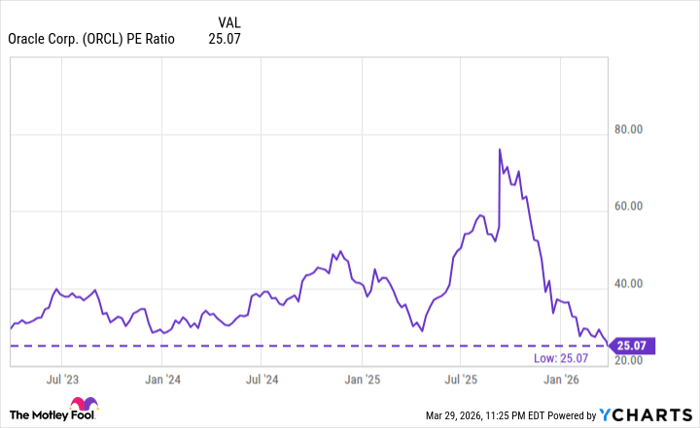
Oracle generated earnings of $5.57 per share over the last four quarters, placing its stock at a price-to-earnings (P/E) ratio of just 25.1. That is the cheapest level in a little over three years:
ORCL PE Ratio data by YCharts
In fact, Oracle stock is trading at a discount to the Nasdaq-100 index, which has a P/E ratio of 29.9. In other words, it might be undervalued relative to a basket of its big-tech peers. But a beaten-down stock isn't always a cheap or valuable stock, so I don't think an attractive valuation alone is enough to make this stock a certain buy.
Oracle seems far more vulnerable than most of its competitors in the cloud infrastructure space because of its high debt load and the composition of its order backlog. Although the company isn't directly affected by the conflict in the Middle East, the resulting economic slowdown that impacts AI spending across the board could have serious negative consequences for its business.
As a result, while Oracle's long-term outlook might be better than its plummeting stock price implies, investors are probably better off waiting on the sidelines until the broader market stabilizes.
Should you buy stock in Oracle right now?
Before you buy stock in Oracle, consider this:
The Motley Fool Stock Advisor analyst team just identified what they believe are the 10 best stocks for investors to buy now… and Oracle wasn’t one of them. The 10 stocks that made the cut could produce monster returns in the coming years.
Consider when Netflix made this list on December 17, 2004... if you invested $1,000 at the time of our recommendation, you’d have $515,294!* Or when Nvidia made this list on April 15, 2005... if you invested $1,000 at the time of our recommendation, you’d have $1,077,442!*
Now, it’s worth noting Stock Advisor’s total average return is 914% — a market-crushing outperformance compared to 184% for the S&P 500. Don't miss the latest top 10 list, available with Stock Advisor, and join an investing community built by individual investors for individual investors.
See the 10 stocks »
*Stock Advisor returns as of April 2, 2026.
Anthony Di Pizio has no position in any of the stocks mentioned. The Motley Fool has positions in and recommends Advanced Micro Devices, Meta Platforms, Nvidia, and Oracle. The Motley Fool has a disclosure policy.
Recommended Articles


