


USD/JPY Hits 160.00 Mark, Will Japanese Government Intervene? Will the Currency’s Rally Be Contained?


TradingKey - As of March 30, the US Dollar against the Japanese Yen ( USDJPY) continues to fluctuate at high levels near the 160 mark, with the Yen having fallen to a nearly one-year low. Expectations that Japanese authorities may intervene have rapidly intensified, while uncertainty over the Bank of Japan's policy path has made this exchange rate level particularly sensitive.
From the market's performance, USD/JPY hasn't seen a directional pullback but instead continues to saw back and forth at high levels. This suggests the market is not simply trading interest rate differentials, but is simultaneously pricing in multiple variables such as oil price shocks, inflation expectations, and policy maneuvering.
Fundamentals
From a fundamental perspective, the core driver pushing USD/JPY higher is not just dollar strength; more critically, the market is repricing the combination of "high oil prices + high interest rates."
On one hand, recurring tensions in the Middle East have kept Brent crude at elevated levels. As a typical energy importer, Japan faces significant cost-push inflationary pressure. Higher oil prices weaken the Yen's real purchasing power and make it harder for the current account to improve, directly undermining the Yen's fundamental support.
On the other hand, Federal Reserve policy expectations are shifting. Markets originally bet on multiple rate cuts this year, but those expectations have cooled significantly as inflation proves sticky. "Higher for longer" has become the new narrative, boosting the appeal of dollar-denominated assets and further widening the yield spread between the US and Japan.
Against this backdrop, the Yen's traditional safe-haven status has been eroded. Instead, it has exhibited a "counter-trend weakening" during periods of rising global risk aversion, which is one of the most anomalous characteristics of the current exchange rate trend.
Meanwhile, as the Yen continues to depreciate, the Bank of Japan is navigating an increasingly complex policy environment.
On one hand, Japan's economic recovery remains fragile, and raising rates too quickly could pressure consumption and corporate financing. On the other hand, a weak Yen combined with high oil prices has already begun to drive up inflation and could trigger second-round price effects.
This is why internal expectations within the Bank of Japan regarding the need for further rate hikes have risen significantly. Markets have begun betting that the BoJ could signal clearer tightening as early as the April policy meeting, or even act sooner.
Technical Analysis
From technical and policy standpoints, 160.00 is no longer just a psychological level but an "intervention threshold" closely monitored by the market.
Historically, the Japanese government has intervened at similar levels, embedding a natural policy risk premium into the current price. Recent frequent statements from the Ministry of Finance and the Bank of Japan about taking "decisive action against excessive volatility" have further reinforced intervention expectations.
For the market, this means the logic of USD/JPY movement above 160.00 has changed; the price action is no longer a simple trend continuation, but a combination of "trend plus policy maneuvering."
Once actual intervention occurs, the exchange rate could see a rapid pullback in a very short time. However, if actions remain limited to verbal warnings, the pair may continue to oscillate at high levels or even test higher upside.
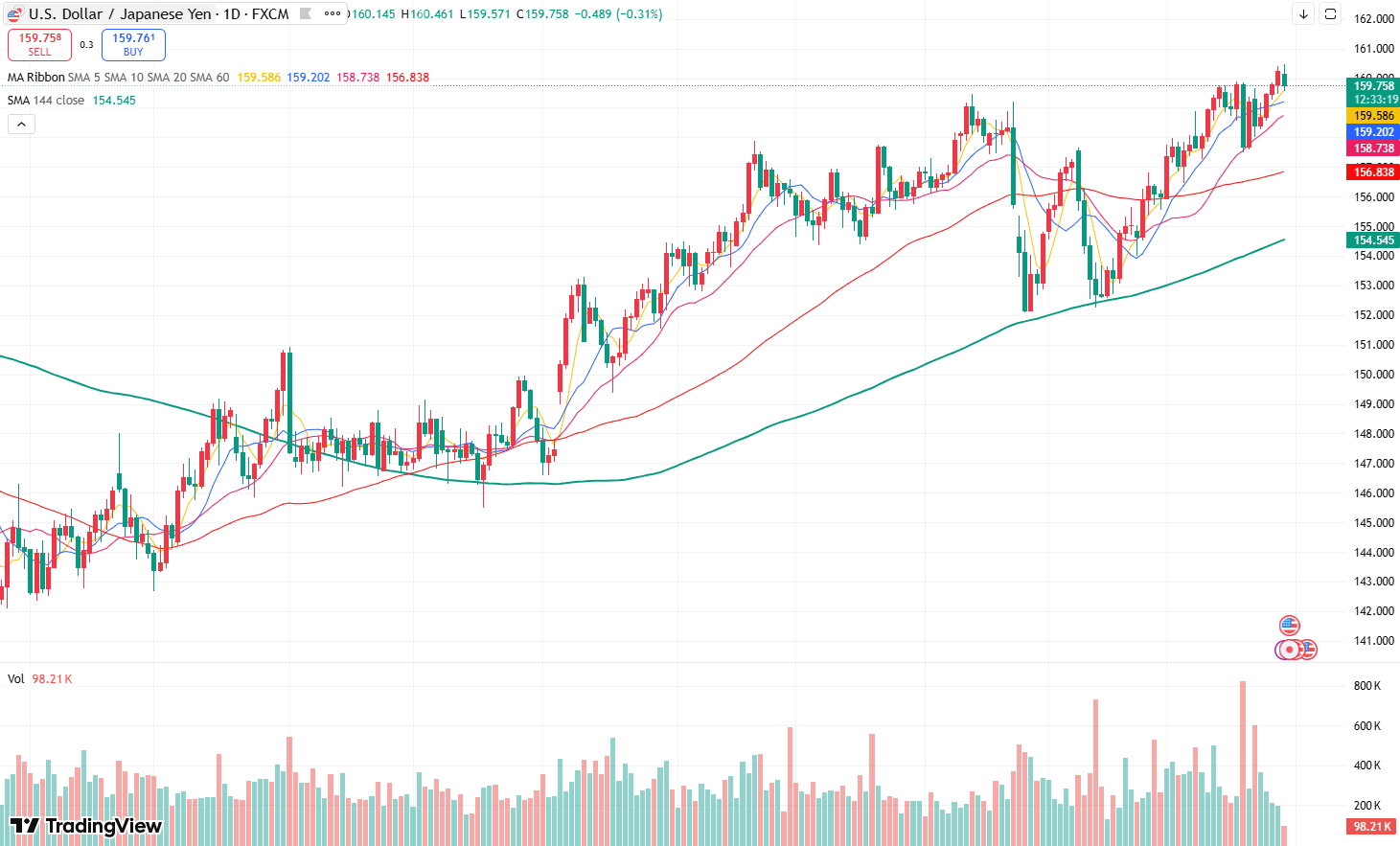
Looking at the daily chart, USD/JPY successfully broke above the 160.00 mark last week. Today, due to market concerns regarding potential intervention by Japanese authorities, intraday price action has hovered near the 160.00 level.
Technical indicators show the Relative Strength Index (RSI) currently near 60.00, staying out of overbought territory and suggesting overall market sentiment remains bullish. Meanwhile, the moving average system maintains a bullish alignment, indicating that the medium-to-long-term trend for the pair remains upward.
Regarding upside resistance, the primary resistance lies in the 160.00-162.00 range, which is also a policy-sensitive zone. A decisive breakout would further open the door for more upside.
On the support side, the first level to watch is 159.00. If this level fails, the pair may further test the key support at 157.60. It is worth noting that a break below 157.60 could signal the exit of short-term long positions, potentially leading to a deeper corrective phase.
Overall, the exchange rate is more likely to oscillate around 160.00 in the near term, with volatility remaining elevated, rather than seeing a one-sided rapid advance or decline.
For short-term strategy, it is recommended to focus on buying the dips, using the SMA60 on the 1-hour chart and the SMA20 on the 4-hour chart as short-term supports, and attempting to go long when signs of a price floor appear.
Support Levels: 159.00, 157.60
Resistance Levels: 160.41, 162.00
Read more
* The content presented above, whether from a third party or not, is considered as general advice only. This article should not be construed as containing investment advice, investment recommendations, an offer of or solicitation for any transactions in financial instruments.


