


3 Reasons Why Micron Is a Brilliant Stock to Buy
Key Points
Micron Technology is growing revenue at a rapid pace now.
Demand for memory chips isn't expected to fall anytime soon.
But investors should recognize the industry's cyclicality.
- 10 stocks we like better than Micron Technology ›
One of the newest artificial intelligence (AI) stars is Micron Technology (NASDAQ: MU), but if you have been following this industry for a while, this should come as no surprise. Micron's stock is up an incredible 335% over the past year, but with the way AI demand is heading, this could be just the start.
I think Micron is a solid stock to buy today, but there are a few items investors must keep track of as well.
Will AI create the world's first trillionaire? Our team just released a report on the one little-known company, called an "Indispensable Monopoly" providing the critical technology Nvidia and Intel both need. Continue »
Image source: Getty Images.
1. Memory demand for data centers is only going to continue rising
Micron makes memory chips, which are utilized in nearly every electronic device, and data center computing devices are no exception. Unlike logic chips, there isn't a ton that separates the competition from one another, which makes memory chips a commoditized product.
This means prices rise and fall based on demand. With the AI build-out hitting full stride, memory chip demand has exploded, causing memory chip prices to soar. With essentially all of the production capacity for memory chips being spoken for, Micron is experiencing huge demand and soaring prices, a one-two punch of success for the company.
At the start of 2025, the market for high-bandwidth memory (HBM, the primary type used in AI computing) was about $35 billion. By 2028, the company expects it to be $100 billion -- and that's just the beginning. Several projections estimate data center spending will grow through 2030, so demand for HBM could be even higher by 2030.
This would lead to several years of impressive growth for Micron, making the stock a compelling buy.
2. Micron's results are unbelievable
Micron recently reported its financial results for the second quarter of fiscal 2026, which ended Feb. 26. Revenue rose to $23.9 billion. The incredible thing about this is that it was just $13.6 billion last quarter. The company expects to add another $10 billion next quarter, with Q3 guidance coming in around $33.5 billion.
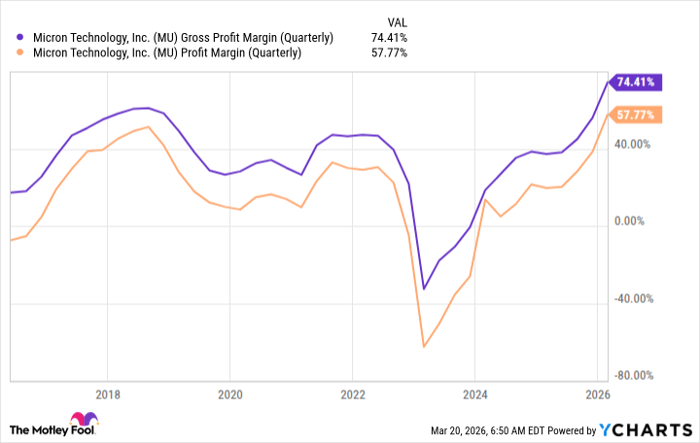
Demand for memory is booming, and Micron is clearly benefiting. But demand is also pushing its gross margin higher. As demand for memory chips grows, so does the price Micron can charge for them. This is pushing Micron's margins to recent highs.
MU Gross Profit Margin (Quarterly) data by YCharts
3. Micron's stock looks cheap, but it's cyclical
All of this adds up to a company that looks like a genius investment, but there is one thing investors must keep in mind: Despite Micron's revenue rapidly rising and profit levels hitting new highs, the stock trades for just 7.7 times forward earnings. Why is that?
Well, it all has to do with the cyclical nature of Micron's business. Memory chip prices rise and fall based on demand. When demand is high, times are good, and Micron makes a huge profit. When demand is low, Micron isn't a great investment, as it's just waiting for the next cycle.
Investors must understand how long this cycle will last -- a near-impossible task. If demand for memory chips stays high over the next five years, Micron is a great stock to consider buying now. If the memory demand wave is set to wrap up in the next few months, it's best to avoid Micron's stock. There are several indications that memory chip supply will remain crunched for several years, which bodes well for a Micron investment.
I think investors are OK to invest in Micron's stock if they understand the cyclical nature of the business and sell it once they see signs of demand easing. If you're more of a set-it-and-forget-it investor, Micron's stock isn't the best for you, as the tides could turn quickly, leaving investors wishing they had sold earlier.
Should you buy stock in Micron Technology right now?
Before you buy stock in Micron Technology, consider this:
The Motley Fool Stock Advisor analyst team just identified what they believe are the 10 best stocks for investors to buy now… and Micron Technology wasn’t one of them. The 10 stocks that made the cut could produce monster returns in the coming years.
Consider when Netflix made this list on December 17, 2004... if you invested $1,000 at the time of our recommendation, you’d have $503,592!* Or when Nvidia made this list on April 15, 2005... if you invested $1,000 at the time of our recommendation, you’d have $1,076,767!*
Now, it’s worth noting Stock Advisor’s total average return is 913% — a market-crushing outperformance compared to 185% for the S&P 500. Don't miss the latest top 10 list, available with Stock Advisor, and join an investing community built by individual investors for individual investors.
See the 10 stocks »
*Stock Advisor returns as of March 25, 2026.
Keithen Drury has no position in any of the stocks mentioned. The Motley Fool has positions in and recommends Micron Technology. The Motley Fool has a disclosure policy.
Recommended Articles


