


Will the Stock Market Crash Under President Trump in 2026? History Says Investors Have Reason to Worry.
Key Points
President Trump's tariffs have coincided with a slowdown in economic growth, and rising oil prices could become another economic headwind.
The S&P 500 usually performs poorly during midterm election years; history says the index has a 50-50 chance of dropping at least 19% in 2026.
The S&P 500 currently trades at an expensive valuation, meaning the index is susceptible to drawdowns caused by economic headwinds and policy uncertainty.
- 10 stocks we like better than S&P 500 Index ›
The S&P 500 (SNPINDEX: ^GSPC) is widely regarded as the best benchmark for the U.S. stock market because it covers about 80% of domestic equities by market value. The index is currently 5% below its record high after falling in three straight weeks. Several factors have contributed to the drawdown:
- President Trump's tariffs have coincided with weak gross domestic product (GDP) and jobs growth.
- Oil prices have skyrocketed to their highest levels in nearly four years.
- Midterm election years are fraught with policy uncertainty.
- The stock market is expensive by historical standards.
History says the S&P 500 could decline even further in the remaining months of the year as those situations continue to develop. Here's what investors should know.
Will AI create the world's first trillionaire? Our team just released a report on the one little-known company, called an "Indispensable Monopoly" providing the critical technology Nvidia and Intel both need. Continue »
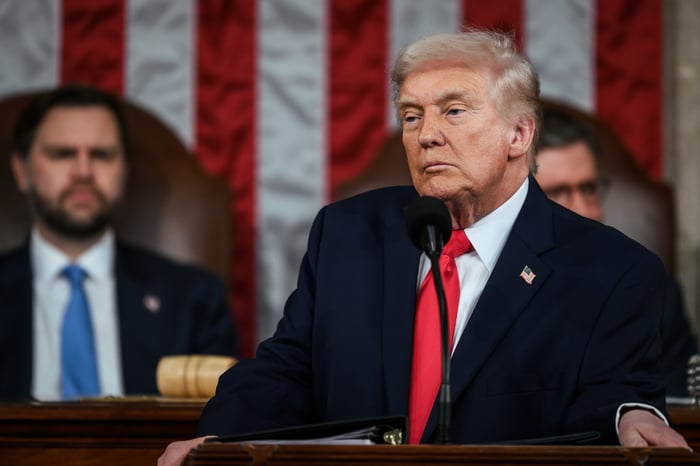
President Donald J. Trump delivers his State of the Union address. Image source: Official White House Photo.
President Trump's tariffs have coincided with weakness in the U.S. economy
Trump has reshaped the global trade landscape by imposing sweeping tariffs on sector-specific goods and imports from most countries. "We are quickly building the greatest economy in the history of the world," he wrote in January. But that statement runs contrary to the facts.
U.S. GDP increased 2.1% last year. Excluding the pandemic in 2020, that ranks as the slowest economic growth since 2016. Furthermore, U.S. employers added 181,000 jobs last year. Excluding the pandemic, that ranks as the slowest labor market growth since 2009. Neither figure paints the picture of a booming economy.
Soaring oil prices could become another economic headwind
The U.S.-Iran war has effectively closed the Strait of Hormuz, a waterway in the Persian Gulf that carries 20% of global oil and gas supply. The number of ship transits through the strait has fallen from about 150 a day to single digits since the war began, according to The Wall Street Journal.
Since late February, Brent crude oil prices (an international benchmark) have soared more than 40% to $103 per barrel, a level last seen in August 2022. U.S. consumers are already paying more at the pump. The average price for a gallon of regular gasoline recently topped $3.50 for the first time since the summer of 2024.
Midterm election years are normally volatile for the stock market
In the past, the S&P 500 has suffered a median peak-to-trough decline of 19% in midterm election years. Put differently, history says there is a 50-50 chance the index tumbles at least 19% at some point in 2026. That pattern can be attributed to policy uncertainty.
The political party in charge almost always loses a significant number of seats in Congress during midterm elections. That raises questions about whether the president's fiscal, trade, and regulatory policies will lose steam. So, investors often take money out of stocks until that uncertainty dissipates.
Stock market volatility could be particularly pronounced as the 2026 midterms approach because Trump's policies have proved especially polarizing. "With affordability a key issue in the U.S. midterms, supply chain pressures and energy prices are top of mind," according to Morgan Stanley.
The stock market is expensive by historical standards
The S&P 500 currently has a forward price-to-earnings (PE) ratio of 20.9, a premium to the 10-year average of 18.9, according to FactSet Research. Baked into that valuation is Wall Street's expectation that earnings growth will accelerate in 2026. In other words, investors have already discounted the fact that analysts expect strong earnings this year.
So what? Economic growth is the cornerstone of corporate earnings growth, so economic headwinds like tariffs and rising oil prices could cause earnings to increase more slowly than Wall Street expects. And a large downward revision to earnings forecasts could easily sink the S&P 500 because stocks are already expensive by historical standards.
However, the stock market is in a particularly precarious position today because midterm election years tend to be volatile anyway. That does not mean the S&P 500 will crash, but I think the odds of a severe drawdown are elevated. Investors should tread carefully in the current environment. Only buy high-conviction stocks whose earnings are likely to be materially higher five years from now, and only if those stocks trade at reasonable prices.
Should you buy stock in S&P 500 Index right now?
Before you buy stock in S&P 500 Index, consider this:
The Motley Fool Stock Advisor analyst team just identified what they believe are the 10 best stocks for investors to buy now… and S&P 500 Index wasn’t one of them. The 10 stocks that made the cut could produce monster returns in the coming years.
Consider when Netflix made this list on December 17, 2004... if you invested $1,000 at the time of our recommendation, you’d have $514,000!* Or when Nvidia made this list on April 15, 2005... if you invested $1,000 at the time of our recommendation, you’d have $1,105,029!*
Now, it’s worth noting Stock Advisor’s total average return is 930% — a market-crushing outperformance compared to 187% for the S&P 500. Don't miss the latest top 10 list, available with Stock Advisor, and join an investing community built by individual investors for individual investors.
See the 10 stocks »
*Stock Advisor returns as of March 16, 2026.
Trevor Jennewine has no position in any of the stocks mentioned. The Motley Fool has positions in and recommends FactSet Research Systems. The Motley Fool has a disclosure policy.
Recommended Articles


