


Jensen Huang Just Delivered Incredible News for Nvidia Investors
Key Points
Nvidia will begin shipping commercial volumes of its next-generation Vera Rubin platform in the second half of 2026.
CEO Jensen Huang recently explained why he believes that spending on AI data center infrastructure won't be slowing down anytime soon.
- 10 stocks we like better than Nvidia ›
Nvidia (NASDAQ: NVDA) supplies the world's best graphics processing units (GPUs), which are the primary chips used to power the development of artificial intelligence (AI) software. Now, it's gearing up to ship processors based on its new Rubin GPU architecture, which will offer further increases in performance over its industry-leading Blackwell chips.
In other words, although its competitors are ramping up their efforts in the AI accelerator space, Nvidia is primarily competing with itself right now, and it's experiencing more demand than it can possibly meet. And during its Feb. 25 conference call with investors following the release of its fiscal 2026 fourth-quarter results, CEO Jensen Huang made a series of comments that suggest demand could surge even further from here.
Will AI create the world's first trillionaire? Our team just released a report on the one little-known company, called an "Indispensable Monopoly" providing the critical technology Nvidia and Intel both need. Continue »

Image source: Nvidia.
The Vera Rubin platform is a game-changer for AI developers
Nvidia's original AI data center GPU, the H100, which launched in 2022, was built on the company's Hopper architecture. But its most recent generation of GPUs, based on its Blackwell Ultra architecture, can deliver 50 times better performance per watt than the H100 in certain configurations. This highlights how fast the company is progressing.
It's taking another leap forward with the Vera Rubin platform, which includes the Rubin GPU, the Vera CPU, the latest NVLink 6 switches, and a range of other networking components. The company says the Rubin architecture is so powerful that AI models can be trained using 75% fewer GPUs compared to Blackwell, while reducing inference token costs by a whopping 90%.
Tokens are pieces of data, like words and images, that an AI model generates. These outputs cost money to produce, which is why many AI companies charge their customers based on usage. When a user prompts a chatbot, for example, they are consuming tokens -- and the more complex the request, the more tokens it requires.
Bringing costs down will encourage more usage while boosting the profit margins of AI companies, which is why Nvidia Chief Financial Officer Colette Kress said, "We expect every cloud model builder to deploy Vera Rubin." Samples have just started shipping to customers, with mass production scheduled to start in the second half of this year.
Jensen Huang just made an incredible statement to investors
Nvidia generated $215.9 billion in revenue during its fiscal 2026, which ended Jan. 25, a 65% increase from the previous year. Its data center sales, which rose 68%, accounted for $193.7 billion of that total, reflecting the strong demand for AI GPUs.
The company expects growth to accelerate in the early stages of its fiscal 2027, with first-quarter revenue forecast to come in at $78 billion, which would be a 77% year-over-year jump. Unsurprisingly, management says most of that growth will come from the data center business.
But during Nvidia's latest conference call, Huang also said something that highlighted the enormous size of the company's longer-term opportunity. When an analyst asked whether Nvidia's customers could sustain their substantial capital expenditures on data centers and chips, Huang replied that the world had spent around $400 billion per year on classical computing infrastructure in the past, but asserted that the amount of capacity required for AI workloads is a thousand times higher.
Last year, Huang estimated that AI data center infrastructure spending could reach up to $4 trillion annually by 2030. That sounded ambitious at the time, but it might be realistic if he's right about the sheer amount of computing capacity required -- especially if AI usage accelerates as inference token costs come down.
Nvidia stock looks cheap at its current level
Nvidia produced adjusted earnings of $4.77 per share during fiscal 2026, giving its stock a price-to-earnings (P/E) ratio of 36.1. That is a whopping 41% discount to its 10-year average P/E ratio of 61.6, so the stock might be heavily undervalued relative to its history.
Looking ahead, Wall Street's consensus estimate for Nvidia's earnings (as provided by Yahoo! Finance) is that they will grow to $8.23 in fiscal 2027. That gives the stock a forward P/E ratio of just 21.5. For some perspective, the S&P 500 (SNPINDEX: ^GSPC) index trades at a trailing P/E of 24.7 today, so if Nvidia stock doesn't move higher over the next 12 months, it could soon be cheaper than the broad market.
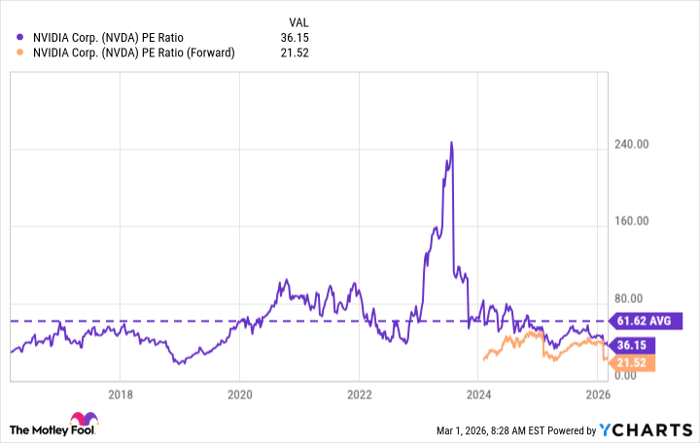
NVDA PE Ratio data by YCharts.
But based on the sheer magnitude of Nvidia's opportunity, I don't think the stock will get much cheaper before investors swoop in and buy. I'm not suggesting this will happen, but if Wall Street's fiscal 2027 earnings estimate proves accurate, the stock would have to soar by 186% over the next year just for its P/E ratio to trade in line with its 10-year average.
Even a fraction of that potential upside would make for a fantastic one-year return, so now might be a great time to scoop up a few Nvidia shares.
Should you buy stock in Nvidia right now?
Before you buy stock in Nvidia, consider this:
The Motley Fool Stock Advisor analyst team just identified what they believe are the 10 best stocks for investors to buy now… and Nvidia wasn’t one of them. The 10 stocks that made the cut could produce monster returns in the coming years.
Consider when Netflix made this list on December 17, 2004... if you invested $1,000 at the time of our recommendation, you’d have $534,817!* Or when Nvidia made this list on April 15, 2005... if you invested $1,000 at the time of our recommendation, you’d have $1,123,912!*
Now, it’s worth noting Stock Advisor’s total average return is 964% — a market-crushing outperformance compared to 192% for the S&P 500. Don't miss the latest top 10 list, available with Stock Advisor, and join an investing community built by individual investors for individual investors.
See the 10 stocks »
*Stock Advisor returns as of March 6, 2026.
Anthony Di Pizio has no position in any of the stocks mentioned. The Motley Fool has positions in and recommends Nvidia. The Motley Fool has a disclosure policy.
Recommended Articles


