


Today’s Market Recap: Global Markets Shaken by Oil Spikes and Geopolitics
Track the Market Trend
TradingKey - Major U.S. indices declined on Thursday as a sharp rise in oil prices and escalating tensions involving Iran reignited inflation fears. The S&P 500 dropped 0.58% to 6,829.91, while the Nasdaq Composite edged down 0.26% to 22,748.99. The Dow Jones Industrial Average saw the steepest decline, tumbling 1.61% to 47,954.75.
The downturn was fueled by a 9% surge in U.S. crude oil prices (USOIL) and a 4% rise in natural gas futures. These spikes followed reports that shipping in the Strait of Hormuz has nearly ceased, with no signs of de-escalation in the Iran conflict. Investors are now reassessing the risks that a prolonged Middle East conflict poses to inflation, interest rates, and overall economic growth.
American Airlines (AAL) fell 5.38% to close at $11.79. The decline was triggered by bearish research citing the carrier's exposure to rising fuel costs and balance sheet risks. Trading volume was heavy at 125 million shares, 114% higher than its recent average. The stock has lost 39% of its value since its 2005 IPO.
Bucking the broader market trend, Broadcom (AVGO) rose 4.75% to close at $332.60. The rally followed strong earnings and guidance that highlighted accelerating revenue growth driven by artificial intelligence. Trading volume spiked to 50.1 million shares — 62% above its three-month average — as investors weighed whether AI infrastructure demand can sustain the company's long-term targets. Since its 2009 IPO, Broadcom has seen a massive 20,431% return.
Industry leaders Nvidia (NVDA), Lam Research (LRCX), and Applied Materials (AMAT) all retreated following reports of potential new global export rules. These regulations might require licenses for shipping AI chips worldwide.
In a notable breakout, The Trade Desk jumped approximately 18% despite its recent 79% drawdown from all-time highs. The surge was driven by news that the ad-buying platform is in early talks to assist OpenAI with launching advertising. Confidence was further bolstered by news that CEO Jeff Green purchased six million shares on the open market — his first such purchase in years — signaling a potential bottom for the stock.
Market Headline
Iran has clarified that it has not officially blocked the Strait of Hormuz, though it maintains that transit rules remain under its strict control. According to Iranian officials, vessels are being managed in accordance with international regulations and established agreements. However, during wartime, Iran will dictate all passage protocols. Military and commercial vessels belonging to or supporting the United States, Israel, and European nations are strictly prohibited from entering these waters and will face military action if detected.
In response to maritime instability, France, Italy, and Greece have formed a coalition to coordinate military deployments and ensure freedom of navigation in the Red Sea. Following a call between President Macron and the prime ministers of Italy and Greece, the three nations agreed to synchronize the delivery of military supplies to Cyprus. As the Strait of Hormuz remains obstructed, several oil-producing nations have been forced to cut production due to full storage tanks, prompting Saudi Arabia to accelerate its shift toward Red Sea export routes.
Within the insurance sector, Lloyd’s of London continues to provide transit quotes for the Strait of Hormuz. The CEO of the Lloyd’s Market Association (LMA) stated that insurers are offering terms to vessels and will continue to do so as long as shipowners deem conditions sufficiently safe for crews. Additionally, Lloyd’s is actively negotiating with the U.S. International Development Finance Corporation (DFC) regarding political risk insurance and guarantee schemes for maritime trade in the Persian Gulf.
In the commodities market, spot gold (XAUUSD) prices plunged $70 following reports that Poland may sell a portion of its gold reserves to finance national defense. The Governor of the Polish Central Bank proposed selling reserves worth approximately $13 billion to bolster defense spending, a move supported by the President as an alternative to EU financing to strengthen Polish-U.S. defense ties. Despite the significant appreciation of gold, the plan faces legal hurdles and political friction with the Prime Minister, leaving its implementation highly uncertain.
South Korea has issued a warning regarding the vulnerability of the semiconductor supply chain due to Middle East tensions. A ruling party lawmaker noted that a prolonged conflict poses a tangible threat to the domestic chip industry. Rising oil prices are expected to drive up domestic electricity costs — thereby weakening the price competitiveness of Korean chips — while disruptions in raw material supplies and surging logistics costs present further systemic risks.
Technological advancements continue as OpenAI released its most powerful professional model, GPT-5.4. This model features native computer-control capabilities, allowing it to operate software, browse the web, and use a mouse and keyboard to complete tasks. It integrates deeply with enterprise applications like Excel and financial analysis tools. GPT-5.4 outperformed human benchmarks in desktop navigation and set new records in web search and professional knowledge tests. The model is available in two versions: "Thinking," optimized for complex reasoning, and "Pro," for high performance. It supports a context window of up to 1 million tokens and includes a dedicated financial services suite.
JD.com reported that its annual total revenue surpassed 1.3 trillion yuan for the first time, representing 13% year-over-year growth. While the core retail business saw its operating margin improve to 4.6% and service revenue grew by 23.6%, the company’s bottom line faced significant pressure. Despite Q4 revenue slightly beating expectations at 3523 billion yuan, the quarter saw a net loss of 2.7 billion yuan due to heavy investment in new business strategies. For the full year, net profit attributable to shareholders was halved to 19.6 billion yuan, largely dragged down by a 46.6 billion yuan operating loss in its new business segments.
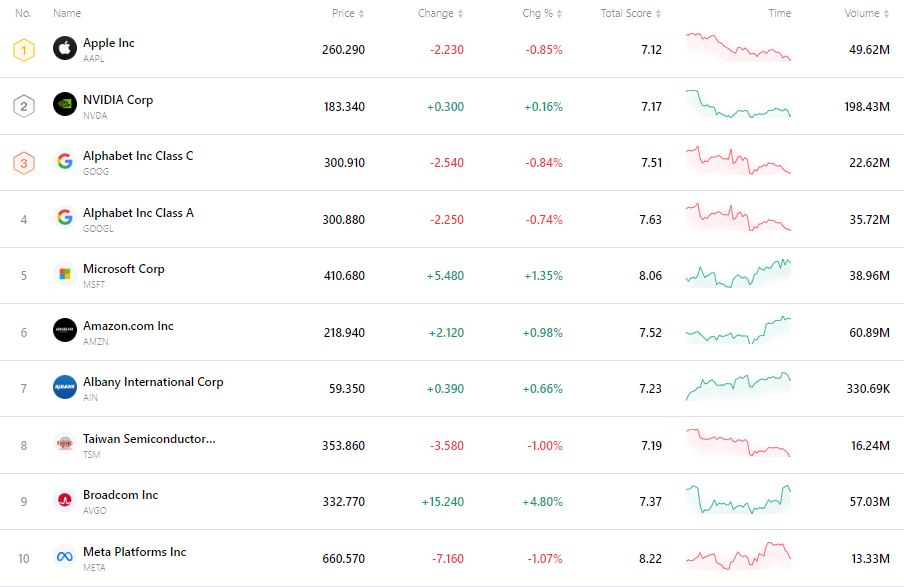
Top 10 Most Traded Stocks
The chart below lists the ten most actively traded stocks in the market. Due to their massive trading volumes and high liquidity, these stocks serve as critical benchmarks for tracking global market dynamics.
Recommended Articles


