


If a Market Crash Hits in 2026, Will Gold, Silver, or Bitcoin Protect Your Wealth Best?
Key Points
Bitcoin hasn't traditionally been a great asset to hold during a market crash.
Silver is vulnerable to fluctuations in demand owing to its industrial uses.
Gold has been volatile recently, and yet it's still priced very high compared to yesteryear.
- 10 stocks we like better than Bitcoin ›
When markets tumble, historically investors reach for safe-haven assets that they think will protect them through whatever happens next. Today, precious metals like gold and silver are joined by digital stores of value, specifically Bitcoin (CRYPTO: BTC), to fulfill that role.
But which of these three assets is really going to weather a crash if one happens later in 2026?
Will AI create the world's first trillionaire? Our team just released a report on the one little-known company, called an "Indispensable Monopoly" providing the critical technology Nvidia and Intel both need. Continue »
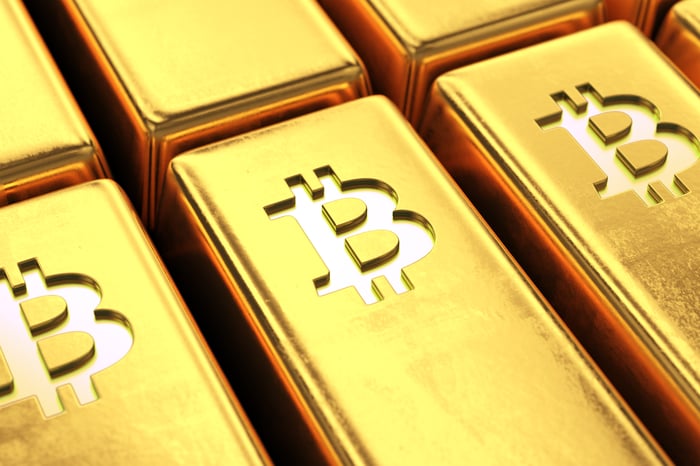
Image source: Getty Images.
In a crash, "protection" usually means "less bad"
Bitcoin is still pitched as digital gold, but its behavior under stress doesn't look much like a portfolio stabilizer.
Bitcoin is generally somewhat correlated with the stock market -- but often, when it performs differently than the wider stock market, it goes down while the market is going up, rather than the reverse. That means if the market crashes, Bitcoin is almost certainly going down with it.
Bitcoin has already shown it can fall alongside everything else when fear spikes. In March 2020, the coin lost more than 30% over five days. Of course, it later rebounded to new all-time highs, but investors didn't know that would happen in the moment.
The explanation for this is that crashes are usually liquidity events. People sell what they can during moments of panic, and the assets they consider most speculative often get hit hardest because they're obviously the riskiest to hold through a crisis.
Traditionally, that dynamic implied some friction. For those who held their Bitcoin in a self-custodied wallet, selling involved pushing a transaction to the blockchain, which required specialized software and a bit of time. Now, the easiest way to get exposure to Bitcoin is not self-custody, but via Bitcoin exchange-traded funds (ETFs) held in a brokerage or retirement account. Those are easier to sell quickly, and they're widely held by financial institutions, which often use algorithmic trading systems that dump holdings when the market flashes certain signals.
There is also a crypto-specific tail risk that will become increasingly relevant over time: quantum computing.
Bitcoin's security relies on cryptography that can one day be cracked by a sufficiently powerful quantum computer. That doesn't mean a quantum break is imminent or inevitable, as such computers won't even exist for years, and the chain's security can be upgraded, but it does mean the "store of value" thesis carries an extra layer of engineering and governance risk that wasn't obvious previously.
Gold is the safer choice, but silver might be a trap
Metals like gold and silver aren't perfect guards against market crashes either.
It's pretty easy to buy silver using vehicles like the iShares Silver Trust (NYSEMKT: SLV). Still, silver's problem is that it tries to play two roles at once, being both a precious metal and an industrial input. That split personality is why it can lag gold when recession anxiety centers on industrial demand. So if the market is in turmoil due to real economic problems expected to linger, silver is quite exposed.
Gold, on the other hand, doesn't necessarily have the same issue. Gold prices rose dramatically during and after the Great Recession. While it does have some uses beyond being a store of value, those uses usually don't drive demand much compared to investors using it as a safe-haven asset. And with thousands of years of use as a medium of exchange, it has a legacy of use that puts Bitcoin's to shame.
For most investors, the simplest way to hold it is via an ETF, like the SPDR Gold Shares (NYSEMKT: GLD). It's also possible to hoard physical gold bars if you're so inclined (and willing to put up with much more transaction friction).
But again, remember that "safer" is not the same as a guarantee that an asset's price can't go down. In one February 2026 episode, gold fell by more than 7% intraday, and silver fell as much as 14% in the same period. Be aware that in recent months these assets have been fairly volatile, contrary to their usual behavior.
So, with all of this in mind, will gold, silver, or Bitcoin protect your wealth best in a 2026-style crash?
Gold is the most reliable of the three, even at its presently elevated price level. Bitcoin might shine in certain scenarios, but it has repeatedly acted like a leveraged bet on liquidity and sentiment -- don't count on it to save you. Silver comes in third, as it can outperform in the right macro setup, but, particularly recently, its price often struggles during periods of economic stress.
Should you buy stock in Bitcoin right now?
Before you buy stock in Bitcoin, consider this:
The Motley Fool Stock Advisor analyst team just identified what they believe are the 10 best stocks for investors to buy now… and Bitcoin wasn’t one of them. The 10 stocks that made the cut could produce monster returns in the coming years.
Consider when Netflix made this list on December 17, 2004... if you invested $1,000 at the time of our recommendation, you’d have $519,015!* Or when Nvidia made this list on April 15, 2005... if you invested $1,000 at the time of our recommendation, you’d have $1,086,211!*
Now, it’s worth noting Stock Advisor’s total average return is 941% — a market-crushing outperformance compared to 194% for the S&P 500. Don't miss the latest top 10 list, available with Stock Advisor, and join an investing community built by individual investors for individual investors.
See the 10 stocks »
*Stock Advisor returns as of March 2, 2026.
Alex Carchidi has positions in Bitcoin. The Motley Fool has positions in and recommends Bitcoin. The Motley Fool has a disclosure policy.
Recommended Articles


