




2 Top EV Stocks to Buy for the Next Bull Market: Rivian and BYD
Key Points
Rivian’s R2 SUV could reboot its business.
BYD's scale gives it a significant advantage against other Chinese EV makers.
Both stocks look undervalued relative to their long-term growth potential.
- 10 stocks we like better than Rivian Automotive ›
The electric vehicle (EV) market's growth has slowed down in recent years, but most analysts still expect EVs to continue replacing gas-powered cars through the end of the decade.
According to Grand View Research, the global EV market could still expand at a 32.5% CAGR from 2025 to 2030. To capitalize on that secular trend, investors should consider buying a few shares of Rivian (NASDAQ: RIVN) and BYD (OTC: BYDDY).
Where to invest $1,000 right now? Our analyst team just revealed what they believe are the 10 best stocks to buy right now. Continue »
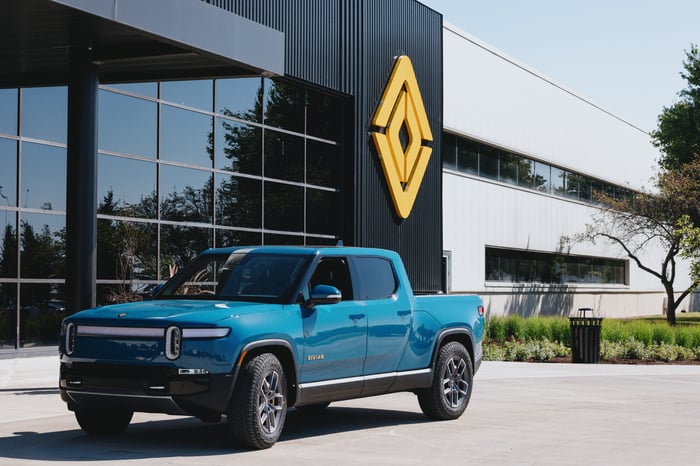
Image source: Rivian.
Rivian
Rivian produces high-end electric pickups, SUVs, and custom electric delivery vans. When it went public in 2021, it initially claimed it could produce 50,000 vehicles in 2022. However, it produced only 24,337 vehicles that year due to supply chain constraints.
Rivian more than doubled its production to 57,232 vehicles in 2023, but it produced only 49,476 vehicles in 2024 amid inflation, higher interest rates, lower EV subsidies, and intense competition. For 2025, it expects to deliver only 40,000 to 46,000 vehicles as it struggles to overcome macro and micro challenges. It also remains unprofitable.
However, analysts expect Rivian's revenue to grow at a 31% CAGR from 2024 to 2027 as it narrows its losses. Its biggest near-term catalysts will be the launch of its more affordable R2 SUV, the opening of its Georgia plant, and its partnership with Volkswagen (OTC: VWAP.Y). That's a bright outlook for a stock that trades at less than three times this year's sales.
BYD
BYD was originally a battery maker, but over the past two decades, it has evolved into China's largest automaker. In 2022, it stopped producing gasoline-only vehicles to expand its lineup of plug-in hybrid EVs (PHEVs) and battery-powered EVs (BEVs). It differentiated itself from its competitors by developing its own lithium iron phosphate (LFP) batteries, which were safer, cheaper, and more power-efficient than traditional lithium-ion batteries.
From 2020 to 2024, BYD's annual vehicle sales surged from 427,302 units to 4.27 million units, its revenue rose more than fivefold, and its net income grew nearly tenfold. The vertical integration of its supply chain, the unification of its fragmented production lines (under its e-Platform 3.0 architecture), and its international expansion fueled that explosive growth.
From 2024 to 2027, analysts expect BYD's revenue and net income to grow at CAGRs of 13% and 16%, respectively. Its growth is slowing down as its business matures, but its stock still looks like a bargain at 16 times this year's earnings.
Should you buy stock in Rivian Automotive right now?
Before you buy stock in Rivian Automotive, consider this:
The Motley Fool Stock Advisor analyst team just identified what they believe are the 10 best stocks for investors to buy now… and Rivian Automotive wasn’t one of them. The 10 stocks that made the cut could produce monster returns in the coming years.
Consider when Netflix made this list on December 17, 2004... if you invested $1,000 at the time of our recommendation, you’d have $450,256!* Or when Nvidia made this list on April 15, 2005... if you invested $1,000 at the time of our recommendation, you’d have $1,171,666!*
Now, it’s worth noting Stock Advisor’s total average return is 942% — a market-crushing outperformance compared to 196% for the S&P 500. Don't miss the latest top 10 list, available with Stock Advisor, and join an investing community built by individual investors for individual investors.
See the 10 stocks »
*Stock Advisor returns as of February 2, 2026.
Leo Sun has no position in any of the stocks mentioned. The Motley Fool recommends BYD Company and Volkswagen Ag. The Motley Fool has a disclosure policy.
Recommended Articles


