




UPS' Latest Update Is Shocking: Here's What It Means for Investors
Key Points
UPS' 2026 free-cash-flow guidance exceeds expectations and supports its dividend.
Cost savings and reduced capital expenditures are driving near-term cash-flow improvements.
Reliance on property sales and cost cuts raises questions about long-term growth and dividend sustainability.
- 10 stocks we like better than United Parcel Service ›
UPS (NYSE: UPS) surprised the market with its full-year 2026 guidance for $6.5 billion in free cash flow (FCF). It's a figure that appears to secure the company's $5.4 billion dividend payment and will reassure passive-income-seeking investors who bought the stock for its dividend yield (currently 6.3%). The guidance came in significantly above the Wall Street analyst consensus going into the earnings. Does it secure the dividend and make the stock worth buying?
UPS shocks the market
The big surprise in the company's guidance came not only from the FCF guidance but also from three main sources.
Where to invest $1,000 right now? Our analyst team just revealed what they believe are the 10 best stocks to buy right now, when you join Stock Advisor. See the stocks »
First is the $3 billion in cost savings management expects to generate in 2026, on top of the $3.5 billion in savings generated in 2025. To be clear, not all of these cost savings are fixed, as UPS is naturally reducing variable and semi-variable costs as it continues to reduce Amazon delivery volume.
As a reminder, management's plan is to reduce low- or negative-margin Amazon volumes by 50% from the start of 2025 to the middle of 2026. This so-called "glidedown" means UPS reduced 48,000 positions in 2025 and plans to lay off another 30,000 in 2026. In addition, 93 buildings were closed in 2026, and the plan is to close another 24 in the first half of 2026.
Roughly a third of the 2025 cost cuts were structural, and together with the 2026 cost cuts will start feeding through in the second half and then into 2027. That will boost cash flow.
One-off property sales are boosting cash flow
Second, UPS claimed it generated $5.47 billion in adjusted FCF in 2025. However, this figure includes $700 million from "proceeds from disposals of property, plant, and equipment."
This figure is arguably not indicative of the company's underlying FCF if it stems from properties that were closed down and sold off, such as the $368 million sale of properties to Fortress Investment Group in September.

Image source: Getty Images.
Management didn't disclose how much it had estimated for property sales in 2026 or how those sales might contribute to the $6.5 billion. Still, one thing is clear: Stripping out the $700 million in disposal proceeds in 2025 would leave $4.7 billion in FCF, which wouldn't have been enough to cover the $5.4 billion in dividends.
Reducing capital spending improves cash flow
Third, UPS made $3.7 billion in capital expenditures in 2025, but plans to significantly reduce them to $3 billion in 2026. The reduction will also boost potential cash flow. Naturally, the question came up on the earnings call, and CFO Brian Dykes outlined that as UPS is making its network more efficient, its maintenance expenses on things like vehicles were coming down and "we'll be kind of around this three to three and a half percent of revenue as a normalized capex."
Given that management estimates 2026 revenue at $89.7 billion, the $3 billion in planned capital expenditures represents 3.3% and is in line with Dykes' projection. However, it marks a significant deviation from the kind of capex-to-revenue metrics achieved in the past.
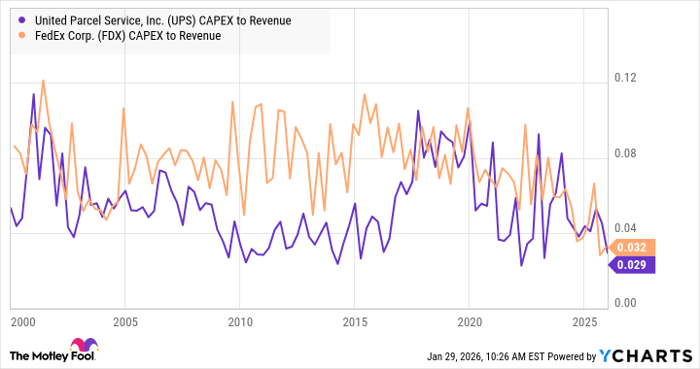
UPS CAPEX to Revenue data by YCharts
UPS also avoided upfront capital expenditures by agreeing to a leasing structure rather than buying the 18 new Boeing 767 aircraft it needs for its network outright.
What it means to investors
Management has steadfastly maintained its commitment to the dividend, as recent actions confirm. Investors simply interested in holding the stock for its dividend will be happy.

Image source: Getty Images.
However, growth-oriented investors might not be so happy. The company can't rely on property disposals forever to boost cash flow. Moreover, once downsizing is complete and the cost-cutting is over, UPS will have to try to grow revenue, and it's far from clear that it will spend such a low share of its revenue on capital when it does. In addition, management's positive outlook on the industrial sector is somewhat at odds with what companies like 3M are saying.
All told, the $6.5 billion in FCF in 2026 is not a good starting point for long-term cash flow assumptions, and even that figure doesn't provide significant cover for the $5.4 billion dividend payment. As such, UPS is a good stock for income-seeking investors, but not for growth-oriented ones.
Should you buy stock in United Parcel Service right now?
Before you buy stock in United Parcel Service, consider this:
The Motley Fool Stock Advisor analyst team just identified what they believe are the 10 best stocks for investors to buy now… and United Parcel Service wasn’t one of them. The 10 stocks that made the cut could produce monster returns in the coming years.
Consider when Netflix made this list on December 17, 2004... if you invested $1,000 at the time of our recommendation, you’d have $450,256!* Or when Nvidia made this list on April 15, 2005... if you invested $1,000 at the time of our recommendation, you’d have $1,171,666!*
Now, it’s worth noting Stock Advisor’s total average return is 942% — a market-crushing outperformance compared to 196% for the S&P 500. Don't miss the latest top 10 list, available with Stock Advisor, and join an investing community built by individual investors for individual investors.
See the 10 stocks »
*Stock Advisor returns as of February 2, 2026.
Lee Samaha has no position in any of the stocks mentioned. The Motley Fool has positions in and recommends 3M, Amazon, Boeing, and United Parcel Service. The Motley Fool recommends FedEx. The Motley Fool has a disclosure policy.
Recommended Articles


