




The S&P 500 Was Up in January. Here's What History Says Happens for the Rest of the Year.
Key Points
When January is positive, the S&P 500 averages a full year return of around 15%.
When January is negative, that full year return drops to just 2.4%.
- 10 stocks we like better than S&P 500 Index ›
In January, the S&P 500 (SNPINDEX: ^GSPC) was up 1.4%. That may not seem like much, but it provides a very powerful indicator of what could happen in the rest of 2026.
You may have heard about the theory that equity market returns in the first month of the year can signal how the rest of the year performs. There are a lot of similar signals out there, such as the Santa Claus Rally, that try to predict better times to own stocks. Sometimes they work. Sometimes they don't.
Where to invest $1,000 right now? Our analyst team just revealed what they believe are the 10 best stocks to buy right now, when you join Stock Advisor. See the stocks »
The "January Barometer" is particularly interesting because it seems to have some statistical backing and history to support it. Not a 100% success rate, mind you, but enough of a track record that it makes you look twice.
Image source: Getty Images.
Let's take a look at what history tells us over the past 40 years.
Of those 40 years, January returns for the S&P 500 were positive 25 times and negative 15 times. In those 25 instances where January was higher, the next 11 months were higher 80% of the time.
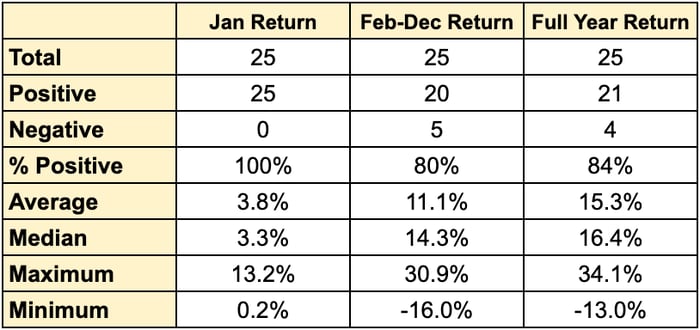
Image source: Yahoo Finance.
We're not just talking modest gains for the February-December period, either. On average, the "rest of the year" was about 11% with the median return even higher at over 14%. That brought the average full year return when January was positive to roughly 15%.
The last time that January was positive but the next 11 months were negative was 2018. That year featured a quick bear market in the 4th quarter of the year that dragged total year returns negative. Prior to that, you'd have to go back to 2011. In other words, it's a rare occurrence, at least historically speaking.
What happens when January is negative? It's a completely different story for the S&P 500.
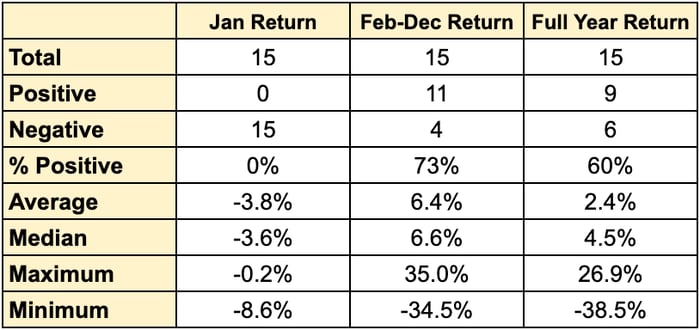
Image source: Yahoo Finance.
The next 11 months are positive just 73% of the time, with the average gain over that period coming out to just over 6%. Those four instances where January was negative and the rest of the year was negative too were in 2022, 2008, 2002, and 2000. When the year starts bad, there's a decent chance it could get a whole lot worse.
In summary, over the past 40 years, when January is positive for the S&P 500, the average full year return is about 15% and is positive 84% of the time. When January is negative, the average full year return is about 2%-3% and is positive just 60% of the time.
If history is any guide, there's a good chance that 2026 will be another positive one for investors.
Should you buy stock in S&P 500 Index right now?
Before you buy stock in S&P 500 Index, consider this:
The Motley Fool Stock Advisor analyst team just identified what they believe are the 10 best stocks for investors to buy now… and S&P 500 Index wasn’t one of them. The 10 stocks that made the cut could produce monster returns in the coming years.
Consider when Netflix made this list on December 17, 2004... if you invested $1,000 at the time of our recommendation, you’d have $450,256!* Or when Nvidia made this list on April 15, 2005... if you invested $1,000 at the time of our recommendation, you’d have $1,171,666!*
Now, it’s worth noting Stock Advisor’s total average return is 942% — a market-crushing outperformance compared to 196% for the S&P 500. Don't miss the latest top 10 list, available with Stock Advisor, and join an investing community built by individual investors for individual investors.
See the 10 stocks »
*Stock Advisor returns as of February 2, 2026.
David Dierking has no position in any of the stocks mentioned. The Motley Fool has no position in any of the stocks mentioned. The Motley Fool has a disclosure policy.
Recommended Articles


