




1 Blue Chip Stock I Keep Doubling Down On No Matter What
Key Points
Visa doesn't take on the credit risks with its credit and debit cards.
Visa's operating margin is one of the highest in the corporate world.
The growth of digital payments will be a natural benefit to Visa's business.
- 10 stocks we like better than Visa ›
I have been investing in Visa (NYSE: V) for years now, slowly but surely adding shares over time. It's one of my largest holdings and a stock I plan to hold on to for decades.
It was a disappointing 2025 for Visa's stock, finishing up only 11% compared to the S&P 500's 16.4%, but that doesn't change how I feel about the stock's long-term potential. Visa is in a unique position in its industry and has all the tools to be a cornerstone piece in my portfolio for the foreseeable future.
Where to invest $1,000 right now? Our analyst team just revealed what they believe are the 10 best stocks to buy right now. Continue »
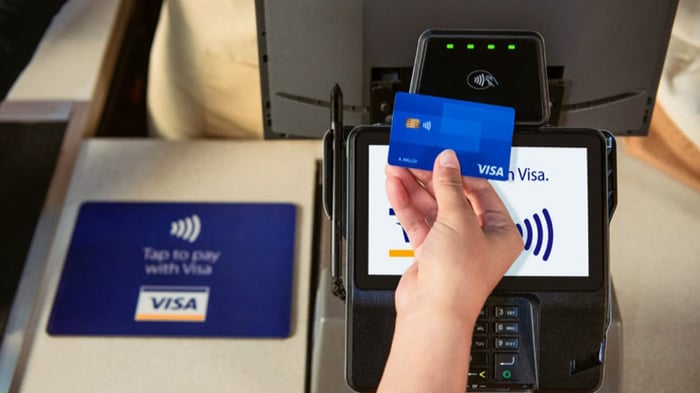
Image source: Visa.
Visa runs a very high-margin business
Although you'll see Visa's logo on your card, it doesn't actually issue the cards. It operates the payment network that enables transactions, but other banks and financial institutions issue the cards.
This allows Visa to make money by taking a percentage of every transaction on its network, but it doesn't take on the credit risk that comes with lending money and hoping people pay it back.
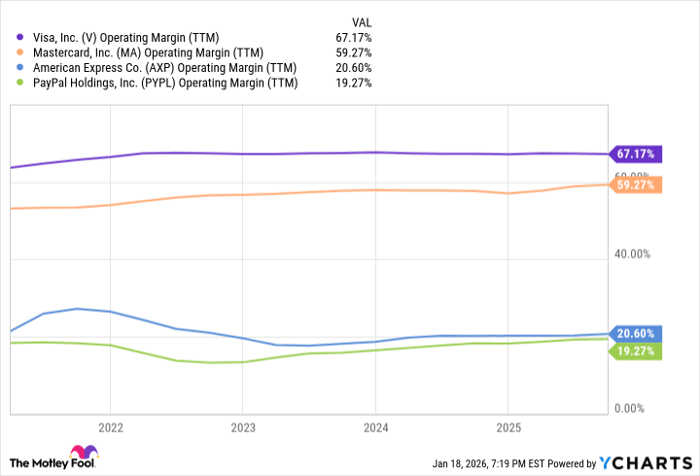
Even better is that once the payment infrastructure is put in place, it can benefit from its network without incurring much more cost. Typically, the only notable costs would be cybersecurity and marketing. That's why Visa routinely operates with some of the highest margins that you'll find in any industry.
Data by YCharts.
The gift that keeps giving
Visa's business also grows organically through the network effect.
If you're looking for a card, there's an incentive to get a Visa card, since it's very likely accepted wherever cards are accepted worldwide. If you're a merchant, there's an incentive to accept Visa, since it's the most widely held card in the world. Not accepting Visa could mean missing out on potential sales.
This dynamic works in Visa's favor because every additional cardholder makes the network more valuable, and each new merchant makes having the card more valuable.
Digital payments continue to grow
Visa naturally benefits from the increased use of digital payments globally. More transactions mean more opportunities to generate revenue, especially cross-border ones. Cross-border transactions typically have higher fees due to currency conversions and processing costs, so Visa makes more per transaction than with domestic transactions.
In 2025, Visa's total payment volume increased by 8%, but its cross-border volume grew by 13%. During the year, it brought in $40 billion in revenue, up 11%.
Visa has been a cash cow for quite some time, but as more revenue opportunities develop (such as from Visa Direct or B2B payments), it should have good growth ahead, even for its size.
Should you buy stock in Visa right now?
Before you buy stock in Visa, consider this:
The Motley Fool Stock Advisor analyst team just identified what they believe are the 10 best stocks for investors to buy now… and Visa wasn’t one of them. The 10 stocks that made the cut could produce monster returns in the coming years.
Consider when Netflix made this list on December 17, 2004... if you invested $1,000 at the time of our recommendation, you’d have $460,340!* Or when Nvidia made this list on April 15, 2005... if you invested $1,000 at the time of our recommendation, you’d have $1,123,789!*
Now, it’s worth noting Stock Advisor’s total average return is 937% — a market-crushing outperformance compared to 194% for the S&P 500. Don't miss the latest top 10 list, available with Stock Advisor, and join an investing community built by individual investors for individual investors.
See the 10 stocks »
*Stock Advisor returns as of January 22, 2026.
American Express is an advertising partner of Motley Fool Money. Stefon Walters has positions in Visa. The Motley Fool has positions in and recommends Mastercard, PayPal, and Visa. The Motley Fool recommends the following options: long January 2027 $42.50 calls on PayPal and short March 2026 $65 calls on PayPal. The Motley Fool has a disclosure policy.
Recommended Articles


